
CSS 2018 Economics Past Paper
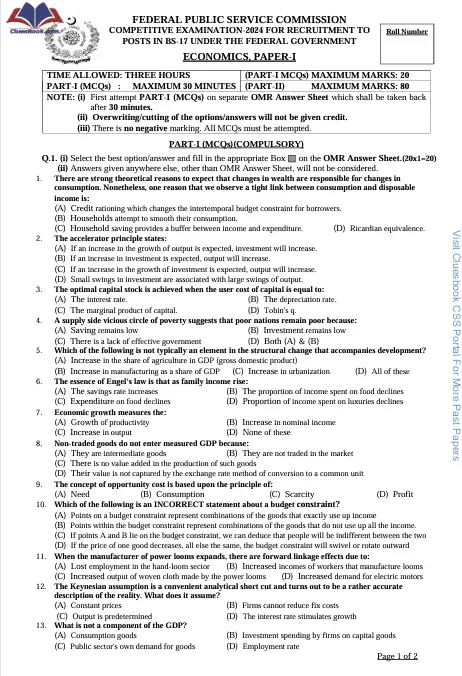
Download CSS 2018 Economics Past Paper. When the candidates walked into the examination halls in 2018 to face the CSS Economics paper, they expected a test of memory. What they got was a test of intellect, relevance, and perspective.
Let’s take a closer look at what this paper offered, not just for those who attempted it, but for all aspirants preparing to sit the CSS exams today.
Part I: The Quick Mental Jog (MCQs Section)
Before the real analysis began, the exam started with a 30-minute rapid-fire session, consisting of 20 multiple-choice questions that tested the fundamentals.
These questions often cover concepts like
- Price elasticity
- Macro and micro theories
- Economic terms and theorists
For scoring high
Brush up on basic definitions, economists’ contributions, and formulas from standard textbooks like Mankiw or Dornbusch.
Part II: A Mix of Depth and Relevance (Descriptive Section)
This is where the real paper began, 80 marks spread across a wide canvas. Candidates had to select 4 out of 7 questions, which included both theoretical discussions and Pakistan-specific analyses.
Let’s unfold what made this paper stand out.
Theoretical Core: Models, Curves, and Equilibrium
Some questions were designed to test pure theoretical understanding, but in a way that required application, not just definitions.
IS LM Model:
- Candidates had to recall and explain the IS and LM equations, then establish equilibrium.
- But the twist? They had to comment on whether this is a short run or long run model, and why it matters.
Keynesian vs. Neoclassical Demand
- How notional and real aggregate demand drive economic fluctuations.
- Bonus marks for those who could balance theory with examples.
Aggregate Supply Shapes
- From constant to vertical supply curves, the paper tested the candidates’ ability to link theory with fiscal policy outcomes.
Practical Economics: Policies and Pakistan
The paper didn’t shy away from questioning candidates about the real state of Pakistan’s economy.
Topics Included
- Income inequality and poverty: why they’re worsening and how to fix them.
- Trade imbalance, chronic deficits, and how to turn the tide.
- Agriculture’s shrinking role in the economy, compared with developed countries.
- Fiscal policies and how effective they are.
- Privatization and denationalization: why they were necessary and what history teaches us.
Candidates who read newspapers, followed economic reports, and linked data with theory had a significant edge.
Pick Your Topics (Short Notes Section)
The last question in both Paper I and Paper II gave students freedom of choice:
Topics included
- Monetary policy tools
- Perfect vs. pure competition
- Balanced vs. unbalanced growth
- Energy crisis solutions
- Import substitution
- Climate change
These 1-mark short notes required sharp, well-rounded, and concise answers.
What Made This Paper Unique?
Unlike many earlier papers, CSS Economics 2018 demanded synthesis:
- It was not enough to just know definitions.
- Candidates had to connect dots between theory, current affairs, and Pakistan’s economy.
- The paper rewarded critical thinking, policy analysis, and up to date examples.
About the CSS
The CSS (Central Superior Services) Competitive Examination is a rigorous federal level test administered by the Federal Public Service Commission (FPSC) to select candidates for prestigious civil service roles across Pakistan. The exam’s rules and regulations, covering age limits, eligibility, subjects, and quotas, are detailed in the official CSS Rules section on the FPSC’s website.
The CSS Exam Rules, issued by FPSC Pakistan, outline eligibility criteria, age limits (21–30 years), and a maximum of three attempts for candidates. The exam includes written tests, a medical exam, a psychological assessment, and an interview. Rules also define quotas, disqualification grounds, and subject selection for a fair recruitment process.
Takeaways for Future Aspirants
If you’re preparing for CSS Economics, here’s what this paper teaches you:
- Understand models like IS LM, aggregate demand/supply, and elasticity, not just by formulas, but by how they apply.
- Read Pakistani economic reports (e.g., SBP, World Bank) to cite recent data in answers.
- Keep answers structured: intro → theory → example → conclusion.
- Stay updated with energy policy, trade policy, taxation, and privatization in Pakistan.
Download Section
You can download the CSS 2018 Economics Past Paper from the download link given below for free! Don’t miss the opportunity!
The CSS 2018 Economics Past Paper wasn’t just another exam. It was a blueprint for understanding what the FPSC expects: clarity of thought, mastery of theory, and relevance to Pakistan’s economic landscape.