
CSS Paper Papers 2017
Download CSS Paper Computer Science 2017. The 2017 CSS Computer Science paper stood out for its conceptual intensity and cross topic depth. Rather than focusing on rote recall, this exam challenged candidates to think critically, apply logic, and structure answers effectively.
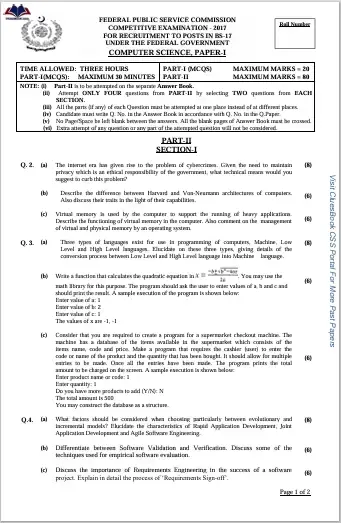
Whether you’re new to CSS or refining your optional subject strategy, a close look at the 2017 paper will equip you with clarity on how FPSC evaluates analytical depth.
Paper Design & Format
Here’s what the CSS Paper Computer Science 2017 structure looked like:
- Total Marks: 100
- Objective (MCQs): 20 marks
- Subjective (Descriptive): 80 marks (Attempt 4 out of 6)
- Time Allowed: 3 Hours
- Answer Requirement: Logical reasoning, clarity, and illustrative support preferred
Coverage Map: Domains Touched in 2017
Rather than sticking to textbook-style questions, the CSS Paper Computer Science 2017 tested real understanding across the following areas:
Core Programming Concepts
- Principles of OOP (encapsulation, polymorphism, etc.)
- Recursive function flow
- Procedural vs object-oriented differences
Operating System Foundations
- CPU scheduling strategies
- Virtual memory and paging
- Process states and lifecycle
Hardware & Architecture Insights
- Von Neumann architecture
- Bus structure and instruction cycle
- Memory hierarchy and cache design
Database Design & SQL Logic
- Data redundancy and normalization
- ER model components
- Transaction processing
Networking Layers & Protocols
- OSI model structure
- TCP/IP comparison
- DNS and routing basics
Software Engineering Process
- Types of software testing
- SDLC stages and models
- Functional vs non functional requirements
About the CSS
The CSS (Central Superior Services) Competitive Examination is a rigorous federal level test administered by the Federal Public Service Commission (FPSC) to select candidates for prestigious civil service roles across Pakistan. The exam’s rules and regulations, covering age limits, eligibility, subjects, and quotas, are detailed in the official CSS Rules section on the FPSC’s website.
The CSS Exam Rules, issued by FPSC Pakistan, outline eligibility criteria, age limits (21–30 years), and a maximum of three attempts for candidates. The exam includes written tests, a medical exam, a psychological assessment, and an interview. Rules also define quotas, disqualification grounds, and subject selection for a fair recruitment process.
What Made This Paper Different?
- Multi layered questions: Some asked for explanation, comparison, and use case, all in one.
- Broad topic sampling: The paper didn’t go deep into one area but touched on many subjects lightly yet intelligently.
- Speed and structure mattered: Candidates had to write precisely and quickly. Wordy or unstructured answers didn’t perform well.
Suggested Resources for 2017 Like Papers
To prepare effectively, use core textbooks and concept focused tutorials:
Books
- “Computer Architecture” – William Stallings
- “Operating System Concepts” – Silberschatz, Galvin, Gagne
- “Software Engineering” – Pressman or Sommerville
- “Database System Concepts” – Korth & Silberschatz
- “Object-Oriented Programming in C++” – Robert Lafore
- “Computer Networks” – Tanenbaum
Online Help
- GeeksforGeeks (conceptual explanations and MCQs)
- W3Schools (for SQL, DBMS, networking basics)
- YouTube (Neso Academy for OS and architecture)
Exam Execution Tips Based on 2017 Pattern
- Organize your answers into an introduction, body (with examples), and a short conclusion.
- Draw diagrams wherever possible, ER diagrams, architecture layers, and memory models.
- Focus on concepts, not just definitions. Define, explain, and relate to real world systems.
- Revise MCQs weekly. These 20 marks can make a major difference.
- Time box your writing practice. Try answering 20 mark questions in 25 minutes.
PDF Access Section
You can download the CSS Paper Computer Science 2017 (PDF) from the link provided below and above of this article. It’s an excellent self-test before attempting other past papers. The CSS Paper Computer Science 2017 highlighted a key lesson: understanding is power. The paper didn’t favor those who memorized definitions; it rewarded those who understood systems, could explain them clearly, and knew where they fit in real applications.
And most importantly, practice writing with clarity and structure.