
CSS Economics Past Papers
Economics CSS Past Paper 2011 focused on theory with application. For example, it asked to compare Perfect vs Pure Competition and build market equilibrium, something every economics student should master.
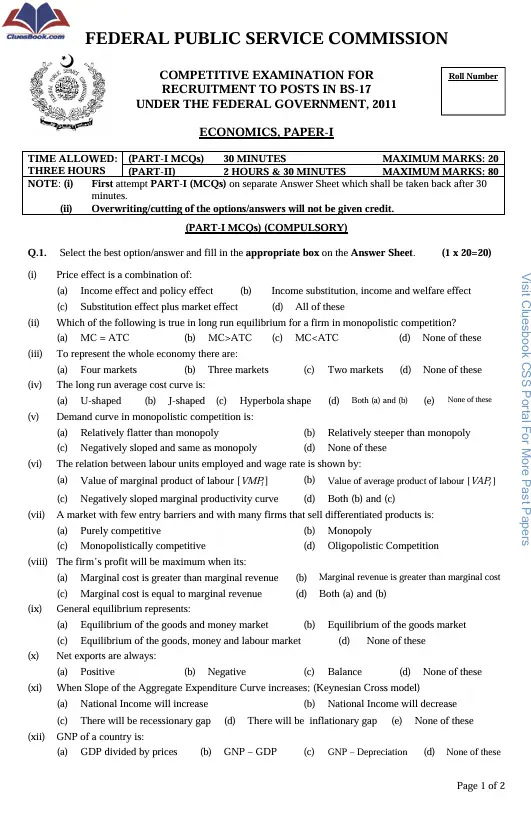
This blog gives a clear, concise guide in a friendly tone for smart preparation! The Economics CSS Past Paper 2011 offers a sharp look into how the exam tests both understanding and application of economic theory. This particular Economics CSS Past Paper challenges candidates to move beyond definitions and apply concepts like market dynamics, competition, and equilibrium to real exam scenarios.
What Makes Economics 2011 a Unique CSS Paper?
The Economics CSS Past Paper 2011 stands out because it mixes textbook theory with applied economic realities, particularly in the context of Pakistan’s development. Both Paper-I and Paper-II blend core economic concepts, policy evaluation, and local case studies. This blog offers a complete analysis, question themes, and strategic tips for aspirants targeting future CSS attempts.
Paper Format Briefly
Economics Paper I
- Total Marks: 100 (20 MCQs + 80 Descriptive)
- Time: 3 hours
- MCQs: Focused on Micro, Macro, Money, and General Equilibrium
- Descriptive Section: 4 long questions to attempt out of 7
Economics Paper II
- Focus: Development Economics, Pakistan Economy, Global Trade
- MCQs: Mostly fact-based and Pakistan-centric
- Descriptive Section: 4 questions out of 7; case-based with evidence requirement
Key Areas Covered in Paper I
Microeconomic Foundations
- Consumer Equilibrium using Cardinal vs Ordinal Utility
- Elasticity of Demand & Revenue Relationships
- Comparison of Perfect and Pure Competition
Macroeconomic Equilibrium
- Short-Run vs Long-Run Aggregate Supply
- Components of Aggregate Demand Function
- National Income Fluctuations
Monetary Theory
- Money Demand: Reasons & Market Equilibrium
- Impacts of Price Increase on Money Market
Inflation and Institutions
- Definitions of Inflation & Hyperinflation Control Measures
- Goals of Global Financial Institutions like IMF & World Bank
Paper II Highlights: Focus on Pakistan & Development
Development Economics
- How Definition of Economic Development Has Evolved
- Impact of Trade Liberalization on Pakistan’s Export Competitiveness
- Structural Adjustment Programs and Debt Trap Issues
Agriculture & Industry
- Agricultural Growth Variables (e.g., irrigation, tenancy)
- Industrial Growth and Obstacles (like informal labor & tariff issues)
Public Finance & Policy
- Fiscal Policy Components and Evaluation
- Foreign Debt and Long-Term Economic Burden
Poverty Measurement
- Three Approaches to Measure Poverty
- A.K. Sen’s Multidimensional Poverty Contribution
Noteworthy Questions from the 2011 Paper
- “Establish consumer equilibrium using both cardinal and ordinal approaches. Which one is more practical?”
- “Discuss how an increase in net exports can impact the national income and employment.”
- “Evaluate the major sources of agricultural growth in Pakistan with data.”
- “Did trade liberalization actually help Pakistan’s export sector?”
These aren’t just theory, they expect applied logic, real-life examples, and evidence.
Expert Preparation Tips
Understand vs Memorize
CSS papers demand conceptual clarity, especially for micro/macro graphs and policy implications.
Practice Writing Analytical Answers
Use real economic data, diagrams, and references from Pakistan’s economy to gain an edge.
Solve Past Papers in Time-Bound Manner
Helps simulate real exam pressure and improves retention.
Stay Updated on Pakistan’s Economic Reports
Useful especially for Paper II topics like debt, fiscal trends, and poverty.
About the CSS
The CSS (Central Superior Services) Competitive Examination is a rigorous federal-level test administered by the Federal Public Service Commission (FPSC) to select candidates for prestigious civil service roles across Pakistan. The exam’s rules and regulations, covering age limits, eligibility, subjects, and quotas, are detailed in the official CSS Rules section on the FPSC’s website.
The CSS Exam Rules, issued by FPSC Pakistan, outline eligibility criteria, age limits (21–30 years), and a maximum of three attempts for candidates. The exam includes written tests, a medical exam, a psychological assessment, and an interview. Rules also define quotas, disqualification grounds, and subject selection for a fair recruitment process.
Why 2011 Paper Still Matters for Aspirants Today
- Combines old-school theory with modern applications
- Encourages evidence-based reasoning
- Questions are recurring or have similar themes in later CSS years
- Ideal for practice and mock attempts
The Economics CSS Past Paper 2011 blends theory with real-world relevance, making it a great resource for smart revision.
It sharpens your concepts, writing, and exam strategy, a must-practice for serious aspirants.