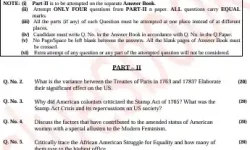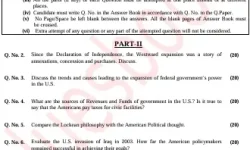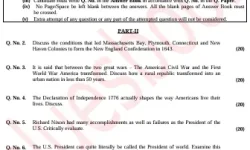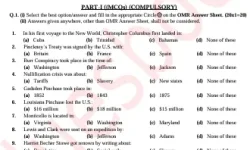

Pakistan Affairs CSS Past Papers 2013
Download Pakistan Affairs CSS Past Papers 2013. The Pakistan Affairs 2013 paper focused on political instability and constitutional development. Download the original PDF to study questions that directly test your understanding of governance and ideology in a real world context.
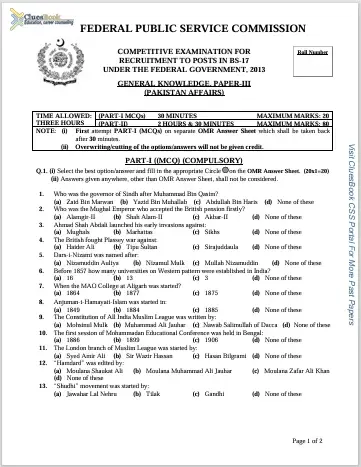
The 2013 paper reflected Pakistan’s ongoing transition from security centered discourse to a constitutional democracy. It questioned both the historical foundations and the emerging challenges faced by the state. Candidates who balanced historical analysis with policy insight performed better.
Exam Format Snapshot
The Pakistan Affairs CSS Past Papers 2013 followed the typical structure but leaned more on theoretical depth:
- Total Marks: 100
- MCQs: 20 marks (Compulsory)
- Subjective Section: 7 long questions, attempt 4 (20 marks each)
- Duration: 3 hours
It tested factual knowledge but emphasized interpretative and argument based responses.
About the CSS
The CSS (Central Superior Services) Competitive Examination is a rigorous federal level test administered by the Federal Public Service Commission (FPSC) to select candidates for prestigious civil service roles across Pakistan. The exam’s rules and regulations, covering age limits, eligibility, subjects, and quotas, are detailed in the official CSS Rules section on the FPSC’s website.
The CSS Exam Rules, issued by FPSC Pakistan, outline eligibility criteria, age limits (21–30 years), and a maximum of three attempts for candidates. The exam includes written tests, a medical exam, a psychological assessment, and an interview. Rules also define quotas, disqualification grounds, and subject selection for a fair recruitment process.
Core Themes and Topics
This paper explored a mix of ideological, historical, and political elements. It wasn’t just about what happened; it asked why it mattered.
- Two nation theory and the ideological foundation of Pakistan
- Failures in constitutional development (1956–1973)
- Role of civil military relations in governance crises
- Education’s role in shaping national identity
Overall, the examiner required a grasp of deeper political patterns, not surface level memorization.
What Was Being Tested?
Behind every question, the examiner was pushing for structured thinking and issue linkage:
- Did the candidate understand why Pakistan’s constitutional journey was so staggered?
- Could they analyze how ideology influenced both unity and division?
- Were they able to connect governance failures to long-term instability?
- Could they evaluate civil military relations objectively?
This wasn’t just a history paper; it was a challenge to demonstrate how history shapes today’s Pakistan.
Study Resources That Help
To handle papers like this, general readings won’t be enough. You need materials that offer context, balance, and critical views:
-
Key Books
- Pakistan: A Modern History by Ian Talbot
- The Idea of Pakistan by Stephen P. Cohen
-
Journals & Publications
-
- IPRI Review
- PILDAT reports on democracy and the constitution
-
Helpful Online Reads
- DAWN opinion archives
- Pakistan Today’s political analysis sections
- Think tanks like PIDE and CRSS
Limit yourself to resources that explain, not just inform.
Download Section
You can download the original Pakistan Affairs CSS Past Papers 2013 (PDF) from the download link mentioned below in the post. It is unsolved and ideal for practice with a focus on analytical writing. The 2013 paper reflected a clear examiner preference for critical understanding over repetition of textbook narratives. The ability to link ideology, policy, and history into one coherent argument set top scorers apart.
Those who trained themselves to think like analysts, not just students, had the edge.