
CSS Applied Mathematics Past Papers
Download the Applied Mathematics CSS Papers 2010 for free. Understand question trends, topic-wise weightage, difficulty level, and time management tips, essential insights to prepare smarter, not harder, for your CSS exam.
What Makes 2010 Worth Reviewing?
Even in 2025, this paper is still highly relevant. Here’s why:
- Repeating Patterns: Many problem types reappear in later exams.
- Balanced Structure: Covers almost all major applied math concepts.
- Real Exam Feel: Great to simulate actual exam pressure and flow.
Section-Wise Weightage & Focus Areas
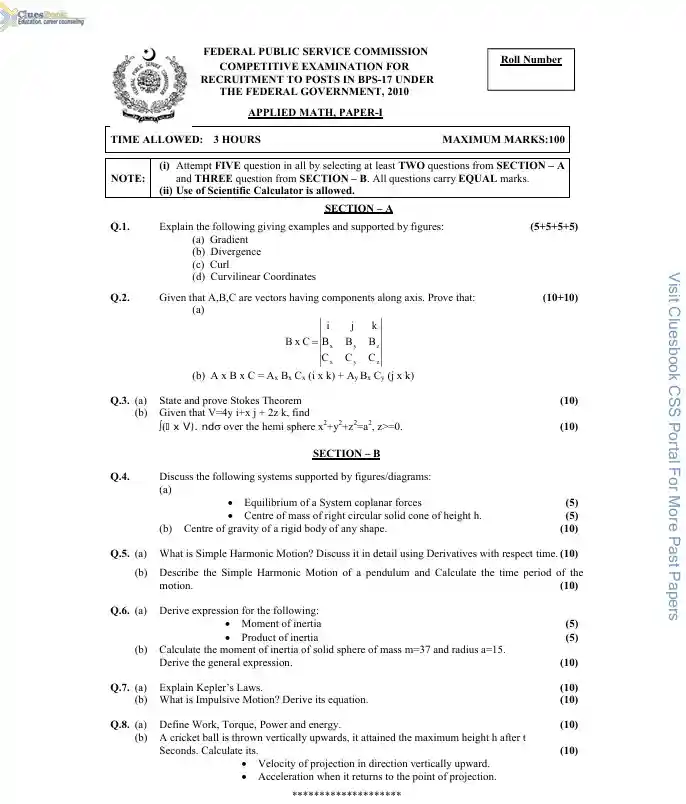
- Calculus & Integration (~25%): This section includes questions mainly focused on definite integrals and substitution techniques.
- Linear Algebra (~20%): Questions revolve around matrices, solving systems of linear equations, and finding eigenvalues.
- Differential Equations (~15%): Covers both first-order and linear differential equations, testing theoretical understanding and application.
- Mechanics & Dynamics (~20%): Includes questions related to laws of motion, force diagrams, and energy-based problems.
- Vector Calculus (~20%): Focuses on gradients, divergence, vector identities, and scalar field applications.
The paper consists of subjective-type questions only, carrying a total of 100 marks.
About the CSS
The CSS (Central Superior Services) Competitive Examination is a rigorous federal-level test administered by the Federal Public Service Commission (FPSC) to select candidates for prestigious civil service roles across Pakistan. The exam’s rules and regulations, covering age limits, eligibility, subjects, and quotas, are detailed in the official CSS Rules section on the FPSC’s website.
The CSS Exam Rules, issued by FPSC Pakistan, outline eligibility criteria, age limits (21–30 years), and a maximum of three attempts for candidates. The exam includes written tests, a medical exam, a psychological assessment, and an interview. Rules also define quotas, disqualification grounds, and subject selection for a fair recruitment process.
What Can You Learn from This Paper?
Solving this paper will boost your preparation in the following ways:
- Understand Recurring Question Types
- Improve Time Efficiency Under Pressure
- Identify Your Strong & Weak Areas
- Sharpen Your Problem-Solving Logic
How to Attempt It for Best Results
Try this 3-step approach:
- Solve full paper under 3-hour timer
- Mark questions you struggled with
- Compare with solved guides or expert explanations
You’ll see real progress within days.
The CSS 2010 Applied Mathematics paper isn’t outdated; it’s a classic. With a perfect mix of conceptual, numerical, and analytical questions, this paper still challenges your thinking and improves your exam readiness.
So, before jumping into random books, practice smart by solving this paper first.