
CSS Past Papers
Download the Statistics CSS past papers 2009 PDF and explore actual questions to understand how to approach your CSS Statistics exam effectively.
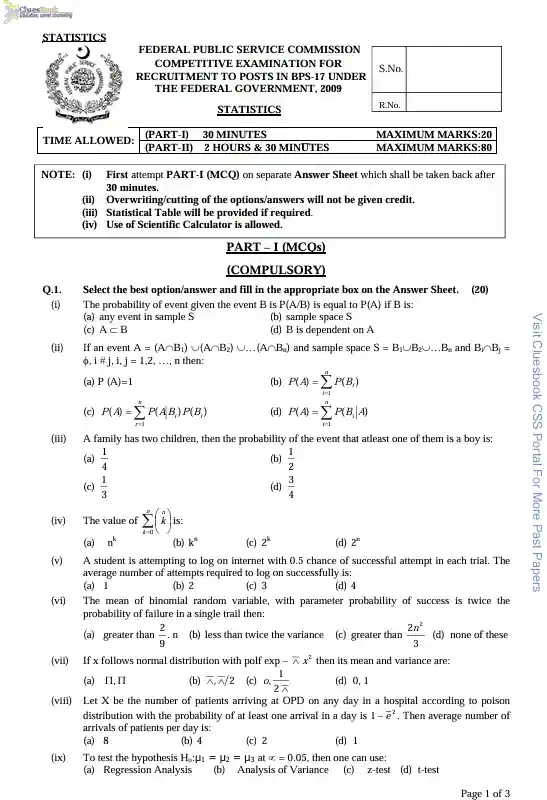
For CSS aspirants, practicing past papers is a crucial step toward exam success. The Statistics CSS past papers 2009 offer valuable insight into question styles and exam expectations from that year. This blog provides a complete overview and an easy PDF download to help you prepare confidently.
Importance of CSS Past Papers
- Reflects the exam’s question trends and difficulty level during that period.
- Offers exposure to diverse question formats, both theory and problem-solving.
- Enables self-assessment by attempting real questions.
- Helps in identifying recurring topics for targeted study.
Core Topics Explored in the Statistics CSS Past Papers 2009
- Statistical Measures: Understanding central tendency and variability.
- Probability Distributions: Application of binomial, Poisson, and normal distributions.
- Estimation Techniques: Point estimation and confidence intervals.
- Testing Hypotheses: Null and alternative hypotheses, types of errors.
- Correlation & Regression: Relationship analysis between variables.
- Analysis of Variance (ANOVA): Comparing group means in one-way ANOVA.
Effective Strategies to Use This Past Paper
- Attempt Without Assistance: Simulate exam conditions for best results.
- Review Mistakes: Analyze errors to identify weak points.
- Focus on Time Management: Practice completing questions within allotted time.
- Mix with Current Syllabus: Cross-reference with latest syllabus for full coverage.
About the CSS
The CSS (Central Superior Services) Competitive Examination is a rigorous federal level test administered by the Federal Public Service Commission (FPSC) to select candidates for prestigious civil service roles across Pakistan. The exam’s rules and regulations, covering age limits, eligibility, subjects, and quotas, are detailed in the official CSS Rules section on the FPSC’s website.
The CSS Exam Rules, issued by FPSC Pakistan, outline eligibility criteria, age limits (21–30 years), and a maximum of three attempts for candidates. The exam includes written tests, a medical exam, a psychological assessment, and an interview. Rules also define quotas, disqualification grounds, and subject selection for a fair recruitment process.
Additional Preparation Tips
- Combine past papers with updated textbooks for better clarity.
- Solve questions regularly to build exam confidence.
- Join study groups or coaching to discuss complex problems.
- Use previous papers to develop answering techniques under time pressure.
Focus your efforts by practicing the Statistics CSS past papers 2009.
Consistent practice will sharpen your skills and improve your confidence for the CSS exam.