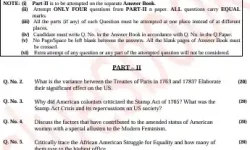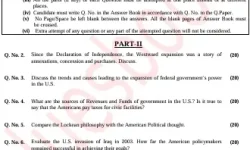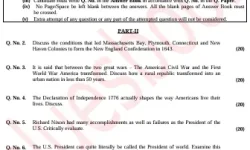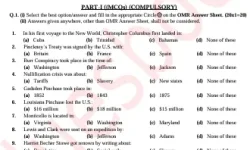

Discover the CSS 2019 past paper of public administration with full analysis, paper structure, examiner’s insights, preparation roadmap, and comparative trends. Access the student resource copy and practice with focused guidance for success in future attempts.
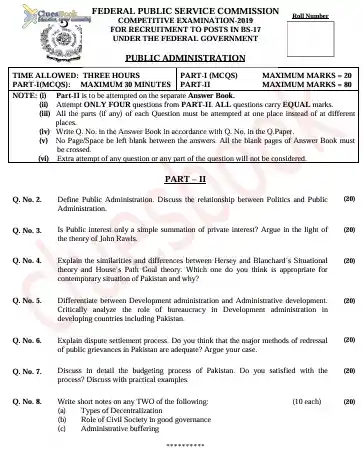
The CSS Public Administration 2019 paper was a balanced mix of theory and practice. It tested the ability of candidates to critically analyze administrative systems, link theoretical knowledge with Pakistan’s governance issues, and demonstrate awareness of reforms in the public sector.
Format and Composition
The paper followed the FPSC’s standard structure with one compulsory section and a descriptive portion.
| Section | Components | Marks |
| Section A | Compulsory questions (MCQs & short notes) | 20 |
| Section B | Descriptive/analytical (attempt 4 out of 6) | 80 |
| Overall Marks | 100 |
About the CSS
The CSS (Central Superior Services) Competitive Examination is a rigorous federal-level test administered by the Federal Public Service Commission (FPSC) to select candidates for prestigious civil service roles across Pakistan. The exam’s rules and regulations, covering age limits, eligibility, subjects, and quotas, are detailed in the official CSS Rules section on the FPSC’s website.
The CSS Exam Rules, issued by FPSC Pakistan, outline eligibility criteria, age limits (21–30 years), and a maximum of three attempts for candidates. The exam includes written tests, a medical exam, a psychological assessment, and an interview. Rules also define quotas, disqualification grounds, and subject selection for a fair recruitment process.
Key Emphasis in CSS 2019 Past Paper of Public Administration
- Application of administrative theories to real-world problems
- Role of bureaucracy and civil servants in policy-making
- Issues of accountability, transparency, and ethics
- Governance reforms and New Public Management (NPM) in Pakistan
- Federalism and inter-governmental relations
Examiner’s Focus
The examiner stressed critical thinking over memorization. Students were expected to:
- Analyze institutional reforms in light of Pakistani case studies
- Show familiarity with global administrative trends
- Apply theories to practical public service delivery challenges
- Write answers with clarity, coherence, and analytical depth
Study Path for Aspirants
To prepare effectively for this subject, students should:
- Build a strong grasp of classical & modern administrative thinkers
- Revise Pakistan-specific governance reforms from independence to recent times
- Study policy implementation and evaluation models
- Prepare real-life examples from Pakistan’s administrative structure
- Practice past papers for time management & analytical precision
Comparative Look with Previous Papers
| Year | Main Themes | Shift in Approach |
| 2017 | Classical theories, administrative law | More theory-heavy |
| 2018 | Governance reforms, NPM, HRM | Balanced approach |
| 2019 | Accountability, policy-making, federalism | Applied + critical focus |
This shows a gradual transition from theoretical orientation (2017) to a practical problem-solving focus (2019).The Public Administration 2019 paper highlighted the need for students to connect theoretical knowledge with practical governance realities of Pakistan. Candidates who prepared with updated reforms, case studies, and analytical frameworks performed better than those who only relied on rote learning.
Continuous practice with past papers remains the most effective preparation strategy.