
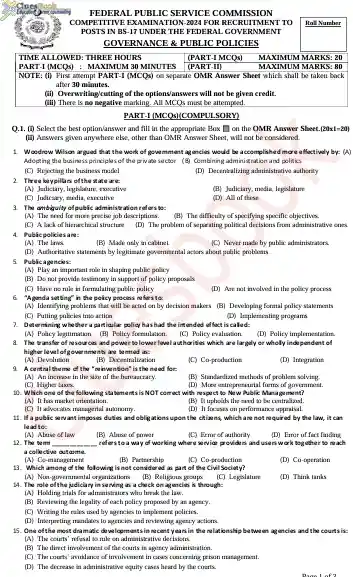
Download governance & public policies CSS paper 2024 PDF with a full breakdown of format, themes, and examiner’s focus. Includes preparation strategies, recommended sources, FAQs, and a free PDF download for practice.
Relevance of Governance & Public Policies in CSS
Governance & Public Policies has gained importance in CSS exams due to its focus on accountability, transparency, reforms, and policy implementation in Pakistan. The subject links directly with current issues like corruption, administrative inefficiency, and institutional reforms, making it a dynamic and practical choice for aspirants.
How the Paper Was Designed in 2024
The structure of the exam remained aligned with FPSC’s standard policy:
- Total Marks: 100
- Duration: 3 hours
- Section I (Objective): 20 multiple-choice questions (20 marks)
- Section II (Descriptive): 6 long questions, attempt any 4 (80 marks)
This structure demanded both factual knowledge and the ability to apply concepts to Pakistan’s governance framework.
About the CSS
The CSS (Central Superior Services) Competitive Examination is a rigorous federal-level test administered by the Federal Public Service Commission (FPSC) to select candidates for prestigious civil service roles across Pakistan. The exam’s rules and regulations, covering age limits, eligibility, subjects, and quotas, are detailed in the official CSS Rules section on the FPSC’s website.
The CSS Exam Rules, issued by FPSC Pakistan, outline eligibility criteria, age limits (21–30 years), and a maximum of three attempts for candidates. The exam includes written tests, a medical exam, a psychological assessment, and an interview. Rules also define quotas, disqualification grounds, and subject selection for a fair recruitment process.
Major Issues Reflected in the Paper
The 2024 paper highlighted governance challenges at national and global levels. Central areas included:
- The policy cycle and its practical application in Pakistan
- Good governance indicators and their absence in developing countries
- Public sector reforms and civil service restructuring
- Corruption and institutional accountability
- E-governance and its potential in Pakistan
- Comparative governance models in democracies
What the Examiner Expected
The paper clearly demanded analytical reasoning over rote memorization. Examiner’s focus was on:
- Explaining governance theories with real-world references
- Connecting answers with Pakistan’s institutional performance
- Evaluating the success and failure of public policies
- Suggesting reforms in line with modern governance practices
- Using updated examples from 2022–2024 government initiatives
Insights for Future Aspirants
Candidates preparing for upcoming CSS exams should:
- Prioritize conceptual clarity on governance models (Weberian bureaucracy, New Public Management, Good Governance theory).
- Stay updated with current policy debates in Pakistan (civil service reforms, digital governance, local government system).
- Practice writing argument-based answers with headings, facts, and examples.
- Consult international governance reports like World Bank Governance Indicators and UNDP Human Development Reports.
Key Books & Sources to Rely On
To cover this subject comprehensively:
- Governance & Public Policies by Dr. Sultan Khan
- Public Policy: An Introduction by Cochran & Malone
- PIDE policy briefs and reports
- Dawn’s editorial section (for governance debates)
- Transparency International reports on corruption and accountability
Download the Original Governance & Public Policies CSS Paper 2024
You can download the original CSS Governance & Public Policies 2024 Paper (PDF) from the download button below. It is unsolved and designed for practice purposes. Governance & Public Policies is not just a subject but a reflection of Pakistan’s administrative and political realities. The 2024 exam proved that success in this subject requires a mix of theoretical knowledge, policy analysis, and updated examples.
With proper preparation, it can be a high-scoring optional that strengthens overall performance in CSS.