
Download town planning and urban management CSS paper 2016 pdf through an in-depth review. Learn about themes, examiner’s priorities, and preparation takeaways.
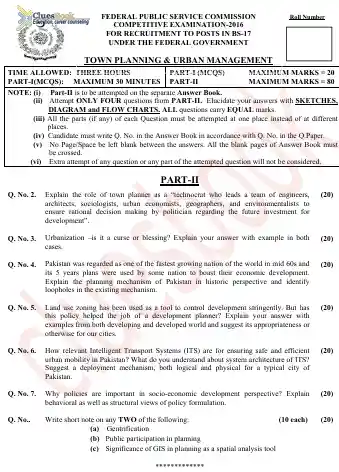
Theme of Town Planning and Urban Management CSS Paper 2016
The CSS 2016 paper carried a unique balance of conceptual depth and practical application. Unlike 2017, which leaned toward a mix of theory and governance, the 2016 exam was more foundational. It reminded aspirants that they must be well-rooted in the philosophy and principles of planning before shifting to policy discussions.
About the CSS
The CSS (Central Superior Services) Competitive Examination is a rigorous federal-level test administered by the Federal Public Service Commission (FPSC) to select candidates for prestigious civil service roles across Pakistan. The exam’s rules and regulations, covering age limits, eligibility, subjects, and quotas, are detailed in the official CSS Rules section on the FPSC’s website.
The CSS Exam Rules, issued by FPSC Pakistan, outline eligibility criteria, age limits (21–30 years), and a maximum of three attempts for candidates. The exam includes written tests, a medical exam, a psychological assessment, and an interview. Rules also define quotas, disqualification grounds, and subject selection for a fair recruitment process.
Which themes dominated the exam
The examiner gave strong attention to certain areas:
Planning Principles and Evolution
The paper tested whether candidates understood how town planning developed over centuries and why these foundations remain relevant today.
Urbanization and Housing
As with other years, Pakistan’s housing shortage and rapid urban sprawl were brought into focus. The examiner pushed aspirants to critically examine why previous planning models failed.
Governance and Policy
The 2016 exam highlighted weaknesses in administrative structures and the absence of long-term strategies. It signaled the importance of discussing reforms, not just identifying problems.
Environment and Infrastructure
Issues of pollution, infrastructure breakdown, and poor transport systems also featured, making the paper holistic.
Snapshot of Themes in 2016 vs Other Papers
| Theme Area | 2016 Focus | Difference from Later Years |
| Planning Foundations | Strongly emphasized | Less stressed after 2018 |
| Housing & Urban Sprawl | Central to several questions | Continued in all papers |
| Governance | Institutional weaknesses spotlighted | Became sharper post-2017 |
| Environment | Pollution and transport included | More detailed in 2019–2020 |
Recommended Material
For those preparing Town Planning and Urban Management, the following sources are valuable:
- Books
- Urban and Regional Planning by Peter Hall
- Cities of the Global South by Faranak Miraftab and Neema Kudva
- Urban Development in Pakistan by Qadeer Muhammad
- Reports & Policy Documents
- Pakistan Vision 2025 (Planning Commission of Pakistan)
- UN-Habitat reports on sustainable urban development
- World Bank’s Pakistan Urbanization Review
- Journals & Articles
- International Journal of Urban and Regional Research
- Pakistan Development Review articles on housing and urban issues
- Online Sources
- Planning Commission of Pakistan official website
- UNDP Pakistan resources on environment and urbanization
- Academic blogs and research databases like JSTOR for planning theory
How should aspirants interpret this paper
The 2016 paper showed that rote memorization was not enough. Aspirants needed to:
- Demonstrate a command of theory and connect it with current urban issues
- Use Pakistan’s city-specific examples, especially Karachi and Lahore, to strengthen arguments
- Include governance-related critique, particularly about weak institutions
- Touch upon sustainability and environment, even when indirectly relevant
Paper Availability
The CSS 2016 Town Planning and Urban Management paper in PDF format can be accessed through this link. The download button is below for PDF and the paper is unsolved, provided for practice purposes.
Why this paper still matters
The 2016 exam was not as policy-heavy as later ones, yet it offered clear lessons: theory is always the backbone, and applied knowledge is incomplete without it.
For current aspirants, reviewing this paper is a reminder to keep preparation balanced between classical foundations and Pakistan’s practical realities.