Apply for the American Heart Association Predoctoral Fellowship 2027 in the USA. Check stipend, eligibility, deadline, benefits, documents, and step-by-step application process.
If you are a PhD, MD, PharmD, DrPH, nursing, public health, or clinical health science student aiming to build a funded research career in cardiovascular or cerebrovascular science, the American Heart Association Predoctoral Fellowship could be one of the strongest pre-doctoral funding opportunities in the United States right now. What makes this fellowship especially attractive is that it is not just a title on your CV.
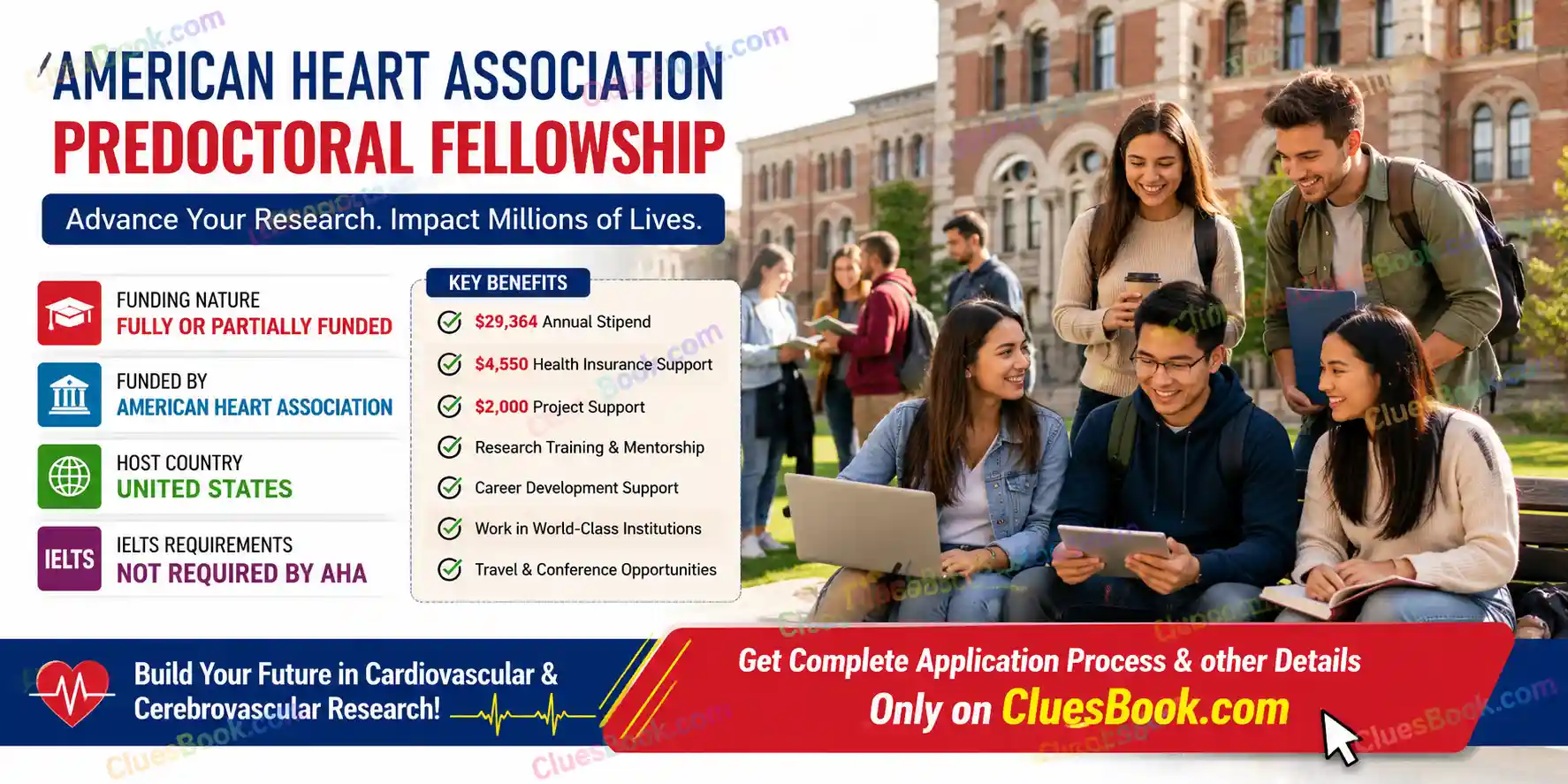
It provides a $29,364 annual stipend, health insurance support, project funding, mentorship-based research training, and access to one of the most respected cardiovascular research ecosystems in the world. For students planning a long-term career as a scientist, physician-scientist, or clinician-scientist, this fellowship can help bridge the gap between doctoral training and an independent research career.
American Heart Association Predoctoral Fellowship Overview
The American Heart Association Predoctoral Fellowship 2027 is a competitive research fellowship offered by the American Heart Association (AHA) to support one to two years of mentored research training for students enrolled in eligible doctoral or clinical health degree programs. The program is designed for applicants who want to pursue research careers focused on cardiovascular health, cerebrovascular health, stroke, brain health, and related biomedical or public health research.
This fellowship is hosted in the United States at eligible U.S.-based nonprofit institutions such as universities, medical schools, public health schools, pharmacy schools, nursing schools, and teaching hospitals. The award is intended to strengthen the research pipeline by supporting promising pre-doctoral trainees with funding, mentorship, and project resources while they build their scientific track record.
AHA Predoctoral Fellowship Details
- Host Organization: American Heart Association (AHA)
- Study Destination: United States
- Funded By: American Heart Association
- Application portal Link: ProposalCentral
- Degree Level: Predoctoral / Doctoral / Clinical Health Doctoral
- Scholarship Type: Funded Fellowship / Research Fellowship
- Number of Scholarships: Not officially specified publicly
- Maximum Funding: $35,914 per year in direct trainee support and project support
- Study Level: PhD, MD, DO, DVM, PharmD, DDS, DrPH, nursing/public health/clinical health doctoral level
- Duration: 1 to 2 years
- Application Deadline: Tuesday, August 4, 2026 at 3:00 p.m.
- Program Start: January 1, 2027
Quick Funding Snapshot
- Annual stipend: $29,364
- Health insurance allowance: $4,550 per year
- Project support: $2,000 per year
- Total annual direct support value: $35,914
- Fellowship length: One or two years
Eligibility Criteria for American Heart Association Predoctoral Fellowship
To apply for the American Heart Association Predoctoral Fellowship, applicants must meet the official fellowship eligibility conditions at the time of application and award activation.
Core Eligibility Requirements
- You must be enrolled as a full-time student in an eligible doctoral or clinical health degree program.
- You must be pursuing research training before starting a long-term research career as a scientist, physician-scientist, or clinician-scientist.
- You must be enrolled in one of the eligible degree pathways such as:
- PhD in science
- MD
- DO
- DVM
- PharmD
- DDS
- DrPH
- PhD in nursing
- PhD in public health
- equivalent clinical health science doctoral program
Research Commitment Requirement
At the time of award activation, the applicant must have completed the initial coursework stage and be at a point in the program where they can devote full-time effort, generally 80%, to research or closely related career-development activities.
Institutional Eligibility
- The fellowship is limited to U.S.-based nonprofit institutions.
- Eligible host institutions include:
- medical schools
- osteopathic schools
- dental schools
- veterinary schools
- pharmacy schools
- nursing schools
- schools of public health
- universities and colleges
- public or voluntary hospitals
- other nonprofit institutions capable of conducting the proposed research
Citizenship / Immigration Status Eligibility
Applicants do not need to have lived in the United States for a specific minimum period before applying. However, they must hold an eligible status at the time of proposal submission and maintain it throughout the award period. Eligible designations include:
- U.S. citizen
- Permanent resident
- Pending permanent resident with filed Form I-485 and I-797C Notice of Action
- E-3 visa
- F-1 visa
- G-4 visa
- H-1B visa
- J-1 visa
- O-1 visa
- TN visa
- DACA
Membership Requirement
- Applicants must be American Heart Association Professional Members at the time of proposal submission.
- Membership processing may take 3 to 5 days, so do not wait until the last week before the deadline.
Eligible Study Fields and Programs Under the AHA Fellowship
The AHA Predoctoral Fellowship is not tied to one university department. Instead, it supports research training that contributes to cardiovascular, cerebrovascular, stroke, and brain health outcomes. Below are the main eligible academic fields and the types of programs that commonly fit this fellowship.
1) Biomedical and Basic Science Programs
- PhD in Biomedical Sciences
- PhD in Molecular Biology
- PhD in Cell Biology
- PhD in Genetics and Genomics
- PhD in Biochemistry
- PhD in Physiology
- PhD in Pharmacology
- PhD in Neuroscience
- PhD in Immunology
- PhD in Bioengineering or Biomedical Engineering with cardiovascular relevance
2) Clinical and Professional Health Doctoral Programs
- MD
- DO
- DVM
- PharmD
- DDS
- DrPH
- equivalent clinical health science doctoral programs with cardiovascular, stroke, or brain-health research focus
3) Nursing, Public Health, and Population Health Programs
- PhD in Nursing
- PhD in Public Health
- DrPH
- PhD in Epidemiology
- PhD in Health Outcomes Research
- PhD in Behavioral Health Sciences
- PhD in Population Health or Global Health with cardiovascular relevance
4) Translational, Cardiovascular, Cerebrovascular, and Brain Health Research Tracks
- Cardiovascular disease mechanisms
- Hypertension and vascular biology
- Heart failure research
- Arrhythmia and electrophysiology research
- Stroke and cerebrovascular disease research
- Brain health and neurovascular research
- Preventive cardiology and risk factor research
- Clinical outcomes research related to heart or stroke care
- Health disparities in cardiovascular and cerebrovascular health
- Digital health, implementation science, or data science applied to cardiovascular outcomes
Application Requirements for American Heart Association Predoctoral Fellowship 2027
The fellowship application is submitted online through ProposalCentral, and the proposal package includes both applicant-submitted materials and third-party documents. All materials must be completed before final submission.
Main Application Requirements
- Online application through ProposalCentral
- American Heart Association Professional Membership active at submission
- A clearly defined mentored research proposal
- A designated mentor/sponsor
- Institutional approval and required signature from the designated institutional representative
- All required third-party documents submitted by the deadline
- Compliance with AHA formatting, biosketch, and proposal instructions
- Research project relevant to cardiovascular, cerebrovascular, stroke, or brain health
Proposal Expectations
The trainee and mentor are expected to submit a thoughtfully planned, systematic proposal that clearly addresses an investigative research question. The proposal should show:
- a clear hypothesis or research objective
- the applicant’s specific role in the project
- significance of the research problem
- relevance to cardiovascular disease, stroke, or brain health
- feasibility within the fellowship period
- how the project supports the fellow’s career development
Language Requirements for American Heart Association Predoctoral Fellowship
The American Heart Association Predoctoral Fellowship page does not list a separate IELTS, TOEFL, Duolingo, or PTE requirement as part of the fellowship application itself. This is because the fellowship is awarded through U.S.-based host institutions, and applicants are already expected to be enrolled in an eligible doctoral or clinical health degree program.
In practice, your language requirement is usually determined by the university or institution where you are enrolled, not by AHA directly. If your university admitted you without IELTS, or if you met the institution’s English requirement through another pathway, the fellowship itself typically does not ask for a separate IELTS score.
IELTS Requirements and Study Abroad Without IELTS,
For this fellowship specifically, there is no standalone IELTS requirement mentioned by AHA. However, international students should still check the language rules of their host university.
Some study-abroad destinations and institutions may allow students to study without IELTS through alternative proof of English proficiency, medium-of-instruction letters, internal English tests, or other accepted exams. Depending on the university and program, this may be possible in countries such as the USA, Germany, Italy, Hungary, Turkey, Malaysia, China, and some universities in the UK and Europe. If you are searching for scholarships without IELTS, always verify whether the waiver comes from the university, the scholarship provider, or both.
Is Supervisor Required for American Heart Association Predoctoral Fellowship?
Yes, a mentor/supervisor is required. In fact, the mentor is one of the most important parts of a successful AHA Predoctoral Fellowship application.
The fellowship is designed as a mentored training award, which means your application must show that an established investigator will guide your research, training, and career development. The AHA also makes it clear that because the award provides a trainee stipend and limited project support, additional research resources must come from the mentor’s lab or research environment.
Smart Strategy for Choosing a Mentor
- Choose a mentor with an active cardiovascular, stroke, brain health, or closely related research program.
- Prefer a mentor with recent publications, grant funding, and a strong trainee record.
- Make sure your project aligns with the mentor’s broader research direction.
- Ask your mentor early whether they can provide:
- research environment support
- project feasibility input
- training plan guidance
- strong institutional backing
- Avoid writing a proposal that looks disconnected from the mentor’s lab resources or expertise.
Benefits of American Heart Association Predoctoral Fellowship
The AHA Predoctoral Fellowship is valuable because it combines research funding, professional prestige, mentorship, and career-building support. It is particularly attractive for doctoral students who want to move into competitive academic medicine, biomedical science, translational research, or public health research careers.
Financial Benefits of American Heart Association Predoctoral Fellowship
- $29,364 annual stipend
- $4,550 per year for health insurance
- $2,000 per year in project support
- Total annual support value of $35,914
- Funding duration of 1 to 2 years
- No indirect costs charged to the fellow
- Project support can be used for approved research-related needs such as travel, computer, equipment, and other project expenses under fellowship rules
- International travel is permitted under the project support guidance and does not require prior AHA approval according to the fellowship materials
Can I work another job while holding the fellowship?
The fellowship is designed around full-time doctoral research training. Because awardees are expected to commit major effort to research and career development, outside work may be restricted by your university, visa rules, and fellowship expectations. Always confirm with your graduate school and grants office.
Additional Benefits of American Heart Association Predoctoral Fellowship
- Mentored research training with an established investigator
- Strong credential for future postdoctoral fellowships, NIH applications, and academic job applications
- Increased visibility in cardiovascular and cerebrovascular research
- Structured pathway toward becoming an independent researcher
- Opportunity to strengthen your publication pipeline and research profile
- Better positioning for future grants, awards, and postdoctoral funding
- Access to a globally recognized health research organization brand on your CV
- Enhanced credibility when applying for academic, medical, public health, and translational research roles
Will AHA help with accommodation or housing in the USA?
There is no separate AHA housing package listed for this fellowship. Accommodation is generally arranged by the fellow through the university or local rental market. If you are applying from outside the U.S., check whether your university offers graduate housing, international student housing support, or relocation guidance.
Program Duration, Timeline & Selection Process for AHA Predoctoral Fellowship
The American Heart Association Predoctoral Fellowship runs for one or two years depending on the approved award period and research plan.
Official Timeline for the 2027 Fellowship Round
- RFP posted: April 28, 2026
- Proposal deadline: Tuesday, August 4, 2026 at 3:00 p.m. CT
- Award notification: December 2026
- Award start date: January 1, 2027
How the Selection Process Works
Applications are reviewed competitively. The fellowship uses peer-review criteria focused on the fellow, the mentor, the training plan, and the scientific quality of the project. The AHA materials highlight areas such as:
- applicant’s research potential
- clarity of career plans
- prior research experience and/or publications
- strength of mentor support and training plan
- significance of the research question
- methodological feasibility
- alignment with cardiovascular, cerebrovascular, or brain health priorities
Review Weighting Mentioned by AHA
- Potential of the Fellow: 30%
- Mentor’s Commitment to the Fellow and Research Training Plan: 40%
- Additional scientific and significance considerations are also assessed in peer review
Step-by-Step Application Process for American Heart Association Predoctoral Fellowship
- Review the official AHA Predoctoral Fellowship page and downloadable RFP carefully.
- Confirm that your doctoral program, immigration status, and institution meet eligibility requirements.
- Join or renew your American Heart Association Professional Membership well before the deadline.
- Identify and confirm your research mentor/sponsor.
- Define a cardiovascular, cerebrovascular, stroke, or brain health research question that fits your mentor’s research environment.
- Draft your research proposal, aims, significance section, and training rationale.
- Prepare your biosketch and personal statement according to AHA instructions.
- Request three reference letters from eligible referees early.
- Coordinate with your mentor on the training plan, research environment description, and budget/project support elements.
- Create or update your account in ProposalCentral.
- Upload all required documents in the correct format.
- Obtain the designated institutional representative signature/approval.
- Review formatting, page limits, and submission rules one final time.
- Submit before 3:00 p.m. Central Time on August 4, 2026.
- Keep copies of all uploaded materials and confirmation emails.
Application Deadline & Important Dates for American Heart Association Predoctoral Fellowship
If you plan to apply, these are the key dates you should save immediately.
- RFP posted: April 28, 2026
- ProposalCentral opens: The official fellowship materials indicate the application cycle opens in advance of the deadline; the downloadable RFP lists the current cycle dates and should be checked directly before submission
- Application deadline: Tuesday, August 4, 2026
- Deadline time: 3:00 p.m. Central Time
- Award notification: December 2026
- Award start: January 1, 2027
Important Deadline Advice
- Do not wait until the final day because AHA does not accept late applications.
- Membership processing can take 3-5 days.
- Reference letters and institutional approvals can delay submission if you start late.
- Early submission is strongly recommended.
Examples of Eligible U.S. Host Institutions for the American Heart Association Predoctoral Fellowship
The American Heart Association does not publish a fixed list of participating universities for this fellowship in the same way a university scholarship would. Instead, the fellowship is tenable at eligible U.S.-based nonprofit institutions that can support the proposed research and meet AHA requirements.
Typical Eligible Host Institutions Include
- U.S. medical schools
- U.S. osteopathic schools
- U.S. dental schools
- U.S. veterinary schools
- U.S. pharmacy schools
- U.S. nursing schools
- U.S. schools of public health
- U.S. universities and colleges with relevant doctoral research programs
- U.S. nonprofit hospitals and research institutions with cardiovascular or cerebrovascular research capacity
Participating Universities / Eligible Host Institutions for American Heart Association Predoctoral Fellowship
The American Heart Association does not provide a fixed public list of participating universities for the Predoctoral Fellowship. Instead, the award is open to eligible U.S.-based nonprofit institutions that can support cardiovascular, cerebrovascular, stroke, brain health, public health, biomedical, or related doctoral research. These institutions typically include medical schools, osteopathic schools, dental schools, veterinary schools, pharmacy schools, nursing schools, schools of public health, major research universities, and nonprofit hospitals or research centers.
| Category | Example Eligible U.S. Host Institutions |
|---|---|
| U.S. Medical Schools |
|
| U.S. Osteopathic Schools |
|
| U.S. Dental Schools |
|
| U.S. Veterinary Schools |
|
| U.S. Pharmacy Schools |
|
| U.S. Nursing Schools |
|
| U.S. Schools of Public Health |
|
| U.S. Universities and Colleges With Relevant Doctoral Research Programs |
|
| U.S. Nonprofit Hospitals and Research Institutions |
|
Important Note:
These are illustrative examples of eligible U.S.-based nonprofit host institutions, not an official American Heart Association list of approved or participating institutions. Applicants should confirm with their university, mentor, grants office, and the current AHA fellowship guidelines that their institution is eligible to administer the award.
Examples of the Kind of Institutions That Commonly Fit This Model
- research-intensive universities with cardiovascular science labs
- academic medical centers
- public health schools with cardiovascular epidemiology research
- biomedical engineering departments working on heart or stroke innovation
- hospitals and institutes with translational cardiovascular research infrastructure
Why Apply for AHA fellowship
- It funds serious doctoral-level cardiovascular or cerebrovascular research training
- It adds a highly respected national fellowship to your CV
- It provides direct stipend, health insurance support, and project funding
- It strengthens your profile for postdoctoral fellowships and faculty-track research careers
- It helps you build a closer mentorship structure around your research training
- It shows external validation of your research potential
- It can improve your competitiveness for NIH, foundation, and university funding later
- It aligns well with students aiming for careers in academic medicine, translational science, public health research, and biomedical investigation
Common Mistakes to Avoid When Applying for the American Heart Association Predoctoral Fellowship
- Waiting too late to activate or renew AHA Professional Membership
- Choosing a weak or poorly aligned mentor
- Submitting a project that does not clearly connect to cardiovascular, stroke, cerebrovascular, or brain health impact
- Writing vague career goals in the biosketch personal statement
- Ignoring page limits or formatting instructions in the application PDF
- Asking ineligible referees to write letters
- Failing to explain your own role in the project clearly
- Submitting a proposal that appears to duplicate a mentor’s grant without a distinct trainee role
- Underestimating institutional approval timelines
- Uploading incomplete documents or waiting for references at the last minute
- Treating the fellowship like a general scholarship instead of a mentored research training award
American Heart Association Predoctoral Fellowship Salary / Stipend
The American Heart Association Predoctoral Fellowship is a stipend-based research fellowship, not a salaried employee contract in the usual sense. For the 2027 cycle, the official funding includes:
- Annual stipend: $29,364
- Health insurance allowance: $4,550 per year
- Project support: $2,000 per year
Estimated Monthly Stipend
If you divide the annual stipend over 12 months, the base stipend comes to roughly $2,447 per month before considering any institutional rules, supplemental support, or deductions that may apply through your host institution.
Is the Stipend Enough?
The answer depends heavily on your city, institution, and whether your program or mentor’s lab supplements your support. In lower-cost college towns, the stipend may be manageable with shared housing and student budgeting. In expensive U.S. cities, you may need additional institutional or departmental support, especially for housing and personal expenses.
AHA Predoctoral Fellowship Acceptance Rate
The official acceptance rate for the American Heart Association Predoctoral Fellowship is not publicly listed on the fellowship page. AHA does not publish a guaranteed annual acceptance percentage for this program in the public quick-facts section.
However, this is widely considered a competitive national fellowship because it combines:
- national-level peer review
- limited fellowship slots relative to applicant demand
- emphasis on mentor quality and research plan strength
- focus on applicant potential and cardiovascular relevance
Practical Competitiveness Takeaway
Instead of focusing only on acceptance rate, applicants should optimize the parts of the application that matter most:
- a strong mentor with a proven training record
- a feasible but meaningful research project
- a clear connection to cardiovascular, cerebrovascular, or brain health
- strong reference letters
- a polished biosketch and personal statement
- evidence of research potential, publications, presentations, or technical training
Apply Now to Secure Your Future in the United States
If you are serious about building a long-term research career in cardiovascular science, stroke research, public health, brain health, or clinical translational medicine, the American Heart Association Predoctoral Fellowship 2027 deserves a place at the top of your funding list. It offers more than a stipend. It gives you structured mentorship, research credibility, project support, and a nationally recognized fellowship title that can strengthen your academic profile for years. For ambitious doctoral students in the United States, this is the kind of award that can accelerate publications, improve postdoctoral opportunities, and make future grant applications more competitive.
The deadline is fixed, late applications are not accepted, and the strongest candidates usually start preparing well in advance. If your research fits the AHA mission and you have the right mentor, start building your application now rather than waiting for the final week.