NSF Scholarships 2027 (S-STEM) are open for institutional applications. Learn eligibility, STEM fields, $15,000/$20,000 funding, deadline and how students apply.
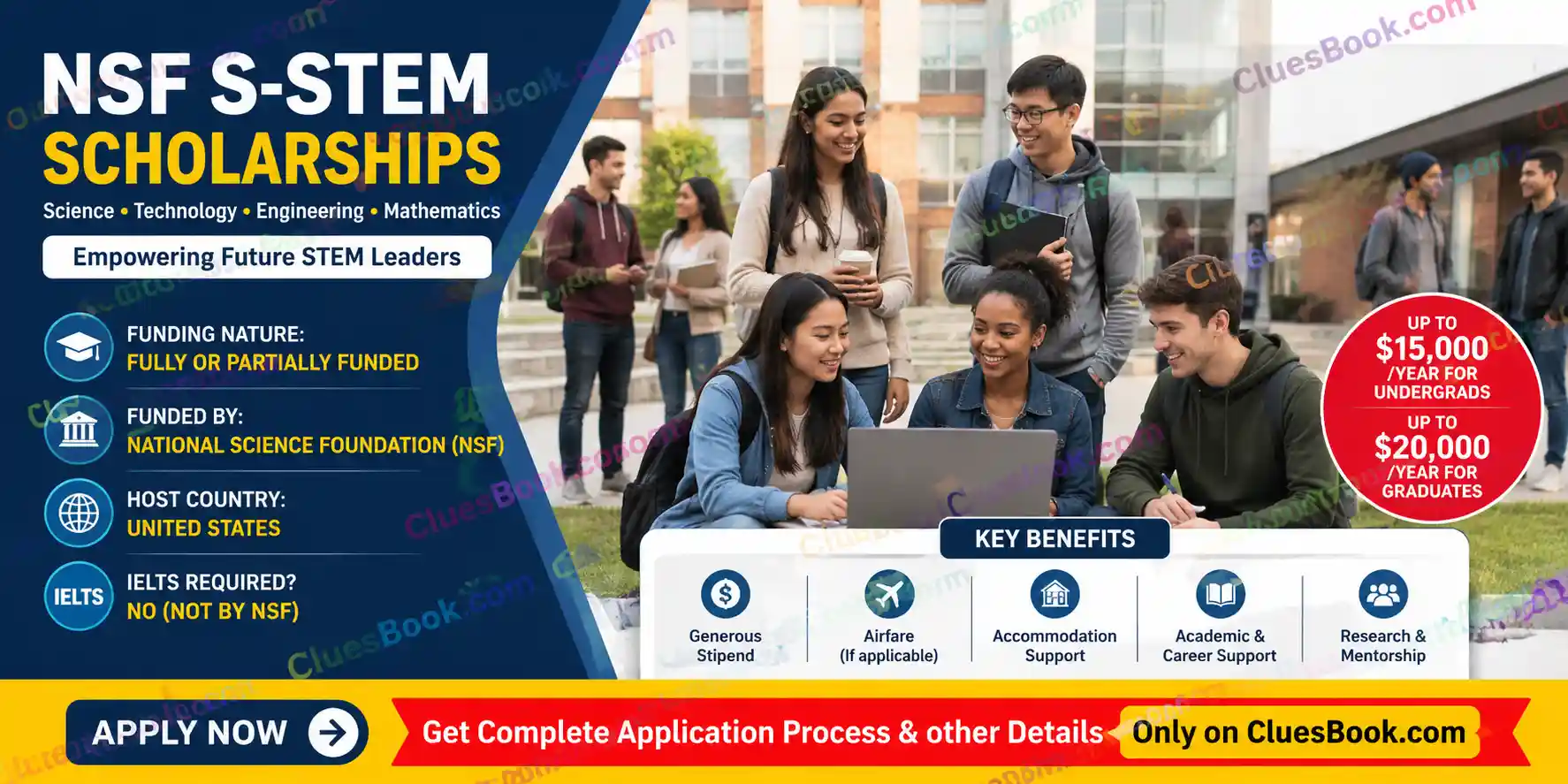
If you are looking for a high-value STEM scholarship in the United States, the NSF Scholarships 2027 opportunity deserves a closer look, but there is one detail that can easily cause applicants to miss the opportunity. The National Science Foundation does not ask individual students to submit a standard scholarship application directly to NSF. Instead, NSF funds eligible U.S. colleges and universities through its Scholarships in Science, Technology, Engineering, and Mathematics Program (S-STEM), and participating institutions select qualified students. The current call is open under NSF 25-514, with the next official institutional proposal deadline set for March 2, 2027. Individual undergraduate scholars may receive up to $15,000 per year, while graduate scholars may receive up to $20,000 per year, subject to demonstrated unmet financial need.
NSF Stem Scholarships Overview
The NSF Scholarships in Science, Technology, Engineering, and Mathematics Program, commonly known as NSF S-STEM, is funded by the U.S. National Science Foundation. Its goal is to help academically talented, low-income students with demonstrated financial need complete eligible STEM degrees and progress toward STEM careers or further graduate education.
The current program is governed by NSF 25-514, which is the active S-STEM solicitation. NSF’s official program page currently lists March 2, 2027 as the upcoming full-proposal deadline. The program is institution-focused. NSF awards grants to eligible U.S. institutions of higher education, while the participating institution develops its own student recruitment, selection and support process within NSF requirements.
This distinction is essential:
- NSF does not operate one nationwide student application portal for S-STEM scholarships.
- Universities and colleges submit S-STEM proposals to NSF.
- Students apply to participating institutions or their S-STEM projects.
- Each institution determines its student-facing application process.
- A university may have its own scholarship deadline that is earlier than the NSF institutional deadline.
The program also provides more than financial assistance. S-STEM projects can include mentoring, academic support, career development, retention initiatives, transfer support and other evidence-based activities designed to improve STEM graduation outcomes.
NSF S-STEM 2027 Program Details
- Host Organization: U.S. National Science Foundation (NSF)
- Study Destination: United States
- Funded By: National Science Foundation
- Application portal Link: Research.gov or Grants.gov for institutional proposals; students apply through participating institutions
- Degree Level: Associate, Bachelor’s, Master’s and Doctoral
- Scholarship Type: Need-based STEM scholarship administered through participating institutions
- Number of Scholarships: No single national student quota; NSF anticipates approximately 40-60 new institutional S-STEM awards annually
- Maximum Individual Funding: Up to $15,000 per year for undergraduate students and up to $20,000 per year for graduate students
- Maximum Scholarship Duration: Up to 5 years at each institution or academic level, subject to program rules
- Study Level: Undergraduate and graduate STEM education
- Institutional Grant Duration: Up to 6 years
- Application Deadline: March 2, 2027, by 5:00 p.m. submitting organization’s local time
- Deadline Pattern: First Tuesday in March, annually thereafter
- Current Solicitation: NSF 25-514
- Expected Annual Program Funding: $80 million-$120 million
- Expected New Institutional Awards: Approximately 40-60
- Track 1 Maximum Award: $2 million for up to 6 years
- Track 2 Maximum Award: $2 million for up to 6 years
- Track 3 Maximum Award: $5 million for up to 6 years
NSF’s official program page confirms that the 2027 full-proposal deadline is March 2, 2027. The $2 million and $5 million figures refer to institutional awards, not money paid to one student.
Official Application Link
The official NSF program page currently identifies March 2, 2027 as the next full-proposal deadline. Students should use the university-level application route for individual scholarship consideration rather than attempting to submit a personal S-STEM scholarship application directly to NSF.
Is NSF S-STEM 2027 Fully Funded?
NSF S-STEM can provide substantial financial assistance, but describing it simply as a guaranteed “fully funded scholarship” would be inaccurate. The scholarship is a last-dollar scholarship. The participating institution’s financial aid office calculates the student’s remaining unmet financial need after other applicable scholarships, grants and fellowships are considered.
The current NSF rules establish these maximum individual scholarship amounts:
- Undergraduate students: up to $15,000 per year
- Graduate students: up to $20,000 per year
- Scholarship amount: limited by the student’s actual unmet financial need
- Scholarship coverage: based on the institution’s defined Cost of Attendance
- Maximum individual duration: up to 5 years at each institution or academic level
The NSF FAQ explains that Cost of Attendance can include more than tuition. Depending on the institution, it may include items such as room and board, textbooks, laptops, transportation and childcare. Therefore, an applicant should not assume that every S-STEM scholar receives the maximum $15,000 or $20,000.
NSF S-STEM 2027 Eligibility Criteria for Domestic STEM Students
The student eligibility requirements are particularly important because international students are generally not eligible for NSF S-STEM scholarships.
Eligible scholars must generally:
- Be a domestic student under NSF’s eligibility requirements
- Be a U.S. citizen, U.S. national, lawful permanent resident, or otherwise fall within an eligible status specified by the program
- Demonstrate low-income status according to the participating institution’s approved definition
- Have demonstrated unmet financial need
- Demonstrate academic ability, talent or potential
- Be enrolled in an eligible STEM degree program
- Pursue an eligible associate, bachelor’s, master’s or doctoral degree
- Meet the participating institution’s academic requirements
- Meet any additional selection criteria established by the approved S-STEM project
NSF requires the participating institution’s financial aid office to play a role in determining low-income eligibility and scholarship amounts.
Are International Students Eligible for NSF Scholarships 2027?
- Generally, no.
NSF S-STEM is designed for eligible domestic students. Students holding only temporary U.S. immigration status, such as an F-1 student visa, should not assume they qualify for S-STEM.
This makes NSF S-STEM fundamentally different from many U.S. scholarships marketed to international students. If you are an international student looking specifically for a U.S. scholarship, you should look for programs that explicitly state that international students are eligible rather than treating NSF S-STEM as an international scholarship.
Eligible Study Fields and STEM Degree Programs for NSF S-STEM 2027
NSF S-STEM supports degree disciplines associated with areas in which NSF funds research, including relevant technology fields. Importantly, NSF does not maintain one simple universal list of every eligible degree title. Institutions are expected to demonstrate that the disciplines included in their proposals align with NSF-supported research areas.
Eligible Associate Degree Programs
- Associate of Arts in an eligible STEM discipline
- Associate of Science
- Associate of Engineering
- Associate of Applied Science
Eligible Bachelor’s Degree Programs
- Bachelor of Arts in an eligible STEM discipline
- Bachelor of Science in an eligible STEM discipline
- Bachelor of Engineering
- Bachelor of Applied Science
Eligible Master’s Degree Programs
- Master of Arts in an eligible discipline
- Master of Science
- Master of Engineering
Eligible Doctoral Degree Programs
- Ph.D.
- Other comparable doctoral degrees in eligible NSF-supported disciplines
Examples of Eligible STEM and Technology Areas
- Computer and information sciences
- Computer science
- Information technology
- Engineering
- Engineering technology
- Mathematics
- Physical sciences
- Chemistry
- Physics
- Astronomy
- Materials science
- Biological sciences
- Biotechnology
- Geosciences
- Chemical technology
- Other technology fields associated with NSF-supported disciplines
The precise majors available to students depend on the S-STEM project approved at the participating institution.
Degree Programs Excluded From NSF S-STEM
The current program excludes several categories, including:
- Clinical medical degrees
- Nursing
- Veterinary medicine
- Pharmacy
- Physical therapy
- Other clinical programs not funded by NSF
- STEM teacher certification or licensure programs covered by the Robert Noyce Teacher Scholarship Program
- Bachelor of Business Administration programs
- Bachelor of Arts or Bachelor of Science in Business Administration
- Master’s degrees in Business Administration
- Doctoral degrees in Business Administration
Students should verify discipline eligibility with the specific participating institution because the approved project determines the disciplines and student populations it serves.
NSF S-STEM 2027 Application Requirements and Scholarship Requirements
There is no universal student application form issued by NSF for S-STEM. Instead, each participating university or college establishes its own student recruitment and selection procedure.
A university may ask for:
- Admission or enrollment in an eligible STEM program
- Financial aid information
- Evidence of low-income status
- Academic transcripts
- Personal statement
- Scholarship essay
- Resume
- Recommendation letters
- Interview
- Proof of eligible citizenship or immigration status
- FAFSA or other financial aid documentation
- Degree plan
- Other institution-specific documents
Students should therefore search the university’s website for terms such as:
- NSF S-STEM scholarship
- S-STEM scholars
- NSF STEM scholarship
- S-STEM application
- S-STEM student application
- NSF-funded STEM scholarship
- S-STEM financial aid
Required Documents for NSF S-STEM 2027 Scholarship Applications
- Academic transcripts
- Financial aid documentation
- FAFSA information, where required
- Proof of eligible citizenship or immigration status
- Evidence of financial need
- Proof of admission or enrollment
- Resume or curriculum vitae, if requested
- Personal statement, if requested
- Scholarship essay, if requested
- Recommendation letters, if requested
- Degree-plan information, if requested
- Additional documents specified by the participating institution
The exact document list is institution-specific. Students should not assume that every S-STEM university uses the same application requirements.
Language Requirements for NSF S-STEM 2027
NSF S-STEM itself does not establish a universal IELTS or TOEFL requirement. English-language requirements are generally determined by the participating university and academic program.
IELTS Requirements for NSF S-STEM 2027
There is no universal NSF S-STEM IELTS requirement. However, this does not mean international applicants can use S-STEM as an IELTS-free scholarship route because the scholarship is intended for eligible domestic students.
Students looking for study-abroad scholarships without IELTS should examine individual university admission policies. Some universities in countries such as Germany, France, Italy and other destinations may accept alternatives to IELTS in certain circumstances, but requirements vary by institution and program.
Is a Supervisor Required for NSF S-STEM 2027?
- No, an individual NSF S-STEM scholarship applicant does not generally need to secure an NSF supervisor before applying.
S-STEM is not an individual research fellowship. The program funds institutional scholarship and student-support projects.
However, graduate students may need an academic advisor or research supervisor for admission to a particular master’s or doctoral program. That is a separate university requirement. The best strategy is to identify an S-STEM institution that supports your discipline first, then determine whether its graduate department requires supervisor approval.
Benefits of NSF Scholarships 2027 (S-STEM)
NSF S-STEM is valuable because it combines financial assistance with structured academic and career support.
Financial Benefits of NSF S-STEM 2027
- Up to $15,000 per year for eligible undergraduate students
- Up to $20,000 per year for eligible graduate students
- Scholarship support based on demonstrated unmet financial need
- Last-dollar scholarship structure
- Potential support toward institutional Cost of Attendance
- Potential coverage of eligible non-tuition costs included in the institution’s Cost of Attendance
- Maximum individual scholarship duration of up to 5 years at each institution or academic level
NSF specifically states that Cost of Attendance may include tuition and other costs such as textbooks, laptops, room and board, transportation and childcare, depending on the institution’s definition.
Additional Benefits of NSF S-Stem scholarship
- Academic mentoring
- STEM faculty support
- Career development
- Retention assistance
- Graduation support
- Transfer support where appropriate
- Academic pathway development
- Career pathway development
- Evidence-based curricular activities
- Evidence-based co-curricular activities
- Potential internship opportunities
- Research experiences where included in the institutional project
- Professional development
- Support designed to reduce financial barriers to STEM completion
The program is specifically designed to address the fact that financial aid alone may not be sufficient to improve STEM retention and graduation.
NSF S-STEM 2027 Program Duration, Timeline and Selection Process
The current institutional S-STEM program provides three funding tracks.
Track 1: Institutional Capacity Building
- Maximum award: $2 million
- Maximum project duration: 6 years
- Intended for eligible institutions developing institutional capacity
- Includes an initial planning/capacity-building period
- Scholarships are not awarded during the initial planning period
- Scholarship support begins after the planning/capacity-building period
- At least 50% of the total requested amount must support pure scholarships
Track 2: Implementation Projects
- Maximum award: $2 million
- Maximum project duration: 6 years
- Designed to implement and evaluate S-STEM activities
- At least 60% of the total requested amount must support pure scholarships
Track 3: Inter-Institutional Consortia
- Maximum award: $5 million
- Maximum project duration: 6 years
- Designed for inter-institutional collaborations
- At least 60% of the total requested amount must support pure scholarships
NSF currently anticipates approximately 40-60 new S-STEM awards annually, subject to availability of funds, with an anticipated annual funding range of $80 million-$120 million.
Step-by-Step NSF S-STEM 2027 Application Process for Students
- Search for U.S. universities and colleges with NSF S-STEM projects
- Identify projects supporting your intended STEM discipline
- Confirm that you meet the domestic eligibility requirements
- Check whether you meet the institution’s low-income and financial-need criteria
- Apply for admission to the relevant STEM program if you are not already enrolled
- Complete the institution’s financial aid process
- Search the university website for its S-STEM student scholarship application
- Prepare transcripts and financial documentation
- Prepare a strong STEM-focused personal statement if required
- Submit recommendation letters if requested
- Complete an interview if required
- Follow the institution’s scholarship deadline rather than relying only on NSF’s March 2, 2027 deadline
- Maintain the required academic progress after selection
How Universities Apply for the NSF S-STEM 2027 Call
The 2027 NSF deadline is primarily relevant to institutions and their faculty, not individual students. Eligible two-year and four-year U.S. institutions, including community colleges, may submit proposals under the current solicitation subject to the detailed eligibility rules. The official NSF deadline is March 2, 2027, at 5 p.m. submitting organization’s local time.
NSF S-STEM 2027 Deadline and Important Dates
The current NSF program page provides the following important information:
- Current Solicitation: NSF 25-514
- 2027 Full Proposal Deadline: March 2, 2027
- Deadline Time: 5:00 p.m. submitting organization’s local time
- Deadline Pattern: First Tuesday in March, annually thereafter
- Letters of Intent: Not required under the solicitation
- Preliminary Proposals: Not required
- Submission Platforms: Research.gov or Grants.gov, according to NSF requirements
- Expected Number of Awards: 40-60
- Expected Annual Funding: $80 million-$120 million
- Current Status: Active funding opportunity
The official NSF program page explicitly lists March 2, 2027 as the upcoming full-proposal deadline.
Is NSF S-STEM a full scholarship for tuition and living expenses?
JNot automatically. It can cover eligible unmet Cost of Attendance up to the annual maximum, but the scholarship is limited by the student’s actual unmet need. Therefore, the maximum award should not be interpreted as a guaranteed full-ride amount.
Important Student Deadline Warning
- March 2, 2027 is not necessarily your university’s student scholarship deadline.
This is the deadline for eligible institutions submitting S-STEM proposals to NSF.
If you are a student, you should contact universities participating in S-STEM projects and ask:
- Are you currently accepting S-STEM scholars?
- Is my STEM major covered?
- What is your student application deadline?
- Do I need to be admitted before applying?
- What financial-need documentation is required?
- Does your project support undergraduate or graduate students?
- How long can scholarship support continue?
This distinction should be highlighted prominently in any scholarship article because it prevents students from incorrectly waiting until March 2, 2027 to apply for a university-level scholarship.
What is the exact NSF S-STEM 2027 deadline?
The official deadline is March 2, 2027, by 5:00 p.m. submitting organization’s local time. The solicitation also establishes the pattern of the first Tuesday in March annually thereafter.
Can part-time students receive NSF S-STEM funding?
Potentially, yes. Eligibility depends on the program’s requirements and the participating institution’s approved project and academic-progress rules. Students should verify the specific institution’s definition of eligible enrollment.
Participating Universities and Host Institutions for NSF S-STEM 2027
There is no permanent nationwide list of universities offering an S-STEM scholarship to every student.
NSF awards S-STEM projects to eligible institutions, and each approved project can target specific disciplines and student populations. The current solicitation allows eligible two-year and four-year institutions, including community colleges, to submit proposals. Historical and current S-STEM project records show participation by institutions of different sizes and types, including universities, colleges and community colleges.
Examples of institutions that have appeared in S-STEM project records include:
- University of San Francisco
- Central Connecticut State University
- Northern Kentucky University
- Ramapo College of New Jersey
- University of Houston-Victoria
- University of Arkansas
- West Virginia University
- Texas Tech University
- University of North Alabama
- Cape Cod Community College
- Wilson College
- University of St. Thomas
However, these examples should not be interpreted as confirmation that every institution listed is accepting new S-STEM students in 2027. The safest approach is to use NSF’s current S-STEM project and award information and then verify the scholarship availability directly with each university.
Can NSF S-STEM be combined with other scholarships?
S-STEM is a last-dollar scholarship. The participating financial aid office calculates remaining unmet need after applicable scholarships, grants and fellowships are applied. NSF states that loans and work income are excluded from that calculation.
Why Apply for NSF S-STEM Scholarships 2027?
- Up to $15,000 per year may be available to eligible undergraduate students.
- Up to $20,000 per year may be available to eligible graduate students.
- Funding addresses demonstrated unmet financial need.
- The scholarship can potentially contribute toward more than tuition.
- Eligible Cost of Attendance may include room and board, books, transportation and other institutional costs.
- Students can receive mentoring and academic support.
- Career development is part of the broader S-STEM model.
- The program supports STEM retention and graduation.
- Community colleges can participate.
- Students may benefit from transfer support where appropriate.
- Graduate STEM pathways can be supported.
- The program is backed by the U.S. National Science Foundation.
Common Mistakes to Avoid When Applying for NSF Scholarships
- Assuming NSF accepts individual student scholarship applications directly.
- Treating March 2, 2027 as every student’s scholarship deadline.
- Assuming every U.S. university offers S-STEM funding.
- Assuming every STEM major automatically qualifies.
- Assuming the maximum scholarship is guaranteed.
- Calling the program a guaranteed full-ride scholarship.
- Ignoring the domestic-student eligibility requirement.
- Applying for an excluded clinical degree.
- Assuming business administration degrees qualify.
- Assuming an F-1 student is eligible.
- Waiting until the NSF institutional deadline to investigate university-level opportunities.
- Failing to check the university’s own S-STEM project.
- Ignoring financial-need documentation.
- Assuming IELTS determines S-STEM eligibility.
- Assuming a research supervisor is mandatory for every applicant.
- Failing to maintain academic progress after receiving the scholarship.
Can I work while receiving an NSF S-STEM scholarship?
S-STEM does not create a separate work permit. Eligible domestic students can follow the employment rules applicable to their status. The scholarship itself is financial aid rather than an employment authorization.
NSF S Stem scholarship Salary and Career Opportunities After Graduation
NSF S-STEM does not provide a fixed salary to scholars.
Instead, the program is designed to help students complete STEM degrees and transition into STEM employment or further graduate education.
Career outcomes depend on the student’s degree, specialization, location, experience and employer.
Potential career areas can include:
- Software engineering
- Data science
- Cybersecurity
- Information technology
- Electrical engineering
- Mechanical engineering
- Civil engineering
- Chemical engineering
- Biotechnology
- Materials science
- Scientific research
- Environmental science
- Mathematics
- Physics
- Chemistry
- Computer and information sciences
Students should evaluate salary information using reliable U.S. labor-market data rather than treating NSF S-STEM as a guaranteed high-paying job program.
NSF S-STEM 2027 Acceptance Rate and Competition
There is no official single student acceptance rate for NSF S-STEM.
The program has two different levels of selection.
- First, NSF evaluates institutional proposals.
- Second, participating institutions select individual scholars.
For the current solicitation, NSF anticipates approximately 40-60 new S-STEM institutional awards annually, subject to available funding. The program anticipates approximately $80 million-$120 million in annual funding. These figures are institutional program estimates and do not represent a student acceptance rate.
For students, competition can vary significantly between universities because each project may have different disciplines, scholarship capacity and selection criteria.
Do I need a supervisor for an NSF S-STEM scholarship?
No general NSF supervisor requirement applies to individual S-STEM scholarship applicants. Graduate programs may separately require an academic advisor or research supervisor, depending on the university and degree.
Apply Now to Secure Your Future in the United States
For eligible domestic students pursuing STEM education, NSF S-STEM can provide a powerful combination of financial assistance, academic support, mentoring and career preparation. The 2027 NSF call is currently active, but students should understand that the March 2, 2027 date belongs to the institutional proposal cycle rather than functioning as one universal student application deadline. The smartest approach is to identify participating U.S. colleges and universities, verify that your STEM discipline is covered by their S-STEM project, confirm your financial-need and domestic-status eligibility, and then follow that institution’s own scholarship application process. With potential support of up to $15,000 annually for undergraduate students and $20,000 for graduate students, NSF S-STEM can reduce financial barriers while helping talented STEM students progress toward graduation and high-value career pathways in the United States.