
Download CSS governance and public policy paper 2019 PDF with a breakdown of its format, major themes, examiner expectations, mistakes candidates made, and comparison with 2018. Includes FAQs, preparation tips, and free PDF download.
Why the 2019 Paper Stood Out
The 2019 Governance & Public Policies paper was considered balanced yet tricky. It tested not only theoretical knowledge but also the ability to critically assess Pakistan’s governance failures and link them with global governance models. Many candidates found it more analytical compared to earlier years.
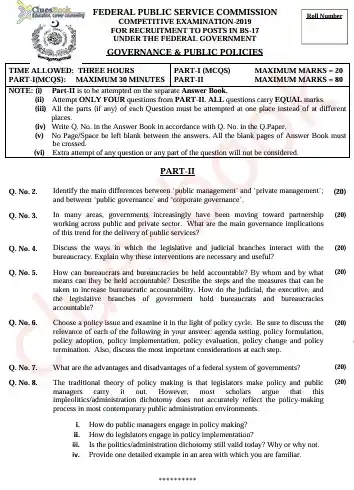
Paper Layout: 2019
The paper followed the FPSC structure:
- Marks: 100
- Time: 3 hours
- Part I (MCQs): 20 marks
- Part II (Descriptive): 6 long questions, attempt 4 (80 marks)
The descriptive section leaned heavily toward policy evaluation and governance challenges in Pakistan.
About the CSS
The CSS (Central Superior Services) Competitive Examination is a rigorous federal-level test administered by the Federal Public Service Commission (FPSC) to select candidates for prestigious civil service roles across Pakistan. The exam’s rules and regulations, covering age limits, eligibility, subjects, and quotas, are detailed in the official CSS Rules section on the FPSC’s website.
The CSS Exam Rules, issued by FPSC Pakistan, outline eligibility criteria, age limits (21–30 years), and a maximum of three attempts for candidates. The exam includes written tests, a medical exam, a psychological assessment, and an interview. Rules also define quotas, disqualification grounds, and subject selection for a fair recruitment process.
Core Themes of 2019 Paper
The 2019 exam tested the following major areas:
- Governance models and their relevance in Pakistan
- Causes of policy failures in developing countries
- Civil service reforms and bureaucratic inefficiency
- Good governance and its link with democratic accountability
- The role of institutions in policy execution
- Global governance frameworks and Pakistan’s position
Examiner’s Emphasis
The examiner expected answers to:
- Evaluate governance systems with critical arguments
- Use case studies from Pakistan (e.g., health, education, local governance)
- Apply theories such as New Public Management and Good Governance
- Provide policy-based solutions instead of only describing problems
Mistakes Candidates Commonly Made
Many students struggled because of:
- Writing descriptive, generic answers without analysis
- Lack of updated examples from 2017–2019 governance reforms
- Weak structure in essays (no headings, flow, or data)
- Ignoring comparative governance perspectives
Comparison: 2018 vs 2019 Papers
| Aspect | CSS 2018 Focus | CSS 2019 Focus |
| Dominant Theme | Theoretical foundations of governance | Applied analysis of Pakistan’s governance |
| Examiner’s Priority | Conceptual clarity | Critical reasoning & evaluation |
| Practical Examples Needed | Low (concept-heavy) | High (Pakistan case studies expected) |
| Candidate Mistakes | Ignoring theory depth | Overly generic answers, weak examples |
Preparation Insights for Future Candidates
- Combine theoretical study with applied governance examples from Pakistan.
- Use data from Transparency International, UNDP, and World Bank Governance Indicators.
- Strengthen knowledge of civil service reforms, accountability institutions, and decentralization efforts.
- Practice writing policy-oriented, analytical essays.
Recommended Sources
- Governance & Public Policies by Dr. Sultan Khan
- Public Policy: An Introduction by Cochran & Malone
- World Bank Governance Reports
- Pakistan Institute of Development Economics (PIDE) research
- Newspapers (Dawn, Express Tribune) for updated governance debates
Download CSS Governance And Public Policy Paper 2019
You can download the original CSS Governance & Public Policies 2019 Paper (PDF) from the link below. It is unsolved and formatted for practice. The CSS 2019 paper marked a transition year where the examiner shifted focus from theory-heavy questions to analytical, Pakistan-centric ones. Success depended on candidates’ ability to connect theory with real governance reforms and failures.
Those who structured answers well and included case studies had a significant edge.