
CSS Physics Past Papers
Download the CSS Past Paper of Physics 2014 in PDF and see how a numerical problem from quantum mechanics was asked in the exam. Download now to start focused practice.
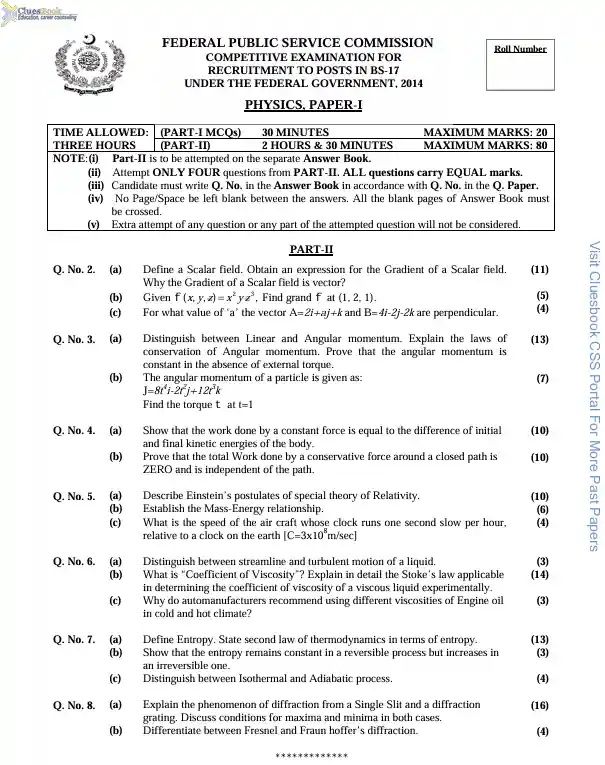
Preparing for the CSS exam can feel overwhelming, especially with a technical subject like Physics. A smart way to ease the pressure is to study actual past papers. This post focuses on the CSS Past Paper of Physics 2014, with a direct PDF download, a detailed overview of the paper’s structure, and tips on how to use it for effective preparation.
What Makes the 2014 Physics Paper Worth Studying?
The 2014 paper stands out because of its:
- Well-balanced mix of theory and numericals
- Broad coverage across classical and modern physics
- Focus on conceptual clarity rather than rote memorization
If you’re struggling to narrow down what to study, this paper helps pinpoint the core areas favored by examiners.
Paper Format Breakdown
The CSS Physics 2014 exam was divided into two parts: Objective (MCQs) and Subjective (Descriptive questions). Below is what you can expect from each section.
Objective Section (20 Marks)
This part contained 20 multiple choice questions, testing core concepts from a range of physics branches.
Topics included:
- Electrodynamics
- Nuclear Physics
- Thermodynamics
- Optics
- Solid State Physics
Example MCQ:
Which law explains the pressure difference across a curved surface of a liquid?
A) Pascal’s Law
B) Bernoulli’s Principle
C) Young-Laplace Equation
D) Boyle’s Law
Correct Answer: C) Young-Laplace Equation
Subjective Section (80 Marks)
Divided into Section I and Section II, this part allowed candidates to choose at least two questions from each section.
Commonly asked themes:
- Laws of Motion and Gravitation
- Maxwell’s Equations
- Quantum Theory
- Semiconductor Physics
- Relativity and Particle Physics
Sample Long Question:
Derive Schrödinger’s Time-Independent Equation and apply it to a one-dimensional infinite potential well. This question demands both theoretical understanding and the ability to solve relevant numerical problems.
How CSS Physics Past Papers Helps in Preparation
Studying this specific past paper allows you to:
- Understand how deep or conceptual the questions are
- Identify recurring numerical problem types
- Practice paper-solving under exam conditions
- Prioritize key topics likely to reappear in future exams
Download the CSS Past Paper of Physics 2014 (PDF)
To help you prepare effectively, you can download the official paper using the link. Make sure to print it out or save it offline for easier access during revision.
About the CSS
The CSS (Central Superior Services) Competitive Examination is a rigorous federal level test administered by the Federal Public Service Commission (FPSC) to select candidates for prestigious civil service roles across Pakistan. The exam’s rules and regulations, covering age limits, eligibility, subjects, and quotas, are detailed in the official CSS Rules section on the FPSC’s website.
The CSS Exam Rules, issued by FPSC Pakistan, outline eligibility criteria, age limits (21–30 years), and a maximum of three attempts for candidates. The exam includes written tests, a medical exam, a psychological assessment, and an interview. Rules also define quotas, disqualification grounds, and subject selection for a fair recruitment process.
Suggested Study Approach
Here’s how you can get the most from this paper:
- Solve MCQs first without consulting notes
- Try attempting full questions under a timer
- After solving, review your mistakes and note down the corrections
- Combine this with textbook reading to solidify weak areas
The CSS past paper of Physics 2014 is more than just a practice tool; it’s a window into how the exam is structured and what the FPSC expects from candidates. If you’re serious about scoring high in Physics, take this paper seriously, study it closely, and use it to shape your study plan. More past papers and preparation tips will be coming soon.
Please bookmark this page and share it with fellow aspirants.