
CSS Physics Past Papers
Download CSS physics past papers 2018 in PDF format and view actual questions from topics like thermodynamics and quantum mechanics to sharpen your preparation.
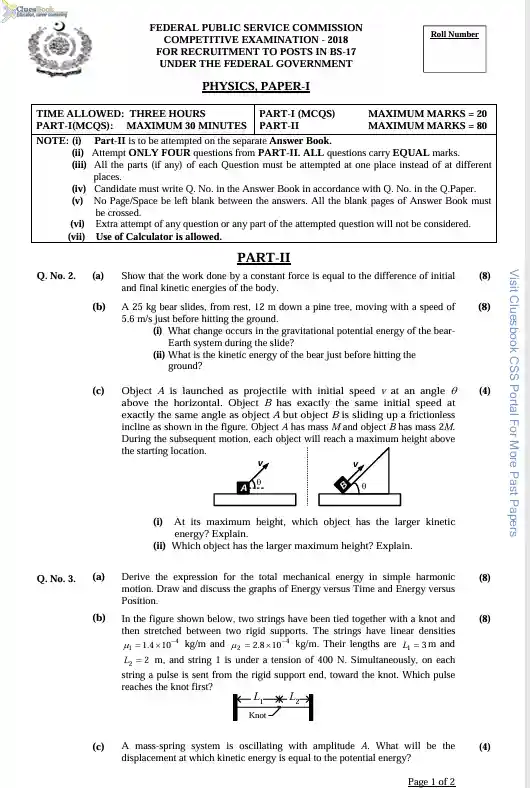
If you’re preparing for the CSS Physics exam, solving past papers is one of the smartest moves you can make. In this post, you’ll get access to the CSS Physics Past Papers 2018 PDF, along with a full breakdown of topics, paper trends, and tips to study effectively.
Let’s walk through what’s included and how to get the most benefit from these papers.
Download CSS Physics Past Papers 2018 PDF
Here’s your free access to the official FPSC Physics papers from 2018:
This file includes:
- Paper I: Classical mechanics, thermodynamics, oscillations, and relativity
- Paper II: Electromagnetism, quantum mechanics, nuclear physics, and electronics
Why Use CSS Physics Past Papers?
Studying from the 2018 Physics past papers offers a number of benefits:
- Understand the paper format – See how Section A covers MCQs and short answers while Section B includes theory and numericals.
- Spot repeating concepts – Topics like Maxwell’s equations, thermodynamics, and wave motion are frequently asked.
- Practice real exam questions – Use the same time limits and question styles as the FPSC exam.
- Identify weak areas – After attempting the paper, evaluate which chapters you need to revise more deeply.
What’s Inside the Papers?
Paper I Breakdown
Section A (MCQs & short questions):
- Mechanics (rotational, linear)
- Thermodynamics laws and applications
- Relativity basics
Section B (Descriptive):
- Numerical problems on oscillations and gravitation
- Derivations involving thermodynamic systems
- Conceptual explanations with diagrams
Paper II Breakdown
Section A:
- MCQs from quantum, electronics, and particle physics
Section B:
- Quantum models and wave equations
- Electromagnetic theory and Maxwell’s laws
- Radioactivity and nuclear decay models
Key Topics Repeated in CSS Physics Papers
From 2016–2018, some topics repeatedly appear in Paper I & II:
- Thermodynamics – Entropy, Carnot cycle, heat engines
- Quantum Mechanics – Schrödinger equation, atomic structure
- Electromagnetism – Gauss’s Law, Ampere’s Law
- Nuclear Physics – Half-life, mass defect, nuclear reactions
Use this trend to structure your study plan effectively.
About the CSS
The CSS (Central Superior Services) Competitive Examination is a rigorous federal level test administered by the Federal Public Service Commission (FPSC) to select candidates for prestigious civil service roles across Pakistan. The exam’s rules and regulations, covering age limits, eligibility, subjects, and quotas, are detailed in the official CSS Rules section on the FPSC’s website.
The CSS Exam Rules, issued by FPSC Pakistan, outline eligibility criteria, age limits (21–30 years), and a maximum of three attempts for candidates. The exam includes written tests, a medical exam, a psychological assessment, and an interview. Rules also define quotas, disqualification grounds, and subject selection for a fair recruitment process.
How to Study Using Past Papers
- Set a timer and solve one paper without help.
- Mark each question as Easy / Moderate / Difficult.
- Revise concepts behind difficult ones using textbooks.
- Retake the same paper a week later to track progress.
- Record your score improvement and time reduction.
This approach not only builds confidence but also develops speed and clarity.
Common Mistakes to Avoid
- Ignoring numericals – Physics is heavily application-based.
- Studying randomly – Always use past paper trends to set priorities.
- Rushing revision – Focus on quality, not quantity.
Benefits of Downloading the PDF Version
- Offline access – Use it anytime, anywhere.
- Original formatting – Familiarize yourself with the actual exam layout.
- Focused study – No distractions or page loading issues.
Using the CSS Physics Past Papers 2018 is one of the best ways to prepare smartly and systematically. By analyzing real questions and practicing regularly, you can improve both accuracy and time management.
Whether you’re preparing for your first attempt or aiming to improve your previous score, this resource will give you a solid edge.