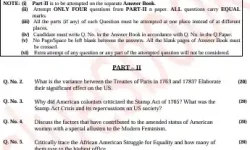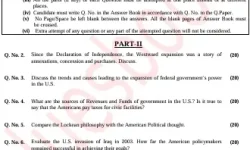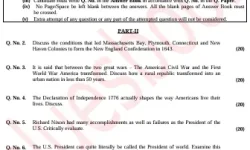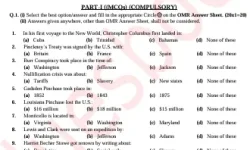

Download public administration past papers CSS 2014 PDF and explore the 2014 Paper with a detailed breakdown of question patterns, paper format, examiner’s approach, and preparation strategies. Includes tables for better understanding and useful insights for CSS aspirants.
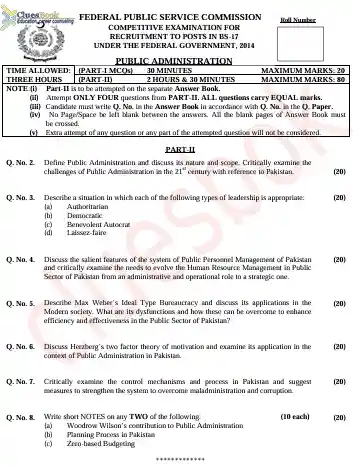
The CSS Public Administration 2014 paper tested candidates on governance, administrative structures, and managerial concepts. It demanded a balance of theoretical knowledge and practical application. Aspirants with clarity on administrative theories, organizational dynamics, and Pakistan’s bureaucratic challenges had a clear edge.
CSS Public Administration 2014 Paper Format
| Section | Details |
| Total Marks | 100 |
| Time Allowed | 3 Hours |
| Number of Questions | 8 (Attempt 4, including Q1 or Q2 compulsory) |
| Question Type | Analytical, descriptive, application-based |
Major Themes Covered in 2014
The paper touched on multiple areas of governance and administration. Some of the key themes were:
- Administrative theories and their practical implications.
- Public policy processes in Pakistan.
- Human resource management and organizational behavior.
- Governance reforms and accountability mechanisms.
- Relationship between public administration and development.
Question Paper Overview
| Question No. | Key Focus Area |
| Q1 | Compulsory MCQs from entire syllabus |
| Q2 | Organizational theories and their relevance |
| Q3 | Administrative reforms in Pakistan |
| Q4 | Leadership and decision-making in administration |
| Q5 | Public policy and its implementation challenges |
| Q6 | Bureaucracy and governance structures |
| Q7 | HRM practices in public institutions |
| Q8 | Role of Public Administration in Development |
About the CSS
The CSS (Central Superior Services) Competitive Examination is a rigorous federal-level test administered by the Federal Public Service Commission (FPSC) to select candidates for prestigious civil service roles across Pakistan. The exam’s rules and regulations, covering age limits, eligibility, subjects, and quotas, are detailed in the official CSS Rules section on the FPSC’s website.
The CSS Exam Rules, issued by FPSC Pakistan, outline eligibility criteria, age limits (21–30 years), and a maximum of three attempts for candidates. The exam includes written tests, a medical exam, a psychological assessment, and an interview. Rules also define quotas, disqualification grounds, and subject selection for a fair recruitment process.
Recommended Material for CSS Aspirants
- Books like “Introduction to Public Administration” by Rosenbloom.
- Sultan Khan’s “Public Administration with Special Reference to Pakistan”.
- Reports from the Planning Commission of Pakistan and the National Commission for Government Reforms.
- Past papers practice for trend analysis.
Examiner’s Approach in 2014
The examiner emphasized analytical depth instead of rote learning. Candidates were expected to:
- Link theoretical models with the Pakistani administrative setup.
- Provide comparative insights from international practices.
- Demonstrate problem-solving abilities in governance issues.
Preparation Insights for Aspirants
To tackle a paper like 2014, students should:
- Study administrative thinkers (Taylor, Weber, Fayol, Gulick, etc.) with practical applications.
- Relate HRM and leadership models to the Pakistani public sector.
- Revise public policy frameworks with examples of implementation gaps.
- Keep track of recent governance reforms in Pakistan.
Download Public Administration Past Papers CSS 2014 PDF
The original CSS 2014 Public Administration paper (PDF) is available in the link below. Click now to download the paper. It is unsolved and presented in a practice-ready format for exam preparation. The 2014 paper emphasized administrative application, making it crucial for aspirants to combine conceptual clarity with current affairs knowledge. The CSS Public Administration 2014 paper was a balanced mix of theory and practice. It rewarded students who had a strong command of concepts, practical governance issues, and reform debates in Pakistan.
By practicing past papers and linking theory to contemporary realities, aspirants can excel in this subject.