
Apply for the University of Exeter Green Futures Scholarship 2026. Fully funded UK Master’s, £17k+ estimated stipend, and tuition coverage for international students.
Overview of the Green Futures Scholarship
The Green Futures Postgraduate Taught Scholarship remains one of the UK’s most competitive financial awards for environmental leadership. Hosted by the University of Exeter, this 2026 initiative is designed to empower high-achieving students from the Global South.
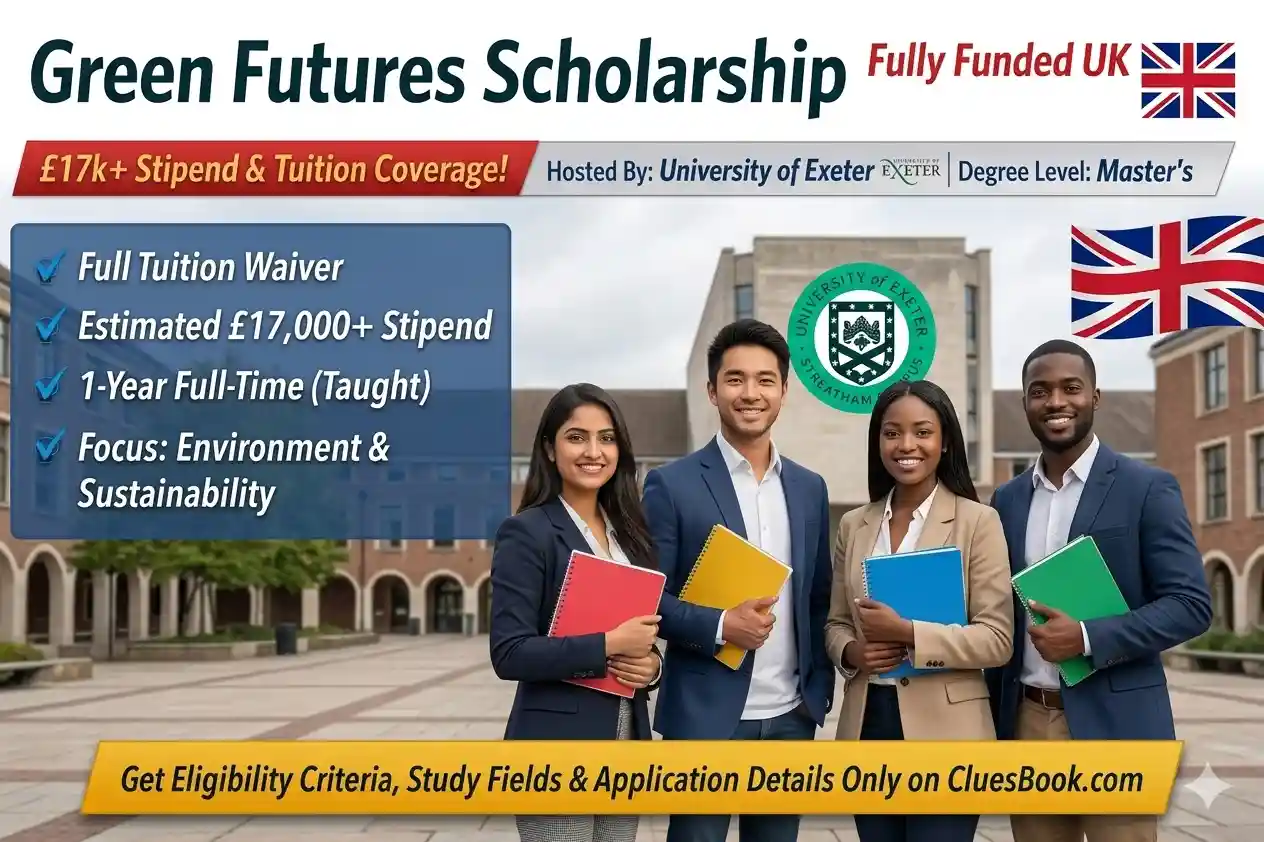
By eliminating financial barriers, the program enables scholars to gain advanced expertise in climate science, policy, and renewable technology to drive sustainable change in their home nations.
Green Futures Scholarship Program Details
- Host Organization: University of Exeter
- Study Destination: United Kingdom (Exeter or Cornwall Campuses)
- Degree Level: Postgraduate Taught (Master’s)
- Scholarship Type: Fully Funded (Tuition + Living Costs)
- Number of Scholarships: Limited merit-based awards
- Maximum Funding: Full Tuition Fees + Estimated £17,000+ Stipend
- Duration: 1 Year (Full-Time)
- Application Deadline: 30 April 2026 (Expected)
- Program Start: September 2026
Eligibility Criteria for Green Futures Scholarship
- To be eligible for the 2026 intake, applicants must be citizens or permanent residents of Low Income or Lower Middle Income countries as categorized by the World Bank.
- Candidates must demonstrate Academic Excellence, typically holding a degree equivalent to a UK First Class Honours.
- You must be classified as an overseas student for fee purposes and hold an active offer (conditional or unconditional) for an eligible Master’s program at Exeter for the 2026/27 academic year.
- A commitment to returning to your home country to implement sustainable solutions is highly valued.
Must Apply For: National Taiwan University Scholarship / NTU SEARCA Scholarship
Available Study Fields & Research Areas
Available Study Fields
- MSc Global Sustainability Solutions
- MSc Renewable Energy Engineering
- MSc Sustainable Development
- MSc Applied Data Science (Environment and Sustainability)
- MSc Marine and Coastal Sustainability
- MSc Conservation and Biodiversity
- MSc Evolutionary and Behavioural Ecology
- MSc Marine Vertebrate Ecology and Conservation
Application Requirements for Green Futures Scholarship
Required Documents
- CV (Highlighting sustainability projects or research)
- Academic Transcripts (Undergraduate degree certificates)
- Personal Statement (500-word impact statement)
- Two Letters of Recommendation (Academic or professional)
- English Language Proficiency (IELTS, TOEFL, or PTE)
- University Offer Letter (Mandatory for scholarship consideration)
Language Requirements
Applicants must meet the English language entry requirements set by the University of Exeter for 2026. Most programs require an IELTS score of 6.5 overall with no less than 6.0 in any section.
IELTS Requirements
While a formal English test is standard, many students explore how to study abroad without IELTS. In 2026, students from countries where English is the official language of instruction (such as Nigeria, Kenya, or India) may sometimes waive this requirement by providing a Medium of Instruction (MOI) certificate, though Exeter often requires a formal test for high-value scholarship applicants to ensure visa compliance.
Is Supervisor Required?
NO. This scholarship is for Postgraduate Taught programs. You do not need to find a research supervisor. Your focus should be on meeting the admission criteria for the Master’s degree itself.
Benefits of University of Exeter Green Futures Scholarship
Financial Benefits
- Full Tuition Fees: Complete waiver of international tuition costs.
- Stipend: Monthly living allowance (aligned with UKRI rates, approx. £17,000-£18,000 for 2026).
- Global Health Surcharge: Assistance with basic arrival needs.
Additional Benefits
- Mentorship: Direct interaction with the Global Systems Institute.
- Networking: Participation in the Exeter Sustainability Network.
- Lab Access: High-tech facilities at the Streatham and Penryn campuses.
- Cultural Exposure: Full immersion in the British higher education system.
Must Apply Opportunity: Georgia Tech Presidential Fellowship
Program Duration, Timeline & Selection Process
Step-by-Step Application Process
- Program Search: Select an eligible 2026 Master’s course at Exeter.
- Submit Admission Application: Apply by March 2026 to ensure timely offer processing.
- Receive Your ID: Obtain your Exeter student ID number.
- Complete Scholarship Form: Use the online funding portal to submit your 500-word statement.
- Selection Review: The committee evaluates academic transcripts and “Global Impact” potential.
- Award Notification: Shortlisted candidates are usually notified by June 2026.
Application Deadline & Important Dates
- University Admission Deadline: Recommended by 31 March 2026.
- Scholarship Application Deadline: 30 April 2026.
- Results Released: Mid-June 2026.
- Term Starts: September 2026.
Also Check: HCL Software Summer Internship
Participating Universities / Host Institutions
The scholarship is offered exclusively by the University of Exeter, a member of the prestigious Russell Group in the UK.
Why Apply for University of Exeter Green Futures Scholarship?
- Prestige: Exeter is ranked among the top universities globally for Climate Action.
- Financial Freedom: The “Fully Funded” status covers both fees and living, rare for UK Master’s.
- Career Pivot: Ideal for professionals looking to transition into the “Green Economy.”
Common Mistakes to Avoid When Applying
- Late Course Application: Applying for the scholarship before having a university offer.
- Plagiarized Statements: Using AI-generated or copied personal statements.
- Missing Eligibility: Applying from a country not on the World Bank Low/Lower-Middle income list.
- Incomplete Documents: Uploading unofficial or blurry transcripts.
Apply Now to Secure Your Future in the United Kingdom
Securing the Green Futures Scholarship for the 2026 academic year is a defining moment for any aspiring environmental leader. By studying at the University of Exeter, you gain access to pioneering research and a global community of experts dedicated to planet-positive solutions. This fully funded path ensures that your focus remains on your education and professional development rather than financial constraints. Position yourself at the forefront of the global green transition and prepare to lead the sustainable initiatives of tomorrow. Start your admission application today to be ready for the April scholarship deadline.