
The Jane Street internship interview process is designed to test a candidate’s analytical thinking, probability knowledge, mental math speed, and problem-solving ability. The process is rigorous but structured, usually consisting of multiple stages before a final offer is made.
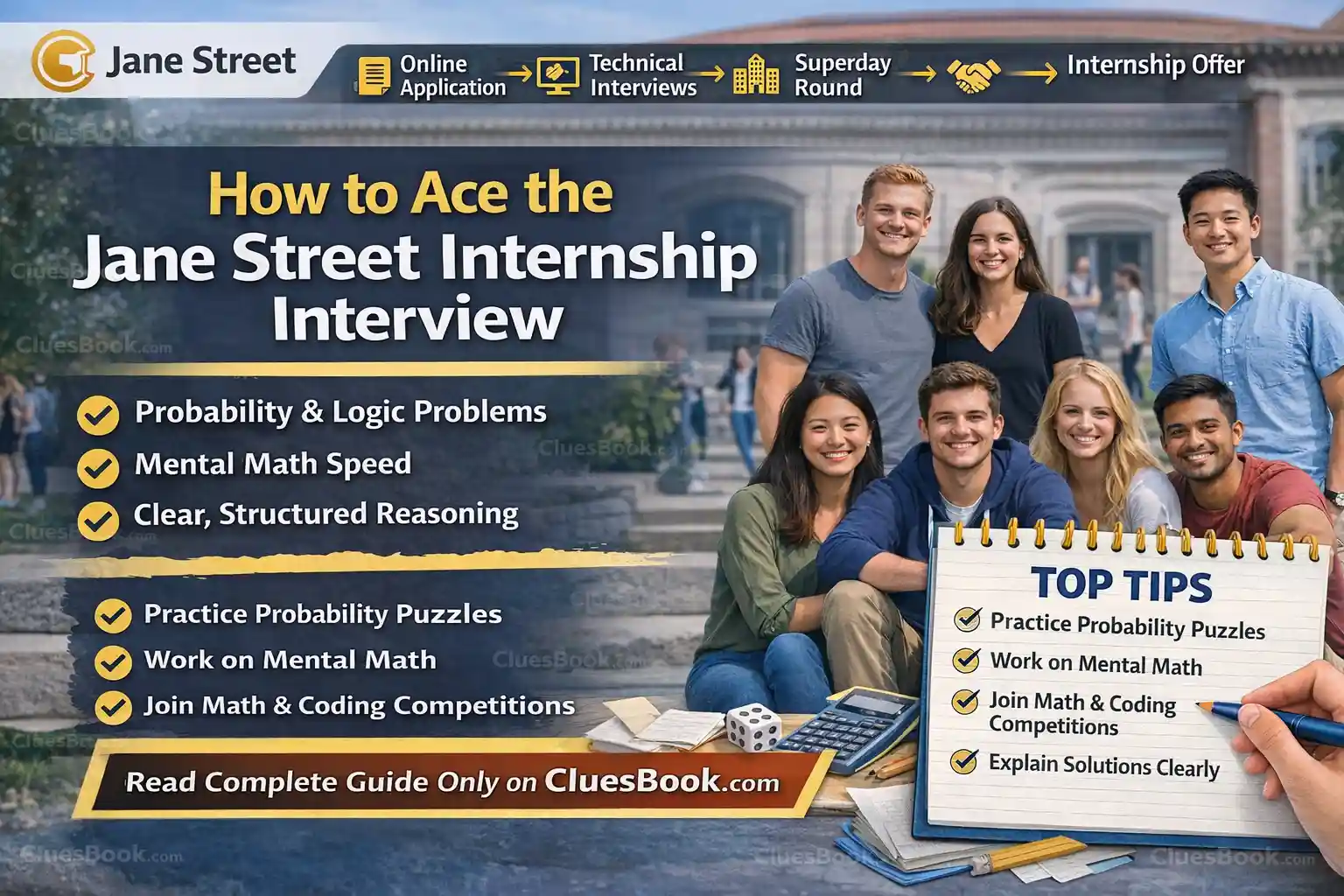
Below is the typical interview process for the Jane Street Quantitative Trading Internship or Software Engineering Internship.
Online Application Submission
The process begins with submitting an application through the official Jane Street careers portal.
Applicants typically submit:
- Resume or CV
- Academic background
- Programming or project experience (if applicable)
Recruiters screen applications to identify candidates with strong quantitative and analytical skills.
Initial Screening Assessment
Some applicants are invited to complete an online assessment or short technical screening.
This stage may include:
- Mental math questions
- Probability puzzles
- Logical reasoning problems
- Basic programming questions (for tech roles)
The goal is to evaluate quick thinking and analytical ability.
First Technical Interview
Candidates who pass the screening are invited to a virtual technical interview.
This interview usually focuses on:
- Probability problems
- Logic puzzles
- Brain teasers
- Mental math calculations
Interviewers are more interested in how you think through the problem rather than just the final answer.
Second Interview Round
In the next round, the questions typically become more challenging and interactive.
Topics may include:
- Game theory scenarios
- Trading strategy discussions
- Market decision-making simulations
- Advanced probability and statistics problems
Candidates are encouraged to think out loud and explain their reasoning clearly.
Final Round (Superday)
The final stage is often called Superday, where candidates participate in multiple interviews in one session.
This stage may include:
- Several back-to-back interviews with traders or researchers
- Complex probability puzzles
- Trading simulations or market games
- Behavioral questions about teamwork and communication
The company evaluates both technical ability and collaboration skills.
Internship Offer
After the final interviews, successful candidates receive an internship offer.
Selected interns join one of Jane Street’s global offices such as:
- New York
- London
- Amsterdam
- Hong Kong
Offers are usually sent within a few days to a couple of weeks after the final interview.
Common Jane Street Interview Topics
Candidates should prepare for questions related to:
- Probability theory
- Combinatorics
- Expected value problems
- Mental math and estimation
- Game theory
- Logical reasoning puzzles
- Market decision-making scenarios
Strong preparation in mathematics and logical problem solving is essential to succeed.
Jane Street Internship Interview Process Tips and Tricks
To improve your chances of success:
- Practice probability puzzles and brain teasers
- Improve mental math speed
- Study expected value and statistics problems
- Participate in coding or math competitions
- Practice explaining your thinking process clearly
Jane Street Probability Interview Questions
Probability questions are a core part of the Jane Street internship interview, especially for the Quantitative Trading Internship. These questions test your analytical thinking, logical reasoning, and ability to calculate expected outcomes quickly.
Common Types of Probability Questions
Basic Probability
Questions on dice, cards, coins, or simple random events.
Example: “What is the probability of rolling a sum of 7 with two dice?”
Conditional Probability
You may need to calculate probabilities given a certain condition.
Example: “If a card drawn is red, what’s the probability it’s a heart?”
Expected Value
Calculating the expected outcome of an event or a sequence of events.
Example: “A game pays $10 with 30% chance and $0 otherwise. What is the expected payout?”
Combinatorics
Counting combinations or arrangements to calculate probabilities.
Example: “In how many ways can you arrange 3 red balls and 2 blue balls in a row?”
Bayesian Probability
Reasoning about updated probabilities after new information.
Example: “A test for a rare disease is 99% accurate. If someone tests positive, what’s the probability they actually have the disease?”
Probability Puzzles
Often presented as logic problems with a probability twist.
Example: “There are 3 boxes: one has two black balls, one has two white balls, and one has one of each. You pick a box at random and draw a black ball. What is the probability the box contains two black balls?”
Examples of Probability Questions
- You roll two six-sided dice. What is the probability that the sum of the dice is 8?
- A standard deck has 52 cards. If you draw one card at random, what is the probability that it is either a heart or a face card?
- You randomly pick a box and then randomly draw a ball. If the ball is black, what is the probability that the box contains two black balls?
- You play a game where you roll a die: if it lands on 6, you win $12; otherwise, you lose $2. What is the expected value of one game?
- You flip a fair coin three times. What is the probability that you get exactly two heads?
Jane Street interviewers value clear reasoning and structured thinking more than memorized answers. The interview process is extremely selective, but students who prepare well in probability, logic, and quantitative reasoning have a much higher chance of success. Start preparing early if you plan to apply for this prestigious internship.