
Learn how to earn a college grant for volunteer work, find scholarships for volunteer work, document service hours, and turn community impact into college aid.
How to Earn a College Grant for My Volunteer Work
Volunteering can do much more than strengthen your college application or help your community. If you have spent months or even years tutoring children, helping at a food bank, supporting nonprofit organizations, organizing community events, assisting elderly people, protecting the environment, or responding to local needs, that service may also help you qualify for college scholarships, service-based awards, education grants, and other financial aid opportunities.
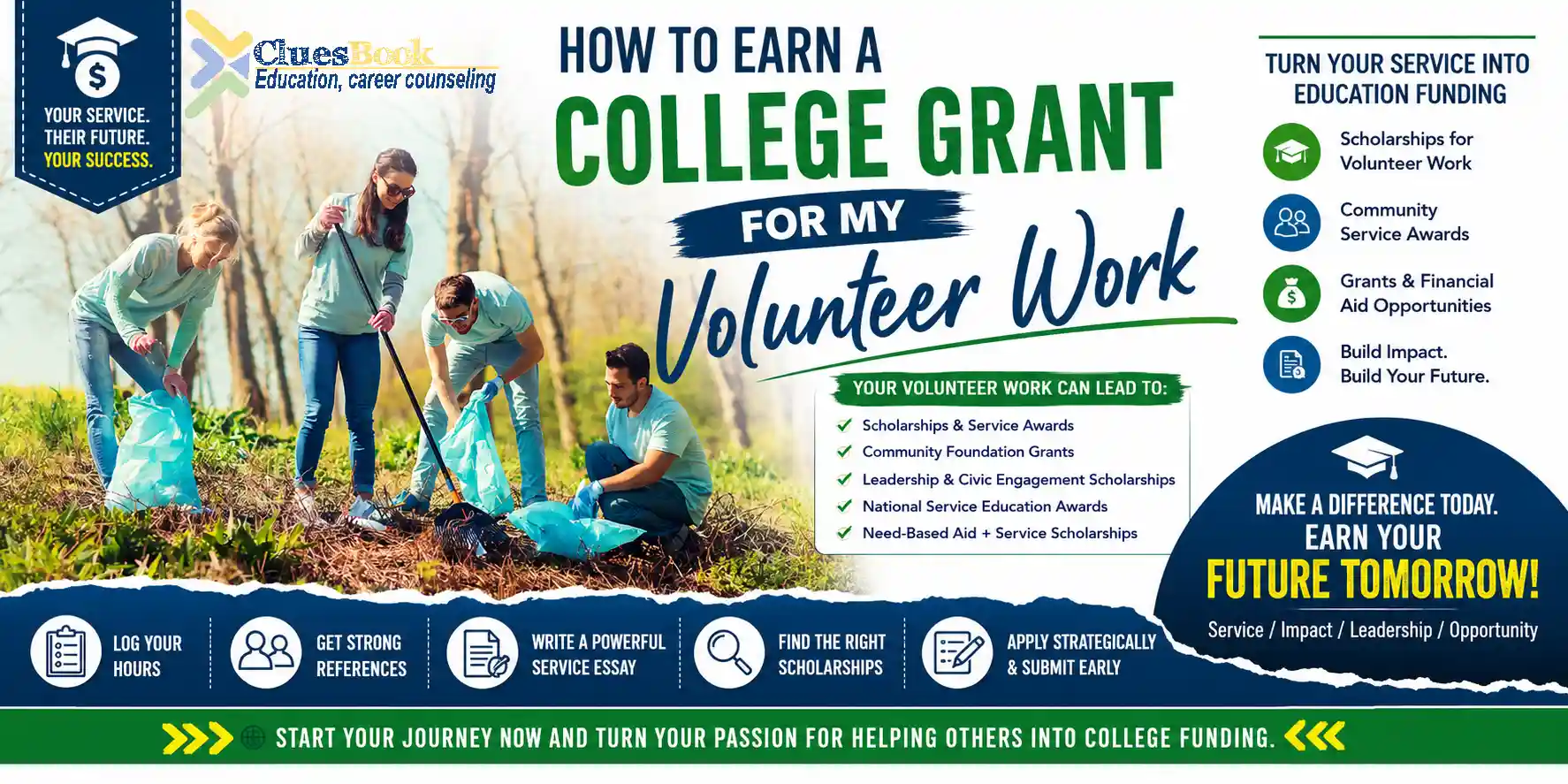
But there is an important distinction: there is no universal federal “college grant for volunteer work.” Grants are generally awarded according to financial need, while scholarships may be based on academic achievement, service, leadership, community involvement, or other criteria. Private organizations, colleges, foundations, states, and service programs can nevertheless use volunteer experience as an eligibility or selection factor. Federal Student Aid explains that grants may come from the federal government, states, colleges, or private and nonprofit organizations, while scholarships can be offered by schools, foundations, companies, nonprofits, community organizations, and other groups.
- That means the better question is not simply, “Can I get a grant for volunteering?”
- The better question is: “How can I turn my volunteer experience into college funding?”
The answer involves finding the right scholarships for volunteer work, documenting your service hours, obtaining strong references, writing an effective service essay, searching local foundations and community organizations, completing the FAFSA when applicable, and applying strategically to awards where your service record gives you an advantage.
This guide explains exactly how to do that.
Can You Really Get a College Grant or Scholarship for Volunteer Work?
Yes, but the type of financial aid matters.
A grant is generally financial aid that does not have to be repaid and is often awarded based on financial need. A scholarship is also generally money for education that does not need to be repaid, but scholarships can be based on merit, service, leadership, identity, academic interests, financial need, or other criteria. Volunteer experience is particularly valuable for service-based scholarships.
Some awards specifically ask applicants to demonstrate:
- Community service
- Volunteer hours
- Leadership
- Civic engagement
- Commitment to a social cause
- Nonprofit involvement
- Community impact
- Service-oriented career goals
- Personal responsibility
- Advocacy or activism
- Leadership through volunteering
Other scholarships do not require volunteer work but consider it as part of the overall application. This creates several possible funding routes.
The main ways volunteer work can help pay for college
You can potentially use your service experience to pursue:
- Volunteer scholarships
- Community service scholarships
- Scholarships based on volunteer work
- Local scholarships
- Community foundation scholarships
- College-specific service awards
- State scholarship programs
- Service-based fellowships
- National service education awards
- Need-based grants combined with service scholarships
The most important strategy is to avoid limiting yourself to awards that use the word “volunteer” in their title. A scholarship might be called a leadership scholarship, community impact scholarship, civic engagement award, service scholarship, or humanitarian scholarship while still valuing volunteer experience heavily.
What Is the Difference: Grant vs. Scholarship?
Before looking, understand the terminology.
What is a college grant?
A college grant is financial aid designed to help cover education costs. Federal Student Aid states that grants may come from federal or state governments, colleges, and private or nonprofit organizations, and grants generally do not have to be repaid.
Many traditional grants are primarily connected to financial need rather than volunteer hours.
For example, completing the FAFSA can help determine eligibility for federal, state, and institutional financial aid. The FAFSA is also used by some states and colleges when determining eligibility for their own programs.
What is a scholarship?
A scholarship is financial assistance that generally does not have to be repaid.
Scholarships may be:
- Merit-based
- Need-based
- Service-based
- Leadership-based
- Athletic
- Academic
- Career-specific
- Community-based
- Organization-specific
- College-specific
This is why the phrase “college grant for volunteer work” can sometimes be misleading.
If your volunteer experience is your strongest qualification, you will often have better results looking for scholarships for volunteer work and community service scholarships rather than searching only for grants.
What Types of Volunteer Work Can Qualify?
There is no single definition of valuable volunteer work. Different scholarship providers have different rules.
Examples of potentially relevant service include:
- Tutoring disadvantaged students
- Teaching literacy
- Volunteering at schools
- Food bank service
- Homelessness assistance
- Environmental cleanup
- Animal rescue
- Elderly care programs
- Hospital volunteering
- Disability support
- Disaster relief
- Youth mentoring
- Community fundraising
- Nonprofit administration
- Public health outreach
- Refugee assistance
- Poverty reduction programs
- Conservation projects
- Community gardens
- Religious community service
- Humanitarian projects
- Public awareness campaigns
- Fundraising for charitable causes
- Domestic violence support organizations
- Community development projects
However, do not assume that every activity automatically qualifies.
Some programs distinguish between:
- Paid employment
- Volunteer service
- Internships
- School activities
- Required academic service
- Independent community projects
Always read the official eligibility requirements before counting your hours.
How Much Volunteer Work Do You Need for a Scholarship?
There is no universal number.
One scholarship might have no minimum number of hours and simply ask you to describe your community involvement.
Another may require 20, 50, 100, or more documented hours.
Some state programs have very specific service requirements. For example, Florida’s Bright Futures program includes volunteer service or paid-work requirements that vary according to the award. Current program documentation shows different hour requirements for awards and emphasizes that service or paid work must be properly documented.
This is why you should never assume that “more hours always wins.”
Impact matters.
A student who volunteered 150 hours performing meaningful responsibilities and demonstrating measurable results may have a stronger application than someone who simply accumulated 300 hours without being able to explain what they accomplished.
How to Build a Strong Volunteer Record Before Applying
If you are still in high school or college and want to maximize future scholarship opportunities, start documenting your service now.
Create a simple volunteer portfolio.
Record:
- Organization name
- Organization contact information
- Your role
- Start date
- End date
- Hours served
- Responsibilities
- Projects completed
- Number of people helped
- Skills developed
- Leadership responsibilities
- Awards or recognition
- Supervisor’s name
- Supervisor’s contact information
Do not wait until the scholarship deadline.
After several years, it can be surprisingly difficult to remember exactly how many hours you completed or what you accomplished during a particular project.
Why a Volunteer Hours Log Is So Important
A volunteer hours log can become one of the most useful documents in your scholarship application. It gives you evidence.
Instead of writing:
“I volunteered extensively in my community.”
you can explain:
“Over two years, I completed more than 180 hours with a local food assistance organization, eventually coordinating weekly distribution activities and helping organize volunteer schedules.”
The second statement is much more persuasive because it demonstrates duration, responsibility, leadership, and measurable commitment.
For programs with formal service-hour requirements, documentation can also be essential.
Bright Futures, for example, requires documentation of volunteer service or paid work, and its handbook describes written documentation that must be signed by the relevant parties.
What Should Your Volunteer Hours Log Include?
A useful volunteer service log can contain these columns:
| Date | Organization | Activity | Hours | Supervisor | Signature/Verification |
|---|---|---|---|---|---|
| January 10 | Local Food Bank | Food distribution | 4 | Supervisor Name | Verified |
| January 17 | Local Food Bank | Packing supplies | 3 | Supervisor Name | Verified |
| February 2 | Community School | Tutoring | 2 | Teacher Name | Verified |
Keep both:
- A digital copy
- A backup copy
If an organization can provide an official letter confirming your service, save that too.
Can I Use References From Volunteer Work for a Scholarship Application?
Yes, when the scholarship allows or requests references, a volunteer supervisor can be an excellent recommender. In fact, a supervisor may sometimes provide more relevant evidence of your character than someone who only knows you academically.
A strong volunteer reference can discuss:
- Reliability
- Leadership
- Initiative
- Communication
- Teamwork
- Compassion
- Problem-solving
- Commitment
- Community impact
- Ability to work with different groups
The strongest reference is not necessarily from the person with the most impressive title.
It is from someone who actually observed your work.
Who should you ask?
Potential references include:
- Nonprofit directors
- Volunteer coordinators
- Teachers
- Community leaders
- Program managers
- Project supervisors
- School counselors
- Religious/community organization leaders
- Professors who supervised your service project
Ask early.
Give your recommender:
- Your resume
- Scholarship description
- Volunteer hours
- Personal statement draft
- Application deadline
- Specific achievements you hope they can discuss
What Proof of Volunteer Work Should You Submit?
If a scholarship requires proof, possible documentation may include:
- Official volunteer service letter
- Signed service-hours log
- Organization verification letter
- Supervisor statement
- Certificate of completion
- Program records
- Emails confirming participation
- Award certificates
- Project reports
- Community organization records
But do not submit unnecessary documents.
Always follow the scholarship’s instructions.
If the application says to provide one reference and a 500-word essay, sending ten additional documents does not necessarily improve your chances.
Must You Include Proof of Volunteer Work With a Scholarship Submission?
Not always.
Some scholarships operate on an honor system and ask applicants to describe their service.
- Others specifically require documentation.
- Still others may verify information later.
- The safest approach is to maintain proof even when it is not initially requested.
- If you are selected as a finalist, the organization may ask for verification.
- Your documentation should therefore be accurate and consistent.
- Never exaggerate volunteer hours.
- Scholarship providers may contact your organization to verify your participation.
How to Find Scholarships for Volunteer Work
Finding the right scholarship is often more difficult than completing the application. Do not rely on one scholarship website. Federal Student Aid recommends searching across multiple sources, including colleges, local organizations, community foundations, employers, state agencies, and organizations connected to your interests.
Why Community Foundation Scholarships Matter
Community foundations can be an excellent source of funding for students with strong local involvement.
Many community foundations administer scholarships created by donors who want to support students from a particular:
- County
- City
- High school
- Region
- Family
- Career field
- Community
This makes them especially valuable if your volunteer work has been local.
Look for phrases such as:
- community foundation scholarships near me
- local community foundation scholarships
- community foundation scholarship application
- community foundation scholarship deadline
- local scholarships for college
- local scholarships for college students
- community scholarships
- community service scholarship
- scholarship foundations near me
Your high school counselor and college financial aid office may also know about local awards that are not widely advertised online.
Can Community College Students Get Scholarships for Volunteer Work?
Absolutely. Do not assume that volunteer scholarships are only for students attending four-year universities.
Community college students can look for:
- Community college scholarships
- Local scholarships
- Community foundation awards
- Transfer scholarships
- Service scholarships
- State grants
- College-specific scholarships
- Foundation-funded awards
- Workforce scholarships
Federal Student Aid also recommends checking with your college’s financial aid office and searching local organizations and community foundations.
What About Scholarships for International Volunteer Work?
Students who have volunteered internationally may also find opportunities. However, international volunteering should not automatically be treated as superior to local service.
Scholarship committees are generally interested in:
- What you did
- Why you did it
- Who benefited
- What you learned
- What changed because of your work
- How the experience influenced your goals
A local food pantry project can be just as compelling as international volunteering if you can demonstrate genuine impact.
Look for:
- scholarships for international volunteer work
- international service scholarships
- humanitarian scholarships
- global leadership scholarships
- international community service awards
- service learning scholarships
Always check whether the scholarship is available to international students, U.S. citizens, permanent residents, or students attending a U.S. institution.
How to Use the FAFSA Alongside Volunteer Scholarships
Volunteer scholarships should not replace your broader financial-aid strategy. Complete the FAFSA when you are eligible and when the programs you are targeting use it. The FAFSA can provide access to federal student aid and can also be used by states and colleges to determine eligibility for their own aid programs.
Think of your funding strategy as a portfolio:
FAFSA-based aid + college grants + state aid + volunteer scholarships + local scholarships + private awards + service education benefits, rather than relying on one source. This is particularly important because a service-based scholarship may cover only part of your education expenses.
How AmeriCorps Can Turn Service Into Education Funding
One of the most important programs to know about is AmeriCorps.
AmeriCorps provides structured national and community service opportunities, and eligible members who complete qualifying service can receive a Segal AmeriCorps Education Award. The award can be used toward eligible education expenses or qualified student loans. AmeriCorps also reports that participating colleges may provide additional incentives to alumni, including education-award matching or service scholarships.
This is different from simply volunteering for a local organization. You are participating in a structured national service program with defined eligibility and benefit rules. Therefore, if you are looking for a way to combine service with education funding, investigate whether an eligible AmeriCorps opportunity fits your plans.
How to Turn Volunteer Experience Into a Winning Scholarship Essay
This is where many applicants make a mistake. They describe what they did but not why it mattered.
A strong essay should answer four questions:
What problem did you see?
- Explain the community issue.
What did you do?
- Describe your actual responsibilities.
What changed?
- Show measurable or meaningful impact.
How did the experience change you?
Connect your service to your future.
For example, instead of writing:
“I volunteered at a food bank and helped families.”
you could explain the problem, your role, the people served, an obstacle you encountered, the solution you helped develop, and what the experience taught you about community responsibility.
That creates a story.
Use the STAR Method for Volunteer Scholarship Essays
A useful framework is:
Situation → Task → Action → Result
Situation
- What community problem existed?
Task
- What responsibility did you take?
Action
- What specifically did you do?
Result
What changed?
Then add a fifth element:
Reflection
What did you learn?
This final step is especially important for scholarship essays. The scholarship committee is not only evaluating the number of hours you completed. It is evaluating the person behind those hours.
How to Demonstrate Impact Instead of Just Hours
Consider the difference.
Weak:
“I completed 100 hours of community service.”
Stronger:
“I completed 100 hours supporting a literacy program and eventually began tutoring younger students independently.”
Even stronger:
“After noticing that several students struggled with reading comprehension, I created weekly practice sessions and coordinated additional volunteers to provide one-to-one tutoring.”
The strongest applications connect:
service → responsibility → initiative → impact → personal growth.
Five Ways to Make Your Volunteer Experience More Valuable
1. Stay involved over time
Long-term commitment can demonstrate genuine interest.
2. Take responsibility
Move from participant to organizer, mentor, coordinator, or project leader when appropriate.
3. Measure your impact
Track:
- People served
- Events organized
- Supplies collected
- Funds raised
- Students tutored
- Meals distributed
- Trees planted
- Hours contributed
- Volunteers coordinated
4. Develop a specific skill
Examples include:
- Leadership
- Public speaking
- Project management
- Fundraising
- Teaching
- Research
- Communication
- Event planning
- Social media
- Data management
5. Connect service with your future
If you want to become a physician, explain how health outreach influenced that goal. If you want to become an environmental scientist, discuss how conservation work shaped your interests. The connection should be genuine.
Four Volunteer Scholarships You Should Explore
You already have several CluesBook resources that fit naturally into this topic.
Act of Kindness Scholarship
The Act of Kindness Scholarship is relevant for students whose community involvement reflects generosity, compassion, and meaningful action. When evaluating an opportunity like this, focus on the official eligibility requirements, application instructions, award amount, deadline, and required documentation before applying.
Altruism + All Good Deeds Scholarship
The Altruism + All Good Deeds Scholarship is another relevant opportunity to explore if your application is centered around positive actions and community contribution. Use your volunteer experience to demonstrate the values behind your service rather than simply listing hours.
Building Bridges Scholarship
The Building Bridges Scholarship can be especially relevant for students whose volunteer work involves connecting communities, helping people overcome barriers, promoting inclusion, or bringing different groups together.
Aaliyah Lee Scholarship
The Aaliyah Lee Scholarship is another opportunity you can investigate as part of a broader merit and community-service scholarship search. Do not apply simply because an award appears on a list. Always compare your profile with the current eligibility requirements.
How to Create a Volunteer Scholarship Application Strategy
Applying to one scholarship at a time without a system can become overwhelming. Instead, create a spreadsheet.
Include:
| Scholarship | Eligibility | Volunteer Requirement | Award | Deadline | Documents | Status |
|---|---|---|---|---|---|---|
| Scholarship A | Eligible | 50 hours | $1,000 | Date | Essay + reference | Preparing |
| Scholarship B | Eligible | Service preferred | $2,500 | Date | Essay | Not started |
| Scholarship C | Eligible | 100 hours | $5,000 | Date | Transcript + log | Submitted |
Use categories such as:
- Green: Ready to apply
- Yellow: Need documents
- Red: Not eligible
- Blue: Submitted
This prevents missed deadlines.
How Many Volunteer Scholarships Should You Apply For?
There is no magic number.
However, applying to several well-matched opportunities is generally more sensible than spending all your time on one extremely competitive national award. Federal Student Aid recommends looking broadly and applying when you find scholarships for which you are eligible.
Your strategy should include:
- A few major national awards
- Several state opportunities
- Several local scholarships
- Community foundation scholarships
- College-specific awards
- Service-based scholarships
- Scholarships related to your major
- Scholarships related to your background or interests
The key is quality plus volume. Do not submit generic applications everywhere.
What Documents Should You Prepare Before Applying?
Create a scholarship folder containing:
Academic documents
- Transcript
- GPA information
- Test scores if required
- Enrollment verification
Volunteer documents
- Volunteer hours log
- Service verification letters
- Certificates
- Supervisor contact information
Personal documents
- Resume
- Personal statement
- Activities list
- Leadership history
Recommendation materials
- Reference list
- Recommendation letters
- Contact details for recommenders
Financial documents
Where applicable:
- FAFSA information
- Financial aid documents
- Family financial information
- Other required financial forms
Having these ready can dramatically reduce application time.
What If You Have Only a Small Amount of Volunteer Experience?
Do not assume you cannot compete. Some scholarships do not specify a minimum number of volunteer hours. And even when service is important, quality can matter more than quantity.
For example, a student who spent 40 hours developing a meaningful community project may have a compelling story.
If your service experience is limited, focus on:
- Leadership
- Initiative
- Personal responsibility
- Results
- Consistency
- Genuine motivation
You can also start building a stronger record before future scholarship deadlines.
What If Your Volunteer Work Was Required by School?
This depends on the scholarship.
- Some programs may count service performed through school.
- Others may exclude mandatory service or certain academic requirements.
- Do not automatically count required hours.
- Read the specific scholarship rules.
If the program permits them, explain what you did beyond the minimum requirement.
For example:
“Although the school initially required service participation, I continued volunteering after completing the requirement and eventually took responsibility for organizing new volunteers.”
That demonstrates intrinsic motivation.
Can Paid Work Count as Volunteer Work?
Usually, paid employment and volunteer service are different categories. However, certain scholarship programs may permit paid work, volunteer service, or a combination. Bright Futures is an example of a program where qualifying volunteer service and paid work can be used under specified requirements. Never assume that another scholarship follows the same rules. Always check the official criteria.
What Are the Biggest Mistakes Students Make?
Mistake 1: look only for “volunteer scholarships”
This limits your results.
Also include:
- Community service scholarships
- Leadership scholarships
- Civic engagement scholarships
- Service awards
- Humanitarian scholarships
- Community foundation scholarships
- Local scholarships
Mistake 2: Focusing only on national scholarships
Local scholarships can be valuable and may have smaller applicant pools.
Mistake 3: Inflating volunteer hours
Never do this.
Mistake 4: Writing generic essays
Your essay should tell your story.
Mistake 5: Waiting until the deadline
References, transcripts, verification letters, and essays can take time.
Mistake 6: Ignoring your college
Your school’s financial aid office may have institution-specific scholarships and other resources.
Mistake 7: Assuming a grant is automatically available for service
Most traditional grants are not simply rewards for volunteering. Your service experience may instead strengthen your eligibility for scholarships and specialized service programs.
A Step-by-Step Plan to Earn College Funding From Volunteer Work
Step 1: List all your volunteer experiences
Include old and current service.
Step 2: Calculate your documented hours
Do not guess.
Step 3: Identify your strongest service story
Choose the experience with the greatest impact.
Step 4: Get verification
Ask organizations for letters or signed records where appropriate.
Step 5: Identify potential recommenders
Choose people who directly supervised your work.
Step 6: Find broadly
Include national, state, local, college, and community foundation opportunities.
Step 7: Complete the FAFSA if applicable
Do this even if you are primarily interested in scholarships because FAFSA information can be used for multiple forms of financial aid.
Step 8: Build a scholarship spreadsheet
Track deadlines and requirements.
Step 9: Customize your essays
Connect your service experience to each scholarship’s mission.
Step 10: Submit early
Avoid last-minute technical and documentation problems.
Step 11: Continue searching
Scholarship opportunities appear throughout the year.
Step 12: Reapply when permitted
Some awards are renewable or allow students to apply again.
What Should You Say in a Volunteer Scholarship Essay?
A strong opening should immediately establish the problem or moment that motivated your service.
For example:
“The first time I realized how many families in my community struggled to access basic food was not through a news report; it was while helping distribute groceries at a local food bank.”
From there, explain:
- What you saw
- Why it mattered
- What you did
- What obstacles you encountered
- What changed
- What you learned
- How the experience shaped your future
Avoid making the entire essay a list of activities. Your resume already does that. The essay should reveal your character and perspective.
How to Make a Volunteer Scholarship Application Stand Out
Think beyond the phrase: “I helped people.”
Instead demonstrate: “I noticed a problem, accepted responsibility, took action, and learned how to create sustainable change.”
That is a much stronger narrative. Scholarship committees often want evidence that applicants will continue contributing to their communities after receiving an award. Your past service can therefore become evidence of your future potential.
Can Volunteer Work Help With College Admission Too?
Yes.
Volunteer experience can strengthen an overall college application, especially when it demonstrates:
- Leadership
- Commitment
- Initiative
- Intellectual interests
- Community involvement
- Personal growth
But admission and scholarship decisions are separate. Being admitted to a university does not automatically mean you will receive a service scholarship. Likewise, winning a scholarship does not guarantee admission unless the scholarship is tied to admission.
Treat these as related but separate processes.
How to Find Local Scholarships Near You
If you want local scholarships, start with your immediate community.
Find:
- “local scholarships for college students + city”
- “community foundation scholarships + county”
- “community service scholarships + state”
- “local scholarships + high school”
- “community foundation scholarship application + state”
Then check:
- Local foundations
- School counselors
- College financial aid offices
- City organizations
- Local employers
- Credit unions
- Banks
- Service clubs
- Professional associations
- Nonprofits
Ask organizations directly whether they administer scholarships. Some smaller awards may not have strong search-engine visibility.
What If You Are a Transfer Student?
Transfer students should search separately for:
- Transfer scholarships
- Community college scholarships
- University transfer awards
- Local foundation scholarships
- Service scholarships
- Major-specific scholarships
If you completed volunteer work while attending community college, include it in your application. Do not assume that transferring means your previous service record no longer matters.
What If You Are an International Student?
International students need to be especially careful about eligibility.
A scholarship may be:
- U.S. citizens only
- Permanent residents only
- Students attending a U.S. college
- International students at U.S. institutions
- Students from specific countries
- Open internationally
Therefore, search specifically for: scholarships for international volunteer work and combine that phrase with your intended degree or field. Also check whether the award can legally be used at your institution and whether the scholarship provider has restrictions on recipient status.
Can Volunteering Lead to More Than One Type of Funding?
- Yes.
Your service record can potentially support several independent funding strategies.
For example:
Volunteer experience
- → Community service scholarship
- → Leadership scholarship
- → Local foundation scholarship
- → College service award
- → State service-based award
- → AmeriCorps education benefits
- → Stronger overall scholarship application
The important thing is to check each program’s rules regarding stacking awards. Some scholarships may restrict how much outside funding you can receive.
How to Avoid Scholarship Scams
Be cautious when a scholarship provider:
- Guarantees that you will win
- Demands large upfront fees
- Requests unnecessary sensitive information
- Pressures you to pay immediately
- Uses suspicious contact information
- Has no verifiable organization
- Provides vague eligibility information
- Makes unrealistic promises
Federal Student Aid recommends being cautious about student-aid scams and suggests contacting your school’s financial aid office if you are uncertain about an opportunity. A legitimate scholarship should have clear eligibility requirements and application instructions.
FAQs About Scholarships for Volunteer Work
Does community service help with college scholarships?
Yes. Community service can strengthen scholarship applications, particularly for awards emphasizing service, leadership, civic engagement, or community impact.
Must I include proof of volunteer work with my scholarship submission?
Only when required or requested. Nevertheless, you should maintain accurate records and verification because some scholarship providers may request proof later.
Are there scholarships for community college students?
Yes. Community college students can search for local scholarships, community foundation awards, transfer scholarships, institutional awards, state aid, and community service scholarships.
Can community colleges give scholarships?
Yes. Individual community colleges may offer institutional scholarships and other financial aid. Check directly with the college’s financial aid office.
Can I get a scholarship for community service?
Yes. Community service is a common criterion for some scholarships. The strongest applications generally demonstrate meaningful involvement rather than simply reporting a large number of hours.
Are there scholarships for international volunteer work?
Yes, although eligibility varies significantly. Some programs support international service or humanitarian work, while others are restricted by citizenship, residence, institution, or country.
Does paid work count as volunteer service?
Usually not, but some programs specifically allow paid employment, volunteer service, or a combination. Bright Futures is an example where qualifying paid work and volunteer hours can satisfy specified requirements.
Can I receive a scholarship without having hundreds of volunteer hours?
Yes. Many scholarships do not specify extremely high service-hour requirements. A meaningful project with measurable impact can be more compelling than a large number of disconnected activities.
What is the best way to prove volunteer hours?
Keep a detailed log and, where appropriate, obtain verification from your organization’s supervisor. Include dates, activities, hours, responsibilities, and contact information.
Should I complete the FAFSA if I want volunteer scholarships?
If you are eligible, completing the FAFSA can be worthwhile because it may be used to determine eligibility for federal, state, and institutional financial aid beyond your volunteer-related scholarships.
Can AmeriCorps help pay for college?
Eligible AmeriCorps members who successfully complete qualifying service can receive the Segal AmeriCorps Education Award, which may be used for eligible education expenses or qualified student loans.
Do colleges reward volunteer work?
Some colleges offer service scholarships, matching benefits, or other incentives, although policies vary by institution. AmeriCorps also maintains a Schools of National Service initiative involving colleges that provide incentives to participating service members and alumni.
Are local scholarships easier to win?
Not necessarily, but local scholarships may have a smaller applicant pool than some national awards. Federal Student Aid specifically recommends investigating local businesses, community organizations, and community foundations.
What should I write about in a volunteer scholarship essay?
Focus on one meaningful experience. Explain the problem, your responsibility, your actions, the result, and what you learned. Connect the experience to your goals and future contribution.
Can I apply for multiple volunteer scholarships?
Yes, provided you meet the eligibility requirements and follow each program’s rules. Applying to several well-matched opportunities can increase the number of funding opportunities available to you.
Turn Your Service Into an Education Opportunity
If you have spent your time helping other people, your volunteer experience can become much more than a line on your college application.
It can become a financial asset. The key is understanding that you should not search only for a program literally called a “college grant for volunteer work.” Instead, build a complete financial-aid strategy around your service record. At the same time, complete the FAFSA when applicable, investigate college and state financial aid, and look for local foundations and organizations.
Most importantly, document everything. Your volunteer hours log, supervisor references, service verification, personal statement, and measurable accomplishments can transform a vague claim of community involvement into a compelling scholarship profile.
If you are looking for specific opportunities, start by exploring Act of Kindness Scholarship, altruism all good deeds scholarship, Building Bridges Scholarship, and Aaliyah Lee Scholarship. These can serve as starting points for finding additional service- and merit-oriented opportunities. Your volunteer work already represents an investment in your community. With the right strategy, documentation, and scholarship search, it can also help you invest in your education.