Want to study a nuclear-related master’s degree with funding? Here you found everything related to IAEA Marie Skłodowska Curie Fellowship, including eligibility, benefits, deadline, study fields, and how to apply.
If you are a woman planning to build a career in nuclear science, nuclear medicine, radiation safety, or nuclear engineering, this is one of the most valuable international funding opportunities to keep on your radar. The IAEA Marie Skłodowska-Curie Fellowship Programme is designed to help women enter and grow in the nuclear field by supporting master’s-level study in nuclear-related disciplines. What makes this fellowship stand out is that it does not only offer financial support for tuition and living costs. It also connects selected students with one of the most influential international organizations working in nuclear science, energy, health, and safety. For students looking for a serious scholarship that can strengthen both academic and career prospects, this fellowship deserves close attention.
Marie Skłodowska Curie Fellowship Overview
The IAEA Marie Skłodowska Curie Fellowship Programme, usually called MSCFP, is a scholarship programme launched by the International Atomic Energy Agency to support young women pursuing master’s degrees in nuclear-related fields. Its main goal is to increase the number of women working in the nuclear sector by reducing financial barriers and encouraging long-term careers in technical and scientific areas linked to the peaceful use of nuclear science and technology.
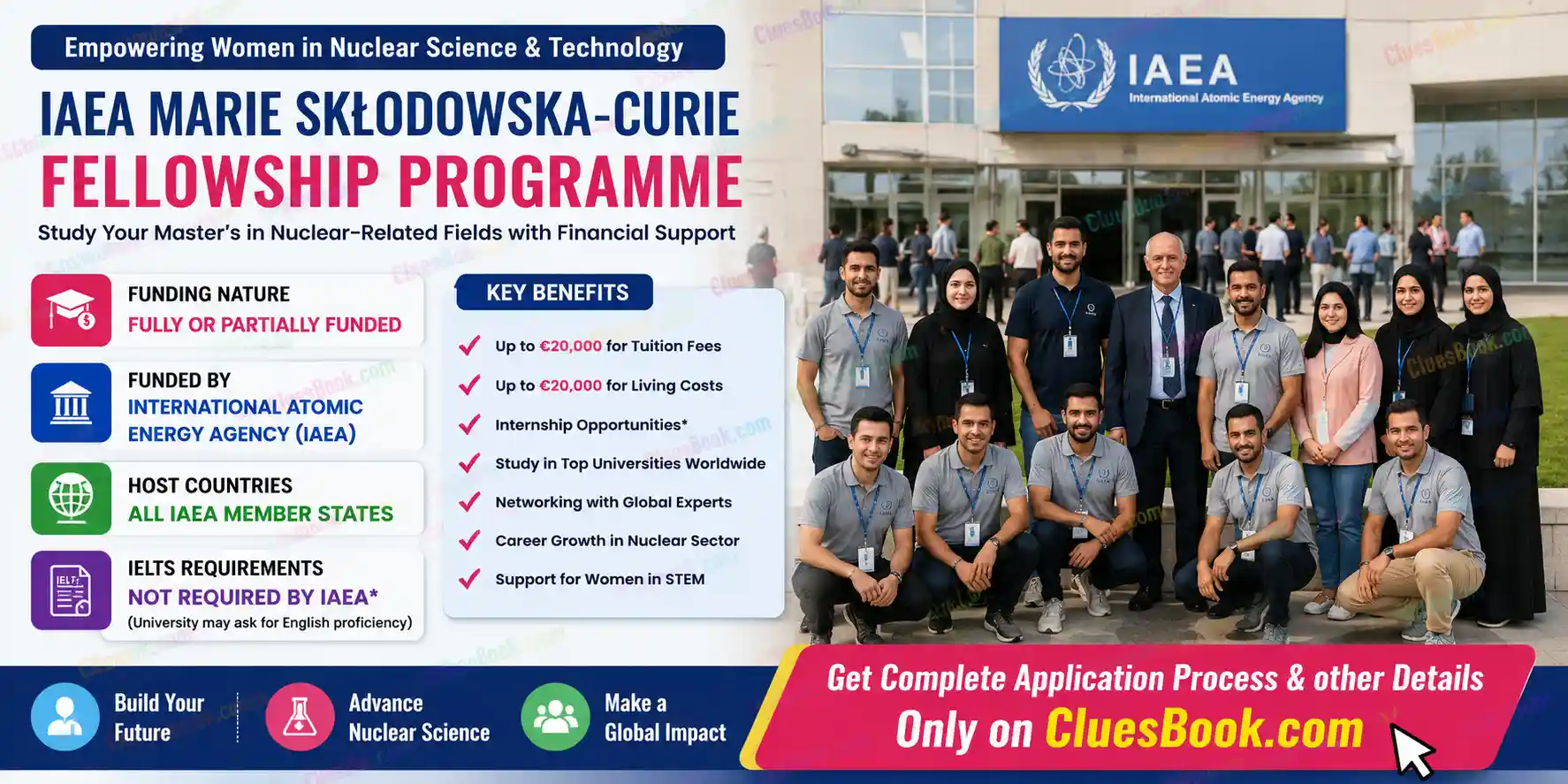
The fellowship is open to female students from IAEA Member States who are accepted into, or already enrolled in, an accredited master’s programme in a nuclear-related subject. According to the IAEA, selected fellows can receive up to €20,000 for tuition costs and up to €20,000 for living costs for the master’s programme. In selected cases, limited internship opportunities may also be facilitated through the IAEA.
This makes the programme especially attractive for students interested in nuclear engineering, nuclear medicine, nuclear chemistry, radiation biology, nuclear safety, nuclear security, isotopic techniques, non-proliferation, and nuclear law.
IAEA Marie Skłodowska Curie Fellowship Programme Details
- Host Organization: International Atomic Energy Agency
-
Study Destination: United Kingdom, France, Germany, Italy, Czech Republic, Sweden, Belgium, Netherlands, Austria, Finland, United States, Canada, Japan, South Korea, China, Pakistan, United Arab Emirates, Australia.
- Funded By: International Atomic Energy Agency
- Application Portal Link: IAEA MSCFP online application portal
- Degree Level: Master’s degree
- Scholarship Type: International fellowship for women in nuclear-related master’s programmes
- Number of Scholarships: Up to 100 female students per year, subject to available funding
- Maximum Funding: Up to €40,000 in total
- Study Level: Postgraduate / Master’s
- Duration: Usually for the duration of the approved master’s programme, generally up to 2 years depending on the programme
- Application Deadline: 31 October 2026
- Program Start: Depends on the applicant’s university admission timeline and the fellowship cycle
Eligibility Criteria for Marie Skłodowska-Curie Fellowship Programme
To apply for the Marie Skłodowska-Curie Fellowship Programme, applicants must meet the official eligibility requirements set by the IAEA.
Basic Eligibility Requirements
- You must be a female applicant
- You must be from an IAEA Member State
- You must be accepted by, or already enrolled in, an accredited university
- Your degree must be a master’s programme in a nuclear-related field
- You must submit the application and supporting documents in English
- You must meet the programme’s academic and document requirements
Academic Preference
The IAEA states that preference is given to applicants with above-average academic records. In practical terms, this usually means:
- 75% or above, or
- GPA higher than 3.0 out of 4.0
This does not automatically disqualify applicants below that threshold, but stronger academic results improve your chances.
Who Is Not the Right Fit for This Fellowship?
This fellowship is not intended for:
- applicants who are not female
- applicants who are not from IAEA Member States
- students applying only for bachelor’s-level study
- students without admission or enrolment in an eligible master’s programme
- applicants whose study area has no meaningful connection to nuclear-related fields
Eligible Study Fields & Nuclear-Related Master’s Programmes Under Marie Skłodowska-Curie Fellowship
The IAEA supports women studying in nuclear-related disciplines that align with its mission to advance the safe, secure, and peaceful uses of nuclear science and technology. The official applicant page specifically mentions several key areas, and related programmes in those areas are typically considered relevant.
Nuclear Engineering and Reactor Technology Programmes
- MSc in Nuclear Engineering
- MSc in Nuclear Energy Engineering
- MSc in Reactor Physics
- MSc in Nuclear Systems Engineering
- MSc in Nuclear Power Engineering
- MSc in Advanced Nuclear Technology
Nuclear Physics, Nuclear Chemistry and Radiochemistry Programmes
- MSc in Nuclear Physics
- MSc in Applied Nuclear Physics
- MSc in Nuclear Chemistry
- MSc in Radiochemistry
- MSc in Radioanalytical Chemistry
- MSc in Isotope Science
Nuclear Medicine, Medical Physics and Radiation Biology Programmes
- MSc in Nuclear Medicine
- MSc in Medical Physics
- MSc in Radiation Biology
- MSc in Radiopharmacy
- MSc in Radiation Protection
- MSc in Molecular Imaging where nuclear applications are central
Nuclear Safety, Security and Safeguards Programmes
- MSc in Nuclear Safety
- MSc in Nuclear Security
- MSc in Nuclear Safeguards
- MSc in Radiation Safety
- MSc in Non-Proliferation Studies
- MSc in Security of Nuclear and Radioactive Materials
Isotopic and Applied Nuclear Science Programmes
- MSc in Isotopic Techniques
- MSc in Nuclear Applications in Agriculture
- MSc in Nuclear Applications in Food and Health
- MSc in Environmental Radioactivity
- MSc in Water Resource Studies using isotopic methods
- MSc in Industrial Nuclear Applications
Nuclear Law and Nuclear Policy Programmes
- Master’s in Nuclear Law
- Master’s in Nuclear Policy
- Master’s in Energy Law with nuclear specialization
- Master’s in Non-Proliferation and International Nuclear Governance
Important Note About Study Fields
Your degree does not always need to include the word “nuclear” in its title. What matters is whether the programme is genuinely related to nuclear science, radiation applications, nuclear medicine, nuclear engineering, safety, security, law, safeguards, or another field relevant to the IAEA’s work.
Application Requirements for Marie Skłodowska-Curie Fellowship
To submit a valid application, you need to complete the official online application form and upload all required documents. Incomplete applications are not considered, so this section is one of the most important parts of the process.
Main Application Requirements
- Complete the official online MSCFP application form
- Be accepted into or enrolled in an accredited master’s programme in a nuclear-related field
- Submit all required supporting documents
- Submit all application materials in English
- Provide official English translations if your original documents are in another language
- Arrange for at least one referee to submit the required reference form directly
- Provide clear tuition fee information from your university
- Declare any additional scholarships or funding support
Required Documents for Marie Skłodowska Curie Fellowship
- Copy of passport or national ID
- Official acceptance or admission letter from the university
- The admission letter should clearly mention the master’s programme, nuclear-related field of study, and programme duration
- Statement of tuition fees or official tuition cost confirmation
- Documents showing any other scholarship support for the same master’s programme, if applicable
- Completed reference template submitted directly by the referee
- Official English translations for any non-English documents
Reference Requirement
- One reference is mandatory
- A second reference is preferred
- Referees must send the reference directly before the application deadline
Language Requirements for Marie Skłodowska-Curie Fellowship
The IAEA requires all application documents to be submitted in English. If your original academic records or supporting documents are in another language, you must also submit an official English translation.
The fellowship page does not list a separate universal IELTS score requirement imposed by the IAEA itself. In most cases, the English language requirement depends on the university where you are applying for admission, not the fellowship programme.
IELTS Requirements
For this fellowship, there is no separate IELTS requirement mentioned on the official IAEA applicant page. However, your host university may ask for IELTS, TOEFL, Duolingo, PTE, or another accepted proof of English proficiency.
In some cases, students may study without IELTS if their university accepts a medium of instruction certificate or another English-language proof. Depending on the institution, this can sometimes be possible in countries such as Germany, Italy, Hungary, Turkey, Malaysia, China, and selected universities in the UK, Europe, and North America. Always check the university’s official admission policy because the IELTS waiver, if available, comes from the university rather than from the IAEA fellowship itself.
Is Supervisor Required for Marie Skłodowska-Curie Fellowship?
In most cases, no separate fellowship supervisor is required by the IAEA when you apply for the Marie Skłodowska-Curie Fellowship. This programme is not structured like a research grant or a postdoctoral fellowship where a supervisor’s formal commitment is mandatory at the funding stage.
The main academic requirement is that you are accepted into, or enrolled in, an accredited master’s programme in a nuclear-related field.
That said, your university may have its own rules.
When You May Need a Supervisor
You may need a supervisor if:
- your target master’s programme includes a thesis and requires supervisor approval
- your department asks you to contact a professor before admission
- your university has research-based admission procedures for nuclear-related programmes
Smart Strategy
- first shortlist a nuclear-related master’s programme
- check whether the programme requires supervisor approval for admission
- secure your admission letter early
- choose referees who can clearly support your academic ability and commitment to the nuclear field
- make sure your application explains why your chosen programme fits the IAEA mission
Benefits of Marie Skłodowska-Curie Fellowship Programme
The biggest strength of the IAEA Marie Skłodowska-Curie Fellowship is that it combines funding with long-term career value. It helps reduce the cost of studying in a specialized technical field while also adding strong international recognition to your profile.
Financial Benefits
- Up to €20,000 for tuition costs
- Up to €20,000 for living costs
- Total support of up to €40,000
- Funding can reduce the financial burden of a one-year or two-year master’s degree
- If you already have another scholarship, the IAEA may adjust the award rather than duplicate support
Can I work part-time during the fellowship?
That depends on the visa rules of your host country and the policies of your university. The fellowship page does not present this as a work contract, but students should always check local immigration and academic rules.
Additional Benefits
- Recognition under a well-known IAEA women-in-nuclear initiative
- Better visibility in the international nuclear field
- Limited internship opportunities may be facilitated by the IAEA
- Access to a network of fellows, experts, and nuclear professionals
- Stronger CV for future work in nuclear energy, nuclear medicine, radiation safety, nuclear security, research, regulation, and international organizations
- Opportunity to contribute to a field where women remain underrepresented
What happens if I do not complete my master’s degree?
The IAEA expects selected fellows to complete the programme. If you fail to meet the fellowship conditions or do not finish the degree, the award may be terminated and you may be asked to repay support already received.
Program Duration, Timeline and Selection Process
The fellowship normally supports the approved duration of the eligible master’s programme. In many cases, this means support for up to two years, depending on the structure and length of the degree.
Applications are reviewed by the IAEA MSCFP Technical Selection Committee. According to the official applicant information, selection is based on a mix of academic merit, programme relevance, motivation, career goals, and overall fit with the objectives of the fellowship.
Selection Factors Considered by IAEA
- whether the applicant meets the entry requirements
- academic background and prior performance
- motivation for pursuing a career in the nuclear field
- the likely impact of the fellowship on the applicant’s career
- commitment to public service
- field-of-study relevance
- geographic and linguistic diversity
- overall strength and completeness of the application
Important Obligation After Selection
Selected fellows are expected to complete the master’s programme. According to the IAEA, failure to graduate or failure to meet the conditions of the scholarship may lead to termination of the award and, in some cases, repayment of tuition and living-cost support.
Step-by-Step Application Process for Marie Skłodowska-Curie Fellowship
- Check whether your country is an IAEA Member State
- Search for an accredited master’s programme in a nuclear-related field
- Apply to the university and secure admission or proof of enrolment
- Request a tuition fee statement from the university
- Prepare your passport or national ID copy
- Ask at least one referee early and share the official MSCFP reference form
- Arrange a second referee if possible
- Gather documents about any other scholarship or funding you already have
- Translate all non-English documents into official English versions
- Complete the IAEA MSCFP online application form carefully
- Upload all required documents
- Make sure your referee submits the reference before the deadline
- Review the full application before final submission
- Watch your email for updates from the IAEA
Application Deadline and Important Dates
The Marie Skłodowska-Curie Fellowship runs in application cycles, and the exact deadline can change from year to year. Because of that, applicants should always check the official IAEA fellowship page for the latest application window.
The current applicant information page does not publish one permanent deadline for all future years. Instead, the IAEA announces each cycle separately through the programme page and application portal.
Important Dates to Track
- application opening date announced by the IAEA
- final application deadline for the current cycle
- referee submission deadline
- selection notification by email
- university programme start date
Deadline Strategy
- start university applications early
- request reference letters well before the deadline
- secure tuition fee documents in advance
- do not leave translations for the final week
- review the application carefully before submission
Participating Universities
The IAEA does not publish a fixed list of “participating universities” for this fellowship. Instead, the fellowship supports female students who are accepted into or enrolled in accredited universities offering eligible nuclear-related master’s programmes.
Typical Types of Eligible Host Institutions
- universities offering master’s degrees in nuclear engineering
- institutions with nuclear medicine or medical physics programmes
- universities with radiation science, radiochemistry, or nuclear physics master’s degrees
- institutions offering nuclear safety, nuclear security, safeguards, or nuclear law programmes
- science and engineering universities with recognized nuclear research and teaching capacity
Example Universities, Offering Relevant Nuclear-Related Master’s Programmes:
| Region | Example Universities Offering Nuclear-Related Master’s Programmes |
|---|---|
| Europe | • KTH Royal Institute of Technology • University of Birmingham • Czech Technical University in Prague • Politecnico di Milano • Université Paris-Saclay • Ghent University • University of Glasgow • Cranfield University |
| North America | • Texas A&M University • North Carolina State University • University of Michigan • Purdue University • University of Wisconsin–Madison • McMaster University |
| Asia | • Tsinghua University • Khalifa University • Hokkaido University • Tokyo Institute of Technology • Pakistan Institute of Engineering and Applied Sciences • King Abdulaziz University |
| Australia and Oceania | • UNSW Sydney • The University of Adelaide |
That means the most important factor is not whether a university appears on a public IAEA list. What matters is whether the institution is accredited and whether the degree clearly falls within a nuclear-related field supported by the fellowship.
Why Apply for Marie Skłodowska-Curie Fellowship
- It is one of the few international fellowships focused specifically on women in nuclear-related master’s education
- It can cover both tuition and living costs
- It adds IAEA recognition to your academic profile
- It supports entry into a specialized, high-impact, globally relevant field
- It can strengthen future career options in nuclear energy, medicine, radiation safety, policy, research, and international organizations
- It helps women enter a sector where gender representation is still improving
Common Mistakes to Avoid When Applying
- applying without a valid master’s admission letter
- choosing a degree that is not clearly nuclear-related
- submitting documents in another language without English translation
- forgetting to disclose other scholarships
- waiting too long to request references
- sending weak tuition fee evidence
- writing a generic motivation statement with no clear nuclear career goal
- assuming IELTS rules come from the fellowship rather than the university
- submitting an incomplete application
Marie Skłodowska-Curie Fellowship Salary / Stipend
The Marie Skłodowska-Curie Fellowship is not a salary-based job contract. It is a scholarship that provides support for tuition and living costs.
The official funding structure is:
- up to €20,000 for tuition costs
- up to €20,000 for living costs
The IAEA presents this as overall support rather than as one public fixed monthly stipend amount on the main applicant page. The real value for each student depends on the approved award, the cost of the master’s programme, the country of study, and whether the student already has other scholarship support.
Marie Skłodowska Curie Fellowship Acceptance Rate
The IAEA does not publicly publish a fixed official acceptance rate for the Marie Skłodowska-Curie Fellowship on the applicant page. However, programme materials indicate that up to 100 female students may be selected per year, subject to available funding.
Because the fellowship is international, specialized, and limited in number, it is competitive. Strong academic performance, a clearly relevant nuclear-related programme, a focused motivation statement, and complete documents can make a big difference.
Apply Now to Secure Your Future in the Nuclear Field
If you are serious about building a future in nuclear engineering, nuclear medicine, radiation science, nuclear safety, or nuclear policy, the IAEA Marie Skłodowska-Curie Fellowship deserves a place at the top of your scholarship list. It offers meaningful financial support, international credibility, and access to a field that continues to need highly trained women professionals. The best applications are usually prepared early, with a clear study plan, a strong admission strategy, and a convincing explanation of how the chosen master’s programme connects to the peaceful use of nuclear science and technology. If you already have a target university in mind, now is the right time to secure your admission documents, line up your referees, and prepare a complete application for the next fellowship cycle.