Apply for the JSPS Postdoctoral Fellowship in Japan. Learn eligibility criteria, funding benefits, salary, application process, deadlines, host universities, and how to secure a Japanese research position.
Overview of JSPS Postdoctoral Fellowship
Imagine conducting world-class research in Japan while receiving a generous monthly stipend, international travel support, research funding, and mentorship from leading scientists. The JSPS Postdoctoral Fellowship is one of the most prestigious international research fellowships available for early-career researchers seeking global exposure and academic excellence.
Funded by the Japan Society for the Promotion of Science (JSPS), this highly competitive fellowship enables talented postdoctoral researchers to collaborate with top Japanese universities and research institutions. Participants gain access to cutting-edge laboratories, advanced technology, international networks, and career-enhancing research opportunities in Japan. For ambitious researchers aiming to build an international academic career, this fellowship can be a significant stepping stone toward faculty positions, industry research roles, and global scientific collaborations.
JSPS Postdoctoral Fellowship Program Details
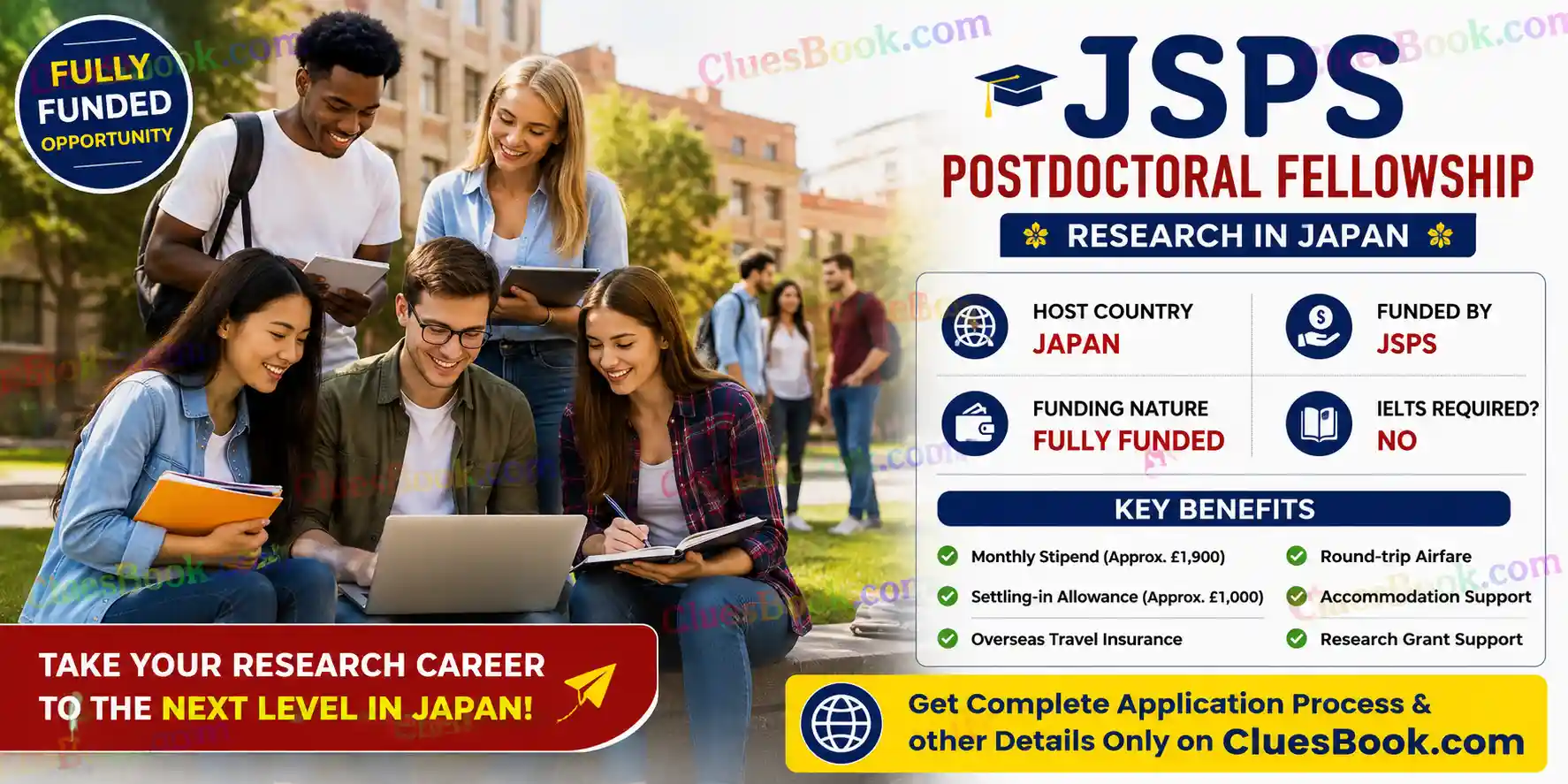
- Host Organization: Japan Society for the Promotion of Science (JSPS)
- Study Destination: Japan
- Funded By: Japan Society for the Promotion of Science (JSPS)
- Application Portal Link: Royal Society Flexi-Grant System
- Degree Level: Postdoctoral Research
- Scholarship Type: Fully Funded Fellowship
- Number of Scholarships: Limited and Competitive
- Maximum Funding: Full Fellowship Support Plus Research Grant Access
- Study Level: Postdoctoral
- Duration: 12-24 Months
- Application Deadline: 18 March 2026
- Program Start: Following JSPS Final Approval
Eligibility Criteria for JSPS Postdoctoral Fellowship
- Hold a PhD degree before the fellowship begins
- Researchers expecting to obtain a PhD before commencement may also apply
- Must not have received their PhD more than six years before the application deadline
- Must be a UK resident
- Must be a citizen of a country maintaining diplomatic relations with Japan
- Must secure agreement from a Japanese host researcher
- Research proposal must fall within the natural sciences
- Previous recipients of the standard JSPS Postdoctoral Fellowship are generally not eligible
- Must demonstrate excellent academic and research achievements
Eligible Research Fields and Academic Programs
Biological Sciences
- Molecular Biology
- Genetics
- Microbiology
- Biotechnology
- Evolutionary Biology
- Ecology
- Zoology
- Botany
Biomedical Sciences
- Medical Research
- Public Health
- Immunology
- Neuroscience
- Pharmacology
- Clinical Research
Physical Sciences
- Physics
- Applied Physics
- Astronomy
- Materials Science
- Nanotechnology
Chemical Sciences
- Organic Chemistry
- Analytical Chemistry
- Physical Chemistry
- Environmental Chemistry
- Industrial Chemistry
Engineering and Technology
- Mechanical Engineering
- Electrical Engineering
- Civil Engineering
- Aerospace Engineering
- Robotics
- Artificial Intelligence
- Machine Learning
- Data Science
- Computer Engineering
Mathematics and Computational Sciences
- Pure Mathematics
- Applied Mathematics
- Statistics
- Computational Modeling
- Mathematical Physics
Environmental and Earth Sciences
- Environmental Science
- Climate Science
- Geology
- Oceanography
- Renewable Energy Research
Application Requirements for the JSPS Postdoctoral Fellowship
- Completed application form.
- Detailed research proposal.
- Academic qualifications.
- PhD certificate or proof of expected completion.
- Host researcher acceptance.
- Publication record.
- Research achievements.
- Career development statement.
- Professional references.
Required Documents for JSPS Fellowship Application
- Passport copy
- Updated curriculum vitae (CV)
- PhD certificate
- Degree transcripts
- Research proposal
- Host researcher invitation or agreement
- Publication list
- Recommendation letters
- Proof of residency
- Academic achievements evidence
- Professional certifications (if applicable)
Language Requirements for International Researchers
Unlike many degree scholarships, the JSPS Postdoctoral Fellowship does not impose a universal IELTS requirement. Language expectations depend primarily on the host institution and research group. Researchers should possess sufficient English proficiency to conduct research, communicate findings, publish papers, and collaborate internationally.
IELTS Requirements
IELTS is generally not mandatory for the JSPS Postdoctoral Fellowship itself. Many Japanese universities and research laboratories accept alternative proof of English proficiency, especially for researchers who completed previous degrees in English.
Countries where researchers often find opportunities without IELTS include:
Many international scholarships without IELTS rely on previous education in English, supervisor approval, or institutional language exemptions.
Is a Supervisor Required for the JSPS Postdoctoral Fellowship?
- Yes
A Japanese host researcher is mandatory for the application.
Applicants must identify a suitable supervisor whose research interests align closely with their proposed project. The host researcher acts as the primary academic mentor and institutional sponsor throughout the fellowship.
Best Strategy:
- Identify researchers publishing in your field
- Read recent journal articles
- Personalize outreach emails
- Present a concise research proposal
- Demonstrate potential collaboration benefits
Benefits of JSPS Postdoctoral Fellowship
Financial Benefits of the Fully Funded Fellowship
- Monthly maintenance allowance of 362,000 Japanese Yen
- Approximately £1,900 per month
- Round-trip international airfare
- Settling-in allowance of 200,000 Japanese Yen
- Approximately £1,000 settling allowance
- Overseas travel insurance coverage
- Access to cooperative research funding
- Additional Grant-in-Aid opportunities through host institutions
Can researchers apply from any scientific field?
The fellowship mainly supports natural sciences, including engineering, chemistry, mathematics, physics, biological sciences, and related disciplines.
Additional Benefits for International Researchers
- Research collaboration with leading scientists
- Access to world-class laboratories
- Career advancement opportunities
- International publication support
- Global academic networking
- Exposure to advanced technologies
- Enhanced research profile
- Future faculty and industry opportunities
- Cultural immersion in Japan
Does the fellowship help with visa processing?
Host institutions generally assist successful fellows with documentation required for obtaining a Japanese research visa.
Program Duration, Timeline & Selection Process
The fellowship duration ranges from 12 months to 24 months.
Selection Process
- Application submission
- Eligibility review
- Scientific assessment
- Expert panel evaluation
- Nomination by the Royal Society
- Final review by JSPS
- Fellowship award notification
Step-by-Step Application Process for JSPS Postdoctoral Fellowship
- Identify a suitable Japanese host researcher
- Discuss collaborative research plans
- Develop a strong research proposal
- Collect required documents
- Create an account in Flexi-Grant
- Complete online application
- Submit before the deadline
- Wait for eligibility screening
- Undergo scientific evaluation
- Receive nomination and final decision
Application Deadline & Important Dates for JSPS Fellowship
- Applications Open: 15 January 2026
- Applications Close: 18 March 2026
- Expected Decision: 30 June 2026
- Fellowship Start: After approval and institutional arrangements
Participating Universities
- The University of Tokyo
- Kyoto University
- Osaka University
- Tohoku University
- Nagoya University
- Hokkaido University
- Kyushu University
- Tokyo Institute of Technology
- Keio University
- Waseda University
- RIKEN Research Institutes
- National Research Centers
Why Apply for This Program?
- Fully funded international research experience
- Competitive monthly financial support
- Prestigious global academic recognition
- Access to advanced scientific facilities
- International collaboration opportunities
- Career acceleration in academia and industry
- Research publication opportunities
- Long-term professional networking
Common Mistakes to Avoid When Applying
- Contacting supervisors too late
- Submitting a weak research proposal
- Ignoring eligibility requirements
- Using generic application materials
- Missing supporting documents
- Poorly explaining research impact
- Failing to align research with host expertise
- Missing application deadlines
JSPS Postdoctoral Fellowship Salary and Monthly Stipend
The fellowship provides approximately 362,000 Japanese Yen per month. This amount is generally considered competitive for postdoctoral researchers in Japan and can cover accommodation, food, transportation, healthcare, and daily living expenses depending on the city and lifestyle.
Additional travel and settlement allowances further improve the overall compensation package.
JSPS Postdoctoral Fellowship Acceptance Rate and Competitiveness
The exact acceptance rate varies annually and is not publicly published. However, the fellowship is considered highly competitive because only a limited number of candidates are nominated through overseas partner organizations.
Successful applicants typically possess:
- Strong publication records.
- Excellent research proposals.
- High-quality supervisor support.
- International research potential.
- Strong academic references.
Apply Now to Secure Your Future in Japan
The JSPS Postdoctoral Fellowship is one of the most prestigious fully funded research opportunities for early-career scientists. With generous funding, international exposure, advanced research facilities, and collaboration with leading Japanese researchers, this program offers an outstanding platform for academic and professional growth. Applicants should begin identifying supervisors, preparing research proposals, and organizing supporting documents well before the deadline to maximize their chances of success. Securing this fellowship can open doors to global research networks, high-impact publications, future faculty positions, and long-term career advancement in science and technology.