
Pakistan Affairs CSS Past Papers
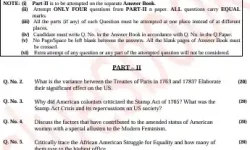
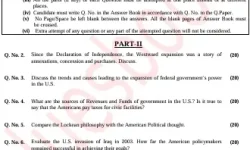
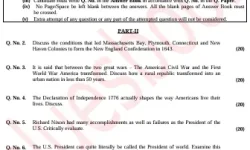
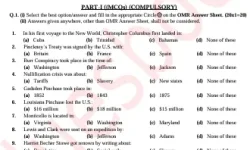
Download Pakistan Affairs CSS Past Papers 2010. The 2010 exam tested ideology, governance, and geopolitics in one sweep. Download the original PDF and see how topics like Kashmir, the military role, and relations between Islam and democracy were framed with precision.
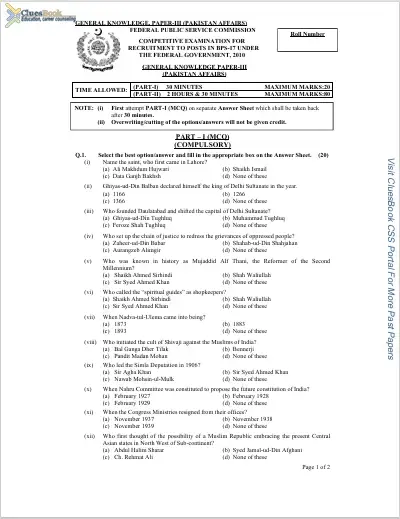
The Pakistan Affairs CSS Past Papers of 2010 were more than a test; they were a reflection of the ongoing national crises. From Kashmir to democracy, Islamic relations gauged candidates’ ability to make balanced, timely arguments. If you’re preparing today, this paper is still relevant for mastering complex topics.
Core Paper Outline
- Total Marks: 100
- Objective Section: 20 MCQs
- Subjective Section: 7 questions (attempt any 4)
- Time Limit: 3 hours
It balanced current affairs with conceptual analysis.
About the CSS
The CSS (Central Superior Services) Competitive Examination is a rigorous federal level test administered by the Federal Public Service Commission (FPSC) to select candidates for prestigious civil service roles across Pakistan. The exam’s rules and regulations, covering age limits, eligibility, subjects, and quotas, are detailed in the official CSS Rules section on the FPSC’s website.
The CSS Exam Rules, issued by FPSC Pakistan, outline eligibility criteria, age limits (21–30 years), and a maximum of three attempts for candidates. The exam includes written tests, a medical exam, a psychological assessment, and an interview. Rules also define quotas, disqualification grounds, and subject selection for a fair recruitment process.
Key Focus Areas in Pakistan Affairs CSS Past Paper 2010
Here’s what the examiner tested:
- Pakistan’s ideological identity and challenges
- Kashmir conflict as a regional flashpoint
- The military’s role in shaping politics
- Tensions between Islamic principles and democratic ideals
These weren’t asked in isolation; they demanded critical comparisons and solution-based thinking.
What Set the 2010 Paper Apart?
Unlike previous years, Pakistan Affairs CSS Past Papers of 2010 questions pushed candidates toward synthesis:
- Ideological questions were linked with constitutional evolution
- Military politics was framed as a governance and legitimacy issue
- Kashmir was explored beyond just history; it asked for realistic resolution paths
- The Islamic democracy question demanded a philosophical yet practical approach
This required both political knowledge and deep conceptual clarity.
Top Resources to Understand 2010 Themes
Recommended Reads
- “Pakistan: A Hard Country” by Anatol Lieven
- “The Idea of Pakistan” by Stephen P. Cohen
- “Military Inc.” by Ayesha Siddiqa
Use These For
- Understanding state ideology
- Civil military imbalance
- Kashmir from multiple angles
These resources support opinion with grounded evidence, ideal for CSS level writing.
Pro Preparation Tips Based on 2010 Trends
Want to attempt such a paper effectively? Here’s how:
- Prepare position based arguments (pros and cons with reasoning)
- Create linkages between ideology, institutions, and policy
- Follow international coverage on Pakistan to frame global perspectives
- Practice writing essays with 3 part structures: intro, layered arguments, conclusion
This type of answer writing is what scores above average
Where Can You Download the Paper
You can download the original Pakistan Affairs CSS Past Papers 2010 (PDF) from the download link mentioned below in this post. It’s an unsolved version, perfect for mock drills and issue based revision. The CSS 2010 paper was multidimensional, stretching from ideology to international relations. Candidates who succeeded were those who interpreted the question within current political realities, not just textbook theories.
Preparing for such papers requires integration, not memorization.