
CSS Past Paper
Download Political Science CSS Past Papers 2013 for free here. Preparing for CSS? Here’s a sharp, no-fluff guide to the 2013 Political Science paper. Instead of the usual pattern, this post brings a bullet-style breakdown with a refreshed arrangement to help you review efficiently.
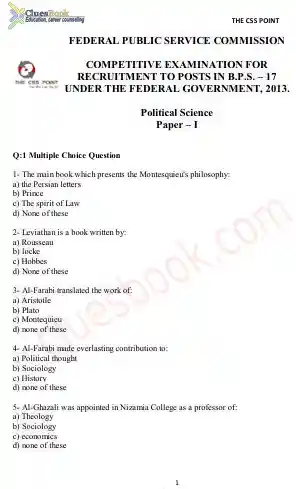
Paper Structure at a Glance
- Total Marks: 100
- Time Allowed: 3 hours
- Sections: 2 (Compulsory & Optional)
- Question Format: Mix of theoretical, conceptual, and comparative questions
- Attempt Limit: 5 questions (Q1 compulsory + 4 others)
Compulsory Question (Q1)
- Format: Short Notes
- Coverage: 4 out of 6 topics
- Nature: Conceptual and factual, required clear, concise definitions
- Themes Included:
- Realism in International Politics
- Jean Bodin’s theory of sovereignty
- Elitist theory of democracy
- Political culture
- Authority vs. Legitimacy
- Judicial review
Strategy Tip: Short note questions test your clarity, not depth. Stick to definitions + examples.
Selected Highlights from Optional Questions
Core Theoretical Questions
- Comparison of Political Science with Natural Sciences
Explored similarities/differences in methods and outcomes. - Elitist vs. Pluralist Democracies
A high-yield comparative topic with practical relevance.
Political Philosophy & Thinkers
- Aristotle’s Views on Revolution
Expected a nuanced understanding of causes and solutions. - Karl Marx’s View on Class Struggle
Still a CSS favorite; tested analytical depth on economic and social theory.
Institutions & Systems
- Judicial Independence
Importance of a strong judiciary in democracy. - Separation of Powers
Asked in the context of U.S. Constitution, classic comparative question.
About the CSS
The CSS (Central Superior Services) Competitive Examination is a rigorous federal-level test administered by the Federal Public Service Commission (FPSC) to select candidates for prestigious civil service roles across Pakistan. The exam’s rules and regulations, covering age limits, eligibility, subjects, and quotas, are detailed in the official CSS Rules section on the FPSC’s website.
The CSS Exam Rules, issued by FPSC Pakistan, outline eligibility criteria, age limits (21–30 years), and a maximum of three attempts for candidates. The exam includes written tests, a medical exam, a psychological assessment, and an interview. Rules also define quotas, disqualification grounds, and subject selection for a fair recruitment process.
Popular Topics Reappearing
The following areas were echoed from previous years, suggesting strong recurring patterns:
- Western Political Thought (Plato, Aristotle, Marx)
- Democracy & Sovereignty
- Political Ideologies (Liberalism, Socialism)
- Comparative Government (USA, UK, France, etc.)
Observations on Trends
- Theory-heavy: 2013 leaned more towards theoretical and philosophical content than current affairs.
- Balanced Paper: Even mix of history of political thought and modern political systems.
- No Overlap with IR Paper: Good for those taking both subjects separately.
Key Takeaways for Future Aspirants
- Master thinkers: Plato, Aristotle, Marx, Hobbes = always useful.
- Practice writing concise, analytical short notes.
- Study constitutions (USA, UK, France, Pakistan) for institutional questions.
- Prepare modern theories (feminism, realism, systems theory) just in case.
Start Preparing
Political Science 2013 was a moderately difficult paper, ideal for well-prepared candidates. With the right theoretical command and examples, scoring well was very achievable. Download the Political Science paper from download button below the article.
Stay strategic. Focus on core concepts and compare across systems when possible.