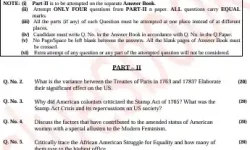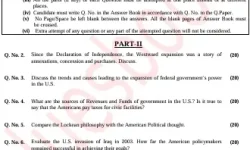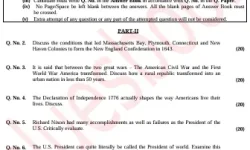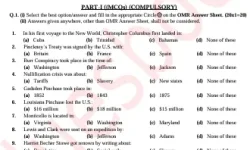

Political Science CSS Past Papers 2019
Download Political Science CSS Past Papers 2019. The CSS 2019 Political Science paper tested how candidates relate political theory to institutional failures. One key question is why Pakistan’s democracy hasn’t matured despite constitutional developments. Here’s a concise, example-driven, and easy-to-follow breakdown to guide your prep.
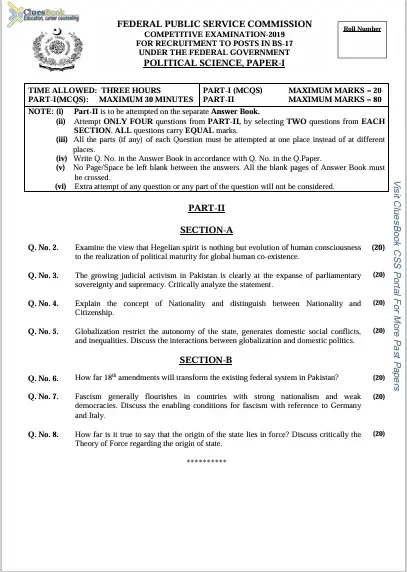
Examiner’s Intent
The paper pushed candidates to move beyond rote knowledge and demonstrate:
- The practical limits of idealistic theories
- An understanding of how political thought evolves in weak democracies
- Awareness of both Islamic and Western paradigms applied to Pakistan’s case
Sectional Overview Of Political Science CSS Past Papers 2019
Political Theory & Western Ideologies
The examiner expected:
- Critical reflections on liberty, equality, and justice
- Evaluation of Hobbes, Locke, and Rousseau beyond textbook answers
- Real world implications of social contract theory in state authority
Muslim Political Thought
Included questions like:
- Does Islamic governance contradict modern democracy?
- Role of Shura, Khilafat, and consensus (Ijma) in state structure
- Comparative outlook: Islamic political heritage vs. modern reforms
Comparative Political Systems
Asked candidates to:
- Differentiate between liberal and illiberal democracies
- Examine unitary vs. federal systems in the context of Pakistan and India
- Explore leadership models in East and West
Pakistan Specific Political Development
A major theme in this section:
- The disconnect between constitutionalism and political practice
- Military influence on democratic institutions
- Failure of political parties to mature ideologically
About the CSS
The CSS (Central Superior Services) Competitive Examination is a rigorous federal level test administered by the Federal Public Service Commission (FPSC) to select candidates for prestigious civil service roles across Pakistan. The exam’s rules and regulations, covering age limits, eligibility, subjects, and quotas, are detailed in the official CSS Rules section on the FPSC’s website.
The CSS Exam Rules, issued by FPSC Pakistan, outline eligibility criteria, age limits (21–30 years), and a maximum of three attempts for candidates. The exam includes written tests, a medical exam, a psychological assessment, and an interview. Rules also define quotas, disqualification grounds, and subject selection for a fair recruitment process.
What Set 2019 Apart from Previous Years?
The Political Science CSS Past Papers 2019 were unique in the following aspects:
- More focus on Pakistan’s internal political decay
- Emphasis on philosophical depth mixed with current examples
- Stronger comparative lens across multiple ideologies and governance models
Performance Gaps Observed
Candidates who struggled often:
- Gave long theoretical answers with no applied insight
- Misquoted thinkers or ignored contrasting views
- Focused too much on memorized definitions rather than interpretations
Best Strategy for Future Candidates
- Use a contextual approach: relate theory to Pakistan or current global scenarios
- Develop answers around evaluative questions rather than factual repetition
- Write answers that interlink thinkers (e.g., how Locke’s ideas clash with Maududi’s perspective on liberty)
- Include modern political case studies from South Asia, the Middle East, and the West
Recommended Study Resources
- Western Political Thought by C.L. Wayper
- Muslim Political Thought by Muhammad Aslam Chaudhry
- Comparative Politics by Ronald Chilcote
- Daily news analysis (Dawn, Al Jazeera, BBC) for Pakistan’s current political trends
- The Constitution of Pakistan annotated editions
Download Section
You can download the original Political Science CSS Past Papers 2019 (PDF) from the viewer resource section. It’s unsolved and formatted for practice purposes. The CSS 2019 Political Science paper combined conceptual sophistication with applied political awareness. It was less about listing what scholars said, and more about asking: How do their ideas hold up today, especially in Pakistan?
Success in this paper depended on critical reasoning, comparative depth, and political relevance.