
Past CSS Economics Paper 2016
Appearing for the CSS Economics paper can be a daunting task, but having access to past papers is like getting a map before entering a maze. The 2016 CSS Economics Paper is one such valuable resource that offers insight into the examiner’s mindset, the trend of questions, and real expectations.
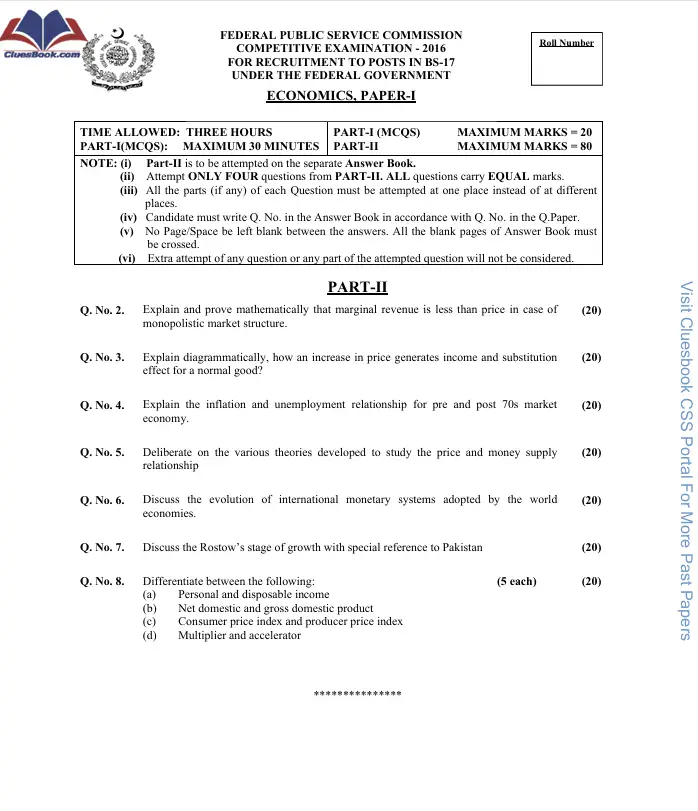
This blog breaks down both Paper-I and Paper-II of CSS Economics Paper, helping aspirants use this paper strategically for their preparation.
Overview of the Exam Pattern
Before we dig into the content, here’s how the structure was laid out in 2016:
- Time Allowed: 3 Hours
- Total Marks: 100
- Two Sections:
- Part-I: Objective (MCQs), 20 Marks (30 minutes)
- Part-II: Subjective, 80 Marks (Choose 4 out of 7–8 questions)
Paper-I: Theoretical Frameworks and Global Concepts
The first CSS economics paper dives deep into economic theories and mathematical principles, often accompanied by diagrams. Some major highlights from 2016 include:
Key Questions Covered
- Monopolistic Market Behavior
- A question that required proving mathematically why marginal revenue is less than price under monopoly.
- Consumer Response to Price Changes
- This tested understanding of income and substitution effects, explained with a proper diagram.
- Inflation vs. Unemployment
- A timeless macroeconomic concept comparing trends before and after the 1970s.
- Money Supply and Price Dynamics
- Theoretical models explaining how changes in money supply influence price levels.
- International Monetary Systems
- Evolution from gold standard to floating exchange rates.
- Rostow’s Growth Model
- Its five stages of growth, with relevance to Pakistan’s economic journey.
Key Conceptual Differences
Candidates had to differentiate between terms like:
- Net vs. Gross Domestic Product
- CPI vs. PPI
- Multiplier vs. Accelerator
- Personal vs. Disposable Income
Paper-II: Pakistan’s Economic Realities & Policy Review
Unlike Paper-I of CSS economics paper, this part dives into local challenges, policy impacts, and strategies for reform. Here’s what the 2016 version covered:
Real-World Issues & Policy Focus
- Sustainable Development
- Candidates were asked to explain how economic development can occur without damaging the environment.
- Agriculture Sector Reforms
- Evaluation of monetary and fiscal steps taken by the government to uplift agriculture.
- Industrial Development
- Comparative critique of import substitution vs. export-led growth strategies.
- Terms of Trade
- Causes for deterioration and how Pakistan can improve its trade position globally.
- Privatization
- Insights into Pakistan’s privatization history, its outcomes, and public reaction.
- Interest-Free Banking
- Was it a success? Paper explored both strengths and weaknesses of Islamic finance in Pakistan.
- Energy Crisis
- Deep reflection on how energy shortages hinder growth, along with possible solutions.
Pro Tips for Preparation
- Practice drawing clear diagrams, they fetch high marks.
- Use this paper to create mock tests for yourself.
- Prepare one-pagers for repeated concepts like inflation, trade, or growth models.
- Write answers using real examples from Pakistan to impress examiners.
About the CSS
The CSS (Central Superior Services) Competitive Examination is a rigorous federal-level test administered by the Federal Public Service Commission (FPSC) to select candidates for prestigious civil service roles across Pakistan. The exam’s rules and regulations, covering age limits, eligibility, subjects, and quotas, are detailed in the official CSS Rules section on the FPSC’s website.
The CSS Exam Rules, issued by FPSC Pakistan, outline eligibility criteria, age limits (21–30 years), and a maximum of three attempts for candidates. The exam includes written tests, a medical exam, a psychological assessment, and an interview. Rules also define quotas, disqualification grounds, and subject selection for a fair recruitment process.
What Makes This Paper Special?
Unlike some other years, the 2016 CSS economics paper:
- Balanced theory with application, especially in Paper-II
- Demanded analytical skills, not just definitions
- Had multiple Pakistan-specific questions, ideal for local context preparation
- Included mathematical and diagram-based components
The CSS economics paper 2016 paper blends theory with practical insight, making it a smart tool for focused preparation. It highlights what examiners expect, clarity, critical thinking, and relevance.
Study it well to strengthen your grip on both global concepts and Pakistan’s economy.