
Past Papers of Economics CSS 2015
Explore updated Past Papers of Economics CSS to prepare smarter. Download papers, understand trends, and boost your score with expert tips.
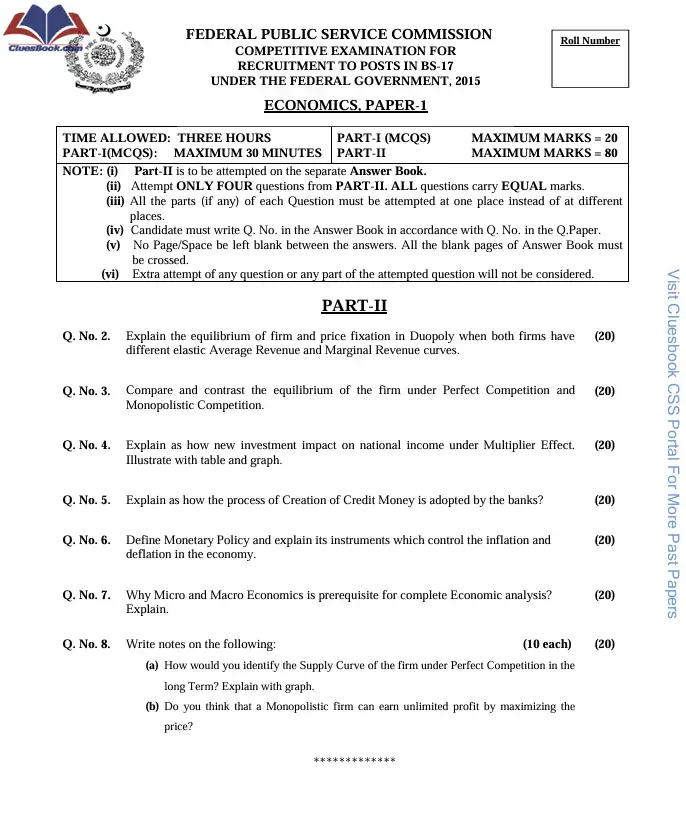
The Past Papers of Economics CSS 2015 tested both conceptual understanding and application of core economic principles. If you’re preparing for CSS and want a smart, structured approach, this blog will help you navigate Paper I and Paper II with ease.
Paper I: Micro & Macro Economics
This paper focused on core economic theories and models that form the foundation of the subject.
Key Questions Breakdown
- Duopoly & Price Fixation
- Understand how two firms behave under interdependence when AR and MR curves differ.
- Perfect vs. Monopolistic Competition
- Learn the structural and behavioral contrasts in equilibrium determination.
- Multiplier Effect on National Income
- A detailed question asking for both tabular and graphical explanation.
- Credit Money Creation
- A classic banking topic, always important for theory-based application.
- Monetary Policy & Inflation Control
- You needed to explain the tools: open market operations, reserve ratio, etc.
- Micro vs. Macro Economics
- Fundamental distinction and why both are essential for comprehensive analysis.
- Supply Curve in Long Run (Perfect Competition)
- Required a graph-based explanation.
- Can Monopolists Earn Unlimited Profit?
- Critical thinking and logical reasoning were tested here.
Paper II: Applied & Development Economics
This section linked economics to policy-making, development strategies, and real-world applications.
Highlights of the Questions
- Lorenz Curve & Income Inequality
- Graphical understanding and critical analysis expected.
- Economic Planning
- Essay-type response analyzing whether planning is necessary in modern economies.
- Green Revolution & Agriculture
- Historical significance and technological impact in agriculture.
- Domestic Resource Development & Industrialization
- Tied to national development goals and strategies.
- Privatization vs. Public Sector Enterprises
- You had to evaluate the inefficiencies of state enterprises and how privatization could help.
- Modern Development & Human Welfare
- A theoretical question calling for critical linkage between welfare economics and development theories.
Short Notes
Focused on:
- Poverty Line
- Basic Need Approach
- Economic Growth
About the CSS
The CSS (Central Superior Services) Competitive Examination is a rigorous federal-level test administered by the Federal Public Service Commission (FPSC) to select candidates for prestigious civil service roles across Pakistan. The exam’s rules and regulations, covering age limits, eligibility, subjects, and quotas, are detailed in the official CSS Rules section on the FPSC’s website.
The CSS Exam Rules, issued by FPSC Pakistan, outline eligibility criteria, age limits (21–30 years), and a maximum of three attempts for candidates. The exam includes written tests, a medical exam, a psychological assessment, and an interview. Rules also define quotas, disqualification grounds, and subject selection for a fair recruitment process.
Unique Tips For Aspirants
- Illustrate With Diagrams: Many questions in Paper I demand graphical clarity, practice sketching MR/AR curves, multiplier graphs, Lorenz curves, etc.
- Understand Theories AND Their Application: The blend of theoretical and applied questions makes it crucial to go beyond textbook definitions.
- Be Policy-Oriented in Paper II: Show awareness of Pakistan’s economy and global economic issues.
- Use Current Examples: Citing real-world cases (like recent privatizations, inflation trends) earns extra marks.
To succeed in the CSS Economics exam, smart preparation is just as important as hard work. One of the best ways to build confidence is by studying the Past Papers of Economics CSS. They help you understand the kind of questions that are repeatedly asked, the structure of answers expected, and how to apply theory to real-world issues. By practicing with Past Papers of Economics CSS, you can sharpen your analytical skills and manage your time more effectively. Whether you’re revising concepts or testing your knowledge, the Past Papers of Economics CSS serve as a reliable tool to guide your preparation in the right direction.
CSS Economics 2015 was a well-balanced paper that tested both conceptual clarity and practical application. A smart approach, studying core theories, practicing diagrams, and understanding real-world policy, can make a big difference.
Stay updated, revise regularly, and tackle each section with confidence!
Follow CluesBook.com for more papers and better preparation.