
CSS Economics Past Paper
Download CSS Economics Paper 2019. Every year, CSS aspirants dig through past papers to understand the mind of the examiner. And if you’re serious about acing Economics as your optional subject, the 2019 paper is one of those gems that can truly sharpen your preparation.
So, let’s take a walk through what this paper was about—and how it can set your strategy straight.
The Pulse of Paper-I: Theory with Real Depth
Paper-I in 2019 didn’t play games. It pushed candidates to think beyond rote learning.
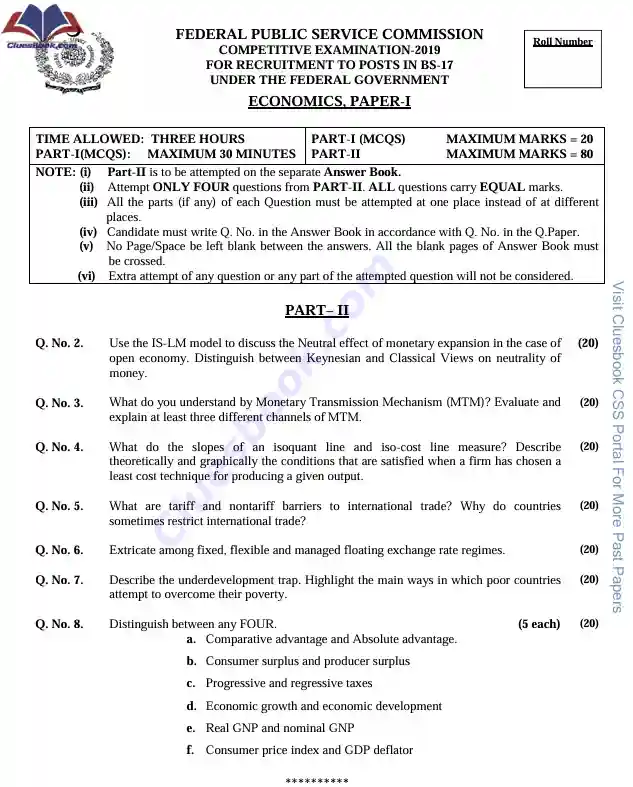
- It started off with the IS-LM model—not just what it is, but how it plays out in an open economy, and whether money is really neutral. It’s that sweet blend of macro theory and real-world interpretation that makes CSS economics such a thrilling (and challenging) choice.
- Then came the Monetary Transmission Mechanism. You weren’t just supposed to define it—you had to critically evaluate how the mechanism travels through interest rates, exchange rates, and the banking system.
- The paper also tested how well you understood the producer’s cost choices, using isoquant and isocost curves. If you couldn’t draw or explain the slope of these lines, it was game over.
- From trade barriers to exchange rate regimes, and the underdevelopment trap—every question was a prompt to link theory with Pakistan’s economic reality.
- And don’t forget the last question: a solid mix-match of economic concepts. If you didn’t know how comparative advantage differs from absolute advantage, or what real GNP means compared to nominal GNP, you missed easy marks.
Paper-II: Ground Realities and Pakistan’s Economy
While Paper-I was theory-heavy, Paper-II brought it home, literally.
- Questions dove into development models by Nurkse, Hirschman, and Ropon, asking you to explain their relevance to Pakistan. Then came the Lewis Model of Surplus Labor, a classic that’s still debated in terms of its fit for our local conditions.
- A serious question hit right at the heart of policymaking: the difference between poverty and inequality. And how public policy could tackle both.
- Inflation, always a hot topic, was there too—types, control measures, and the role of monetary vs fiscal policies in managing it.
- Then came the question every future policymaker should be ready to answer: What role should trade, and the WTO play in Pakistan’s development?
- And finally, we talked about agriculture and the balance of trade—two cornerstones of Pakistan’s struggling economy.
About the CSS
The CSS (Central Superior Services) Competitive Examination is a rigorous federal-level test administered by the Federal Public Service Commission (FPSC) to select candidates for prestigious civil service roles across Pakistan. The exam’s rules and regulations, covering age limits, eligibility, subjects, and quotas, are detailed in the official CSS Rules section on the FPSC’s website.
The CSS Exam Rules, issued by FPSC Pakistan, outline eligibility criteria, age limits (21–30 years), and a maximum of three attempts for candidates. The exam includes written tests, a medical exam, a psychological assessment, and an interview. Rules also define quotas, disqualification grounds, and subject selection for a fair recruitment process.
Why This Paper Still Matters
The CSS Economics 2019 paper wasn’t just a test. It was a mirror. It reflected what an economist in Pakistan needs to understand, how to balance theory with on-the-ground problems. From textbook definitions to actual economic crises, it challenged you to think, connect, and argue. If you’re preparing for an upcoming attempt, use this paper as a benchmark. Practice answers. Draw diagrams. Think policy. Go beyond definitions.
Quick Tips for Aspirants
- Use real-life Pakistan examples in Paper-II answers
- Always draw diagrams where applicable
- Learn to compare theories, not just define them
- Study WTO and current trade agreements
- Make distinctions between economic terms sharp and clear
Download the Paper
Grab the official PDF copy of the CSS Economics 2019 paper right here:
Keep it saved. Print it. Solve it. It’s one of your best practice tools. The CSS Economics 2019 paper was a true test of conceptual clarity, analytical thinking, and applied knowledge. It wasn’t about memorizing textbook lines, it was about connecting theories with the real economic challenges of Pakistan.
Whether it was the IS-LM model or the role of agriculture, each question demanded critical insight and structured arguments.