
CSS 2017 Economics Paper
Download CSS 2017 Economics Paper. Preparing for the CSS examination and need solid practice with optional subjects like Economics? You’re at the right place!
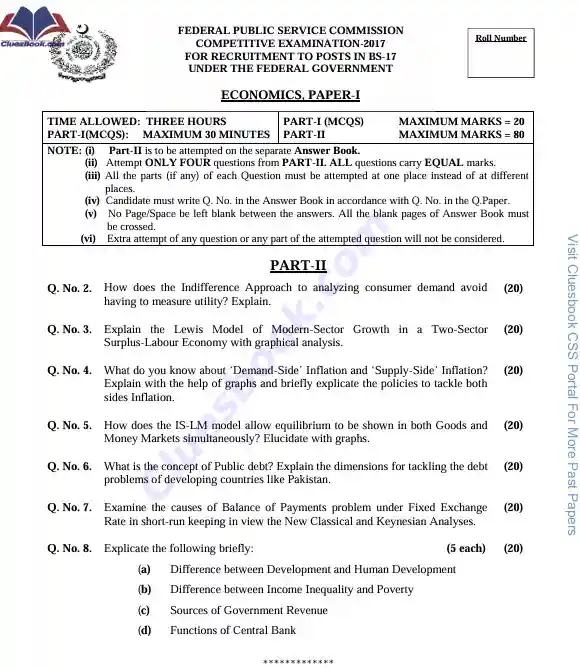
We’re offering the CSS 2017 Economics Paper along with a full analysis of the question paper to help you gear up your preparation.
Format of the Economics Paper 2017
The Economics paper in 2017 was conducted in two parts under the Federal Public Service Commission (FPSC):
- Paper I: Focused on core economic theories and global concepts.
- Paper II: Covered Pakistan’s economic development, challenges, and policy frameworks.
Each paper included:
- Part-I (MCQs): 20 marks, to be solved in 30 minutes
- Part-II (Descriptive): 80 marks, attempt 4 out of 7–8 questions
Paper I: Theoretical Focus and Global Concepts
This paper examined the analytical and conceptual grip of candidates on major economic models and global issues.
Topics Included
Indifference Curve Analysis
How it avoids cardinal measurement of utility.
Lewis Dual-Sector Model
Explained with a graphical approach.
Inflation Types
Distinction between demand pull and cost push inflation, along with graphical illustrations and policy recommendations.
IS LM Framework
- Integration of goods and money market equilibrium through diagrams.
Public Debt in Developing Economies
- Its implications and strategies for management in countries like Pakistan.
Balance of Payments under Fixed Exchange Rate
- Explained through Keynesian and New Classical viewpoints.
Conceptual Clarifications
Short explanations on:
- Human vs. Economic Development
- Poverty vs. Inequality
- Central Bank’s functions
- Sources of Government Revenue
Paper II: Pakistan Centered Economic Analysis
Paper II aimed at assessing how well candidates understand the economic situation of Pakistan, its weaknesses, and development strategies.
Key Areas Covered
Features of Less Developed Countries (LDCs)
Focused on Pakistan’s socioeconomic profile.
Pakistan’s Economic Planning
A critical view and suggested improvements.
Agriculture vs. Rural Development
Core differences and shortcomings in Pakistan’s policies.
Industrial Policy Tools
A look at fiscal and monetary support over the last two decades.
Foreign Trade Patterns
Directional shifts in Pakistan’s exports/imports and trade partners.
Privatization, Deregulation, and Decentralization
Definitions and evaluation of Pakistan’s performance.
Brief Essays
Choose any two:
- Export led Growth
- Growth vs. Distribution
- Pakistan’s Energy Crisis
Strategy for Attempting the CSS 2017 Economics Paper
To make the most of your attempt:
- Start with questions you’re most confident in.
- Use real life examples and graphs where possible.
- Stick to a balanced writing style, analytical yet simple.
- Pay attention to conceptual clarity and structure.
About the CSS
The CSS (Central Superior Services) Competitive Examination is a rigorous federal level test administered by the Federal Public Service Commission (FPSC) to select candidates for prestigious civil service roles across Pakistan. The exam’s rules and regulations, covering age limits, eligibility, subjects, and quotas, are detailed in the official CSS Rules section on the FPSC’s website.
The CSS Exam Rules, issued by FPSC Pakistan, outline eligibility criteria, age limits (21–30 years), and a maximum of three attempts for candidates. The exam includes written tests, a medical exam, a psychological assessment, and an interview. Rules also define quotas, disqualification grounds, and subject selection for a fair recruitment process.
Why You Should Download This Paper
By studying the CSS 2017 Economics Paper, you can:
- Anticipate the style of questions
- Practice diagrams and policy analysis
- Strengthen both concepts and application skills
- Improve the speed and structuring of your answers
The CSS 2017 Economics Paper provides a complete blend of theory and real world relevance. Whether you’re a first time candidate or reattempting, this paper can guide you in sharpening your exam approach and identifying important topics. Download from the link given below.
Stay focused and remember, smart preparation always beats hard memorization!