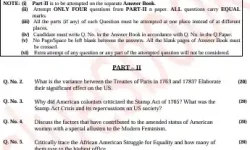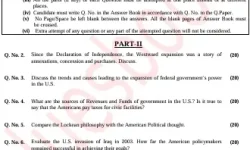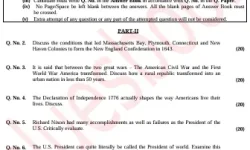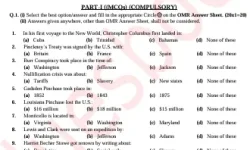

CSS Past Papers 2018
Download CSS Past Papers 2018 Computer Science. The CSS 2018 Computer Science paper was a well-balanced blend of practical and theoretical concepts. It provided a clear indication of the FPSC’s evolving approach, favoring analytical understanding and applied knowledge over simple memorization.
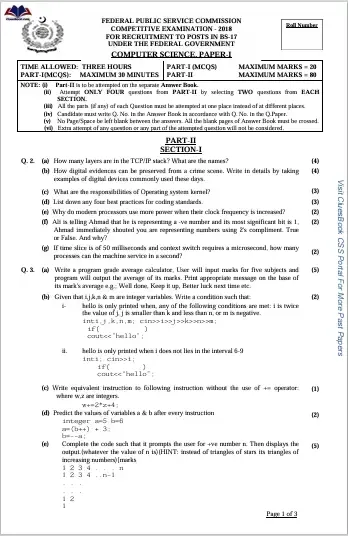
If you’re aiming to attempt CSS Computer Science, studying the 2018 paper is a smart move. It gives insight into recurring themes, paper structure, and question complexity.
Structure of the 2018 Paper
- Total Marks: 100
- Objective Section (MCQs): 20 marks
- Subjective Section: 80 marks
- Question Format: Choose 4 questions from 6 in the subjective section
- Time Allowed: 3 Hours
The paper tested foundational knowledge and application-based reasoning across major CS disciplines.
Major Areas Covered in CSS Past Papers 2018 Computer Science
Programming & Algorithms
- OOP principles and classes
- Pseudocode and algorithm analysis
- Recursion and complexity
Operating Systems
- Process lifecycle
- Paging vs Segmentation
- CPU scheduling
Data Structures
- Trees and traversal algorithms
- Stack and queue operations
- Linked lists and applications
Computer Architecture
- Von Neumann architecture
- Instruction cycles and addressing modes
- Cache memory concept
Software Engineering
- Requirement specification techniques
- Software development models (Waterfall vs Spiral)
- Functional vs non functional requirements
Computer Networks
- Switching techniques
- Types of transmission media
- Basics of routing protocols
About the CSS
The CSS (Central Superior Services) Competitive Examination is a rigorous federal level test administered by the Federal Public Service Commission (FPSC) to select candidates for prestigious civil service roles across Pakistan. The exam’s rules and regulations, covering age limits, eligibility, subjects, and quotas, are detailed in the official CSS Rules section on the FPSC’s website.
The CSS Exam Rules, issued by FPSC Pakistan, outline eligibility criteria, age limits (21–30 years), and a maximum of three attempts for candidates. The exam includes written tests, a medical exam, a psychological assessment, and an interview. Rules also define quotas, disqualification grounds, and subject selection for a fair recruitment process.
Examiner’s Implied Focus
Unlike some other years, the 2018 paper emphasized:
- Conceptual clarity over direct definitions
- Application based questions rather than simple theoretical recall
- Interdisciplinary links (e.g., how memory management affects performance in OS)
- Structured, concise, and well illustrated answers
Preparation Strategy Based on 2018 Paper
- Understand core principles in each subject rather than memorizing isolated facts.
- Practice writing pseudocode and drawing diagrams, especially for data structures and OS.
- Allocate revision time equally across programming, systems, and networking.
- Attempt mock papers under timed conditions to build writing speed and clarity.
- Prepare for short note type questions on multiple subtopics rather than only long essays.
Suggested Books and Resources
- “Object-Oriented Programming in C++” – Robert Lafore
- “Data Structures and Algorithms in C++” – Mark Weiss
- “Operating System Concepts” – Silberschatz, Galvin, Gagne
- “Computer Architecture and Organization” – William Stallings
- “Computer Networks” – Andrew Tanenbaum
- “Software Engineering” – Ian Sommerville
Helpful Platforms
- GFG (GeeksforGeeks) for coding logic
- TutorialsPoint for revision
- Neso Academy (YouTube) for OS and Architecture
- Javatpoint for simplified theory
Download Section
The CSS Past Papers 2018 Computer Science (PDF) can be downloaded from the link below. It’s highly recommended for practice, revision, and identifying key topic areas tested by FPSC. The CSS Past Papers 2018 Computer Science shows that success lies in clarity, structure, and balanced preparation. Whether you come from a CS background or not, if you approach each subject area with discipline and conceptual depth, scoring well is entirely possible.
Make sure to analyze trends across years, practice writing effectively, and focus on application, not just memorization.