
Computer Science 2016 CSS Paper
Download Past Computer Science 2016 CSS Paper. The CSS 2016 Computer Science Paper offered a classic view of how FPSC balances foundational understanding with practical application. This paper leaned heavily on technical clarity and required students to demonstrate breadth over depth, a shift that would shape future exams.
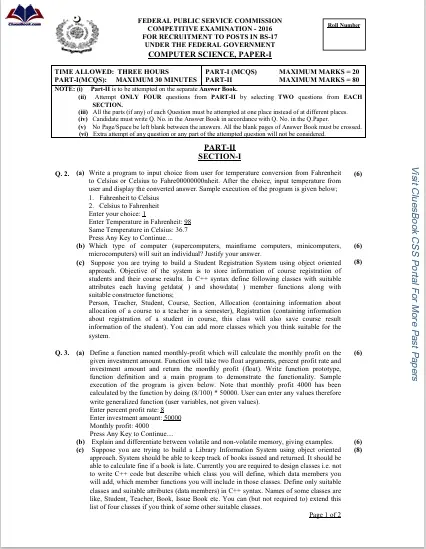
If you’re preparing for CSS and considering Computer Science as your optional subject, the 2016 paper can help you decode exam structure, question framing, and core expectations.
What Was the Paper Format?
- Total Marks: 100
- Time Allowed: 3 Hours
- Section I: 20 MCQs (compulsory)
- Section II: 6 descriptive questions; attempt any 4
- Answer Requirement: Concise, logical, and preferably illustrated
This paper rewarded clear explanation and technical correctness more than length or complex vocabulary.
Subject Matter Breakdown
Below are the reframed headings covering the core areas included in the 2016 paper:
Logic in Code: Programming and Languages
- Procedural vs Object Oriented approach
- Syntax and semantics of high level programming
- Function calls, scope, recursion
- Basic control structures and program design principles
Inside the Machine: Architecture & Hardware Logic
- Registers and buses
- Instruction cycle and execution stages
- Addressing modes and assembly logic
- CPU operations and performance units
Systems in Action: Operating System Mechanics
- Process management and life cycle
- Deadlocks: prevention, detection, and avoidance
- Virtual memory and paging systems
- File management and disk scheduling
Data Backbone: Databases and Information Modeling
- Relational schema and key constraints
- Normalization and redundancy control
- Entity Relationship diagrams
- SQL basics and query structure
Networks That Connect: Communication and Protocols
- OSI model: functions of each layer
- TCP/IP stack comparison
- Network devices and routing basics
- Switching techniques and transmission media
Engineering the Software: Development Life Cycle
- Software process models (Waterfall, Spiral, Agile)
- Requirements gathering and feasibility
- Black box and white box testing
- Maintenance phases in software life
About the CSS
The CSS (Central Superior Services) Competitive Examination is a rigorous federal level test administered by the Federal Public Service Commission (FPSC) to select candidates for prestigious civil service roles across Pakistan. The exam’s rules and regulations, covering age limits, eligibility, subjects, and quotas, are detailed in the official CSS Rules section on the FPSC’s website.
The CSS Exam Rules, issued by FPSC Pakistan, outline eligibility criteria, age limits (21–30 years), and a maximum of three attempts for candidates. The exam includes written tests, a medical exam, a psychological assessment, and an interview. Rules also define quotas, disqualification grounds, and subject selection for a fair recruitment process.
Key Highlights of the 2016 Paper
- Heavy focus on definitions + use case explanation.
- Several questions offered diagrams as optional but scoring-enhancing.
- Programming was tested theoretically, not through actual code-writing.
- No significant inclusion of Automata or Theoretical Computation topics this year.
- Questions were generally straightforward but broad, testing how well students could structure knowledge.
Smart Preparation Tips for CSS Based on 2016 Paper
- Focus on fundamentals: Know the why, not just the what.
- Revise terminologies and differences, like various addressing modes, protocol layers, and memory types.
- Draw diagrams for systems related answers like instruction cycles, OS models, or ER diagrams.
- Practice short, structured answers using past paper questions.
- Don’t over focus on any one topic; this paper sampled all major areas evenly.
Resources You Should Consider
Books to Follow
- “Object-Oriented Programming in C++” – Robert Lafore
- “Computer Organization and Architecture” – William Stallings
- “Operating Systems” – Silberschatz, Galvin
- “Database Systems” – Elmasri & Navathe
- “Computer Networks” – Tanenbaum
- “Software Engineering” – Pressman or Sommerville
Online Learning Platforms
- GFG for MCQs and conceptual articles
- W3Schools for DBMS and networking basics
- Neso Academy (YouTube) for system-level concepts
- Khan Academy for basic architecture and logic gates
Download Section
The Computer Science 2016 CSS Paper (PDF) is available through the downloadable button below and above of this post. It’s recommended for time-based practice and checking your coverage against real exam expectations. The Computer Science 2016 CSS Paper served as a solid foundation year for what would later become more integrated, analytical exams. It’s a must-try for any serious CSS aspirant. Don’t just read the paper; attempt it, evaluate your answer style, and refine how you approach technical writing.
The ability to explain complex concepts simply is what FPSC rewards most.