Explore the Scoville Peace Fellowship eligibility, $4,497 monthly salary, benefits, application requirements, deadlines, host organizations and step-by-step application guide.
What if you could turn a strong interest in international peace and security into full-time policy experience in Washington, DC, while receiving a monthly salary and professional-development support? The Herbert Scoville Jr. Peace Fellowship offers exactly that kind of opportunity for recent college and graduate-school alumni. But this is not a conventional scholarship: it is a highly competitive, six-to-nine-month professional fellowship in which fellows work with nonprofit public-interest organizations on real peace and security issues. With fewer than 3% of applicants selected in recent years, the quality of your essays, policy interests, references and host-organization choices can make a decisive difference.
Scoville Peace Fellowship Overview
The Herbert Scoville Jr. Peace Fellowship is a professional fellowship designed to help develop the next generation of policy and advocacy leaders working on international peace and security. The programme was established in 1987 and has awarded more than 230 fellowships over its history. Fellows spend six to nine months working full time with a participating nonprofit or public-interest organization in Washington, DC.
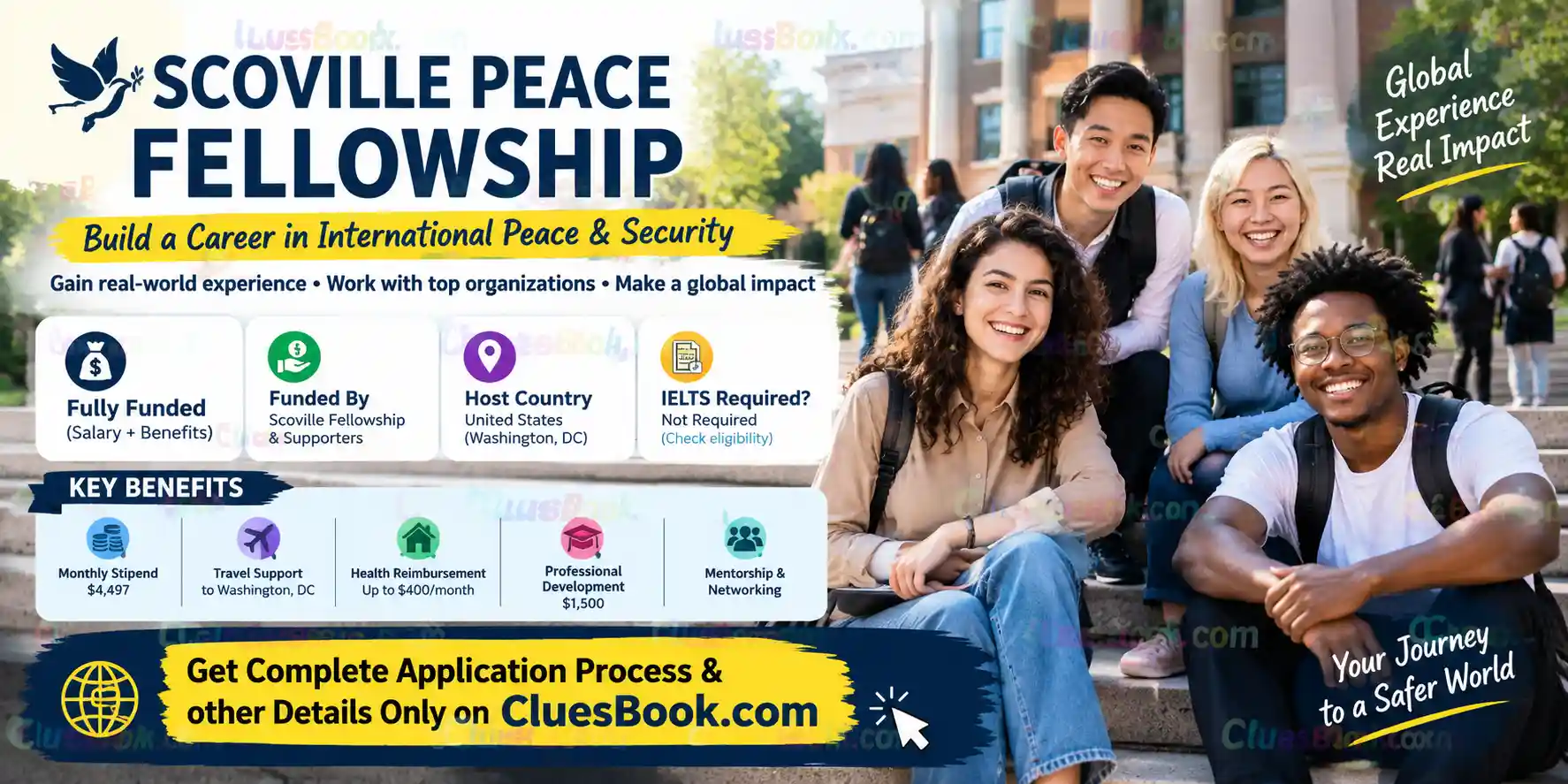
Rather than funding independent academic research, the fellowship places fellows inside organizations where they can contribute to research, policy analysis, writing, advocacy, public education and related projects. Fellows are supervised by senior-level staff and also receive mentoring from a former fellow and a Scoville board member. One important clarification for applicants looking for a “fully funded Scoville scholarship”: the Scoville Fellowship is not a tuition scholarship. It is a salaried professional fellowship with health-related reimbursement, relocation travel support and professional-development funding.
Scoville Peace Fellowship Program Details
- Host Organization: Herbert Scoville Jr. Peace Fellowship
- Study Destination: Washington, DC, United States
- Funded By: Scoville Fellowship program and its supporting funders
- Application Portal Link: Online Submittable application
- Degree Level: Bachelor’s or graduate degree completed before the fellowship begins
- Scholarship Type: Fully supported salaried professional fellowship; not a tuition scholarship
- Number of Scholarships: Small group of fellows selected twice each year
- Maximum Funding: $4,497 monthly salary, up to $400/month health reimbursement, $1,500 professional-development funding, plus travel reimbursement to Washington, DC
- Study Level: Recent college and graduate-school alumni
- Duration: 6-9 months
- Application Deadline: The official expected deadline is February 27, 2027 for the Fall 2027 Fellowship.
- Program Start: Fall fellowships begin between July 15 and October 1
- Work Location: In person at the selected host organization in Washington, DC
Official Application Link
- Official Scoville Peace Fellowship Application Portal
- Official Scoville Fellowship How to Apply Page
- Official Scoville Fellowship Deadlines
- Official Scoville Fellowship Eligibility & Application Information
The current official salary page lists $4,497 per month, up to $400 per month for health insurance premiums or healthcare expenses on a pre-tax basis, reimbursement of travel expenses to Washington, DC, and $1,500 for professional development.
The official deadlines page currently lists February 27, 2027 as the deadline for the Fall 2027 Fellowship. Because that date has already passed, applicants should not assume that the current online page means applications are presently open. The official site should be checked for the next cycle before submitting materials.
Eligibility Criteria for the Scoville Peace Fellowship
The Scoville Fellowship targets graduates who have already developed a serious interest in international peace and security.
Applicants should generally meet these requirements:
- Have completed a bachelor’s degree by the time the fellowship begins.
- Be a recent college or graduate-school alumnus.
- Demonstrate excellent academic accomplishments.
- Demonstrate a strong interest in international peace and security.
- Have relevant coursework, graduate study, independent reading or academic experience in the field.
- Demonstrate strong written and oral communication skills.
- Have experience or demonstrated interest in public-interest activism or advocacy.
- Be considering a career involving international peace and security.
- Be interested in work with public-interest organizations, government, academia or media.
- Be prepared to work full time in Washington, DC.
- Be able to work legally in the United States for the duration of the fellowship.
United States citizens living in the United States or abroad are eligible. Non-U.S. citizens may apply only if they live in the United States and have a U.S. work visa covering the fellowship period. Non-U.S. citizens living outside the United States are not eligible. The fellowship also gives preference to candidates who have not already had substantial public-interest or government experience in Washington, DC.
Who Is the Scoville Fellowship Designed For?
The programme is particularly relevant to graduates interested in careers involving:
- Arms control
- Nuclear policy
- Nonproliferation
- International security
- Conflict resolution
- Peacebuilding
- Emerging technology security
- Climate and security
- Global health security
- Foreign policy
- Public-interest advocacy
- National security policy
- International policy research
- Government policy
- Think tanks
- Nonprofit organizations
- Policy communications
Eligible Study Fields and Academic Programs for the Scoville Peace Fellowship
There is no single mandatory undergraduate major. The fellowship values demonstrated interest and relevant preparation rather than requiring one specific degree title.
Relevant academic fields can include:
- International Relations
- Political Science
- International Security
- Peace and Conflict Studies
- Security Studies
- Public Policy
- Public Administration
- International Development
- Law
- Economics
- History
- Sociology
- Environmental Studies
- Climate Policy
- Global Health
- Public Health
- Computer Science
- Artificial Intelligence
- Cybersecurity
- Data Science
- Engineering
- Physics
- Chemistry
- Nuclear Science
- Biology
- Biotechnology
- Strategic Studies
- Defense Studies
- Communications
- Journalism
- Media Studies
The strongest applicants are not necessarily those with the “perfect” degree. The official selection criteria emphasize academic achievement, substantive interest, communication ability, advocacy experience and a demonstrated commitment to peace and security.
Five Major Policy Fields Covered by the Scoville Peace Fellowship
The fellowship currently identifies five broad policy areas for fellow projects.
Nuclear Nonproliferation and Weapons of Mass Destruction
This area can include nuclear security, nuclear nonproliferation, chemical and biological weapons, defense spending, procurement and protection of nuclear and radiological materials.
Climate and Security Nexus
Relevant subjects include environmental security, military disaster response, Arctic changes and security implications of competition over resources.
Peacebuilding and Conflict Resolution
This area includes conflict prevention, conventional arms, arms trade, refugee movements, atrocity prevention, counterterrorism, regional institutions and international agreements.
Emerging Technology Threats
Applicants may focus on security implications involving artificial intelligence, drones, cyber warfare, satellites and space technologies.
Global Health Security
This category includes biosecurity, pandemic-related risks and broader international health-security challenges.
Applicants whose proposed interests fall outside these policy areas are unlikely to be selected.
Application Requirements for the Scoville Peace Fellowship
The application requires substantial preparation. Applicants should not treat this as a simple CV-and-form fellowship.
You will need to prepare:
- Personal information
- Semester for which you are applying
- Contact details for two references
- A list of five or six preferred participating organizations
- A curriculum vitae or résumé
- A personal essay
- A policy/opinion essay
- Official academic transcript or transcripts
- Two reference letters
- Required supporting information through the online application
- A Submittable account
The official application guidance specifically asks candidates to identify five or six participating organizations they would like to work with if selected.
Required Documents for the Scoville Peace Fellowship
- Curriculum vitae or résumé of no more than two pages.
- Personal essay of no more than 750 words.
- Policy/opinion essay of no more than 750 words.
- Official transcript or transcripts covering the applicant’s college academic record.
- Two letters of reference.
- Contact information for both references.
- Preferred participating organizations.
- Other information requested by the online application.
The personal essay should explain your qualifications, interests, fellowship objectives and career goals while demonstrating your passion for international peace and security. The policy essay must answer the question: “What is the greatest emerging threat to international peace and security, and why?” Applicants should discuss possible solutions and connect the topic with relevant fellowship issue areas.
The fellowship’s application instructions also state that candidates must not use generative AI programs such as ChatGPT to write application materials. AI may be used for spelling and grammar assistance, but applicants must affirm that the substantive work is their own.
How to Prepare the Scoville Fellowship Personal Essay
Your personal essay should not simply repeat your résumé.
A strong essay should connect:
- Your personal motivation.
- Your academic background.
- Your relevant experiences.
- Your peace and security interests.
- Your advocacy or public-interest activities.
- Your professional objectives.
- Why the Scoville Fellowship is the logical next step.
The official guidance asks applicants to discuss a personal experience that informs their worldview or relates to an international peace and security issue.
How to Prepare the Scoville Fellowship Policy Essay
The policy essay must answer the fellowship’s central question about the greatest emerging threat to international peace and security.
A competitive approach is to:
- Define one specific emerging threat.
- Explain why it is becoming more serious.
- Establish who is affected.
- Provide evidence and credible sources.
- Connect the issue to a Scoville policy area.
- Propose realistic policy solutions.
- Explain implementation challenges.
- Show why your proposed approach matters.
The fellowship permits different formats, including academic policy papers, op-ed-style essays and short multimedia formats, subject to the stated requirements.
Scoville Peace Fellowship Transcript Requirements
Applicants should submit high-quality academic transcripts.
Important requirements include:
- Include the entire relevant college academic record.
- Include undergraduate, graduate and foreign-study records where applicable.
- Submit transcripts in the required format.
- Ensure scans are easy to read.
- Do not submit password-protected temporary transcript links.
- Do not include copies of certificates or diplomas unless specifically requested.
- Avoid including the grade-guide page.
- Follow the fellowship’s instructions if multiple transcripts are required.
The official guidance specifically warns that difficult-to-read transcripts may need to be resubmitted, which can delay processing.
Scoville Peace Fellowship Reference Letter Requirements
Two reference letters are required.
Reference writers should address:
- Your accomplishments.
- Your academic or professional standing.
- Your interest in peace and security.
- Your relevant experience.
- Your oral communication ability.
- Your written communication ability.
- Your maturity.
- Your judgment.
- Your potential contribution to peace and security.
Applicants must not submit more than two reference letters. Letters from Scoville board members, participating-organization staff or current funders are not accepted because of conflict-of-interest concerns.
Language Requirements and IELTS for the Scoville Peace Fellowship
The official Scoville application materials do not list IELTS, TOEFL or another standardized English-language test as an application requirement. The more important requirement is the ability to communicate effectively in English because fellows perform professional policy research, writing, advocacy and communication work in Washington, DC.
Is IELTS Required for the Scoville Peace Fellowship?
No specific IELTS requirement is stated by the official fellowship application. This means the fellowship can accurately be described as an opportunity with no published IELTS requirement, rather than as an “IELTS-free scholarship.” For international applicants, however, English proficiency does not remove the U.S. work-authorization requirement. A non-U.S. citizen living outside the United States is not eligible, while a non-U.S. citizen living in the United States must have a U.S. work visa covering the fellowship period.
Scholarships and fellowships without IELTS can exist in countries such as the United States, United Kingdom, Germany, France, Italy, Hungary and other destinations when the specific institution does not require an IELTS score or accepts another form of English proficiency. Requirements vary by programme and should always be checked against the official rules.
Is a Supervisor Required for the Scoville Peace Fellowship?
You do not need to secure a university professor as a supervisor before applying.
However, supervision is an important part of the fellowship after selection. Each fellow works under senior-level staff at the host organization and signs an agreement outlining the fellowship project and expected outputs. Fellows also select two mentors: one Scoville alumnus and one member of the Scoville Fellowship board.
The best strategy is therefore to focus on demonstrating that your interests and experience match the work of your preferred host organizations.
Scoville Peace Fellowship Benefits: Salary, Health Support, Travel & Professional Development
The Scoville Fellowship offers substantial financial and professional support.
Financial Benefits of the Scoville Peace Fellowship
- $4,497 monthly salary.
- Up to $400 per month reimbursement for health insurance premiums or healthcare expenses on a pre-tax basis.
- Reimbursement of travel expenses to Washington, DC to begin the fellowship.
- $1,500 professional-development funding.
- Professional-development funding can support relevant conferences, meetings, travel, accommodation and registration expenses.
- The professional-development allowance can also support a language or policy course.
- Some lenders may allow fellows to defer college loan payments.
The current official salary page confirms the $4,497 monthly salary and current benefits. At the published monthly salary, six months represents $26,982 in gross salary before applicable deductions, while nine months represents $40,473. These calculations exclude health reimbursement, travel reimbursement and the separate professional-development allocation.
Additional Benefits of the Scoville Peace Fellowship
- Full-time professional experience in Washington, DC.
- Placement with a participating public-interest organization.
- Supervision from senior-level professionals.
- Mentoring from a former fellow.
- Mentoring from a Scoville board member.
- Meetings with policy experts.
- Networking with Scoville alumni.
- Opportunities to attend policy briefings.
- Opportunities to attend congressional hearings.
- Opportunities to participate in conferences and coalition meetings.
- Experience in policy research and advocacy.
- Opportunities to write articles, reports, blogs, op-eds and other policy materials.
- Exposure to nonprofit and public-interest careers.
- Professional development in international peace and security.
The fellowship’s expert-meeting programme connects fellows with policy experts from government, nonprofits, academia and media.
Scoville Peace Fellowship Duration, Timeline & Selection Process
The fellowship lasts six to nine months and takes place full time in Washington, DC. Spring fellowships begin between January 15 and April 1, while fall fellowships begin between July 15 and October 1.
The selection process is highly competitive. The official FAQ states that fewer than 3% of applicants have been selected as Scoville Fellows in recent years.
Step-by-Step Scoville Peace Fellowship Application Process
- Confirm that you satisfy the citizenship, residence and work-authorization requirements.
- Review the five Scoville policy areas.
- Identify the policy issue that best matches your experience.
- Research the participating organizations.
- Select five or six organizations that fit your interests.
- Create a Submittable account.
- Prepare your two-page CV or résumé.
- Draft your personal essay.
- Draft your policy/opinion essay.
- Obtain official transcripts.
- Contact two appropriate referees early.
- Give referees enough time to prepare strong letters.
- Check every application requirement.
- Upload the required applicant-generated materials.
- Arrange for reference letters and transcripts to reach the fellowship through the approved process.
- Check that all uploaded documents are readable.
- Submit the complete application before the official deadline.
- Confirm that Submittable has acknowledged your submission.
- Contact the fellowship if the expected confirmation does not arrive.
- Monitor your email for interview information.
- If selected as a finalist, prepare for the video interview.
- Research and speak with potential host organizations if requested.
- Complete the placement process after selection.
Applicants can begin the online application and return to complete it later, but the application is not submitted until all required documents have been uploaded.
Scoville Peace Fellowship Application Deadline & Important Dates
The current official deadlines page lists:
- Fall 2027 Fellowship: February 27, 2027
- Fall fellowship starting window: July 15 to October 1
- Selection interviews: approximately 12 weeks after the application deadline
There is also an important inconsistency across the fellowship’s current web pages: the “How to Apply” page says the Fall 2027 application is open and gives February 27 as the deadline, while the official deadline page identifies February 27, 2027 as the Fall 2027 deadline. The site therefore should be checked directly before relying on any statement that the Fall 2027 application is still open. No future fellowship deadline should be invented until Scoville officially publishes it. Applicants preparing for the next cycle should monitor the official deadlines and application pages.
Can I choose my host organization?
Selected fellows participate in the placement process and choose an organization that matches their interests and experience, but a first-choice placement is not guaranteed. The fellowship recommends considering five or six organizations because more than one fellow may want the same organization and some organizations may be unavailable in a particular semester.
Participating Universities and Host Organizations for the Scoville Fellowship
The fellowship does NOT have participating universities
The Scoville Peace Fellowship is not hosted by universities. Fellows work full-time with participating public-interest organizations in Washington, DC. The official site says fellows select one of the participating organizations as their host.
Exact universities attended by previous Scoville Fellows
The official Scoville website lists universities from which previous fellows earned their undergraduate degrees. The list includes:
- Allegheny College
- American University
- Amherst College
- Augsburg College
- Augustana College
- Austin College
- Boston College
- Boston University
- Bowdoin College
- Brown University
- Butler University
- California State University, Sacramento
- California State University, San Bernardino
- Centre College
- Colby College
- College of the Holy Cross
- Columbia College
- Columbia University
- Concordia College
- Cornell University
- Dartmouth College
- Dickinson College
- Drew University
- Earlham College
- Emory University
- Evergreen State College
- Florida State University
- Georgetown University
- Gonzaga University
- Grinnell College
- Hampshire College
- Harvard University
- Haverford College
- Hood College
- Illinois Wesleyan University
- Indiana University
- Johns Hopkins University
- Kalamazoo College
- Lewis and Clark College
- Louisiana State University
- Loyola University
- Luther College
- Massachusetts Institute of Technology
- Miami University
- Middlebury College
- Minnesota State University Moorhead
- Mount Holyoke College
- Mount St. Mary’s University
- North Carolina State University
- Northeastern University
- Northwestern University
- Norwich University
- Oberlin College
- Occidental College
- Ohio State University
- Ohio Wesleyan University
- Oregon State University
- Pepperdine University
- Princeton University
- Principia College
- Ripon College
- Saint Michael’s College
- San Francisco State University
- Santa Clara University
- Sarah Lawrence
- School for International Training
- Smith College
- Stanford University
- St. John’s College
- St. John’s University
- Stevens Institute of Technology
- Swarthmore College
- Texas A&M University
- Texas Christian University
- Trinity University
- Tufts University
- Union College
- University of California at Berkeley
- University of California at Davis
- University of California, Los Angeles
- University of California, San Diego
- University of California at Santa Cruz
- University of Chicago
- University of Georgia
- University of Illinois at Urbana-Champaign
- University of Iowa
- University of Maryland
- University of Michigan
- University of Minnesota–Twin Cities
- University of Montana
- University of New Mexico
- University of North Carolina
- University of Notre Dame
- University of Oregon
- University of the Pacific
- University of Pennsylvania
- University of Pittsburgh
- University of San Francisco
- University of Southern California
- University of South Florida
- University of Utah
- University of Virginia
- University of Washington
- University of Wisconsin
- Vassar College
- Villanova University
- Wellesley College
- Whitman College
- Winthrop College
- Yale University
The official Scoville impact page describes these as universities attended by former Scoville Fellows, not participating universities. It currently reports 110 U.S. undergraduate institutions in 32 states in its detailed list.
The official list includes:
- Arms Control Association
- Brookings Institution
- Carnegie Endowment for International Peace
- Center for Arms Control and Non-Proliferation
- Center for Strategic and International Studies
- Federation of American Scientists
- Foreign Policy for America Foundation
- Friends Committee on National Legislation Education Fund
- International Crisis Group
- James Martin Center for Nonproliferation Studies
- National Security Archive
- Natural Resources Defense Council
- Nuclear Threat Initiative
- Partnership for Global Security
- Partnership for a Secure America
- Peace Action Education Fund
- Peace Direct
- Physicians for Social Responsibility Nuclear Weapons
- ReThink Media
- Search for Common Ground
- Stimson Center
- Truman Center for National Policy
- Union of Concerned Scientists
- Win Without War Education Fund
- Wisconsin Project on Nuclear Arms Control
The official site currently identifies 27 partner organizations, while some organizations can be temporarily ineligible because of the fellowship’s rotation rule.
Why Apply for the Scoville Peace Fellowship?
- Earn a competitive professional salary while developing a career in international security.
- Gain six to nine months of full-time Washington, DC experience.
- Work directly with an established public-interest organization.
- Build practical policy research and advocacy skills.
- Develop professional relationships with senior policy experts.
- Receive mentoring from a board member and former fellow.
- Access professional-development funding.
- Attend relevant conferences and policy meetings.
- Build a network across the peace and security community.
- Gain exposure to think tanks, advocacy organizations and policy institutions.
- Strengthen your profile for future government, nonprofit, academic and policy careers.
- Work on substantive projects rather than independent research disconnected from an organization.
- Develop writing, communication, research and strategic-thinking skills.
The programme’s mission is explicitly focused on developing future leaders in peace and security and bridging the gap between academic preparation and professional policy work.
Do I need a supervisor before applying?
No academic supervisor is required before applying. However, fellows are supervised by senior-level staff at their host organizations and also select two Scoville mentors after selection.
Common Mistakes to Avoid When Applying for the Scoville Peace Fellowship
- Treating the programme as a conventional scholarship.
- Assuming tuition will be paid.
- Ignoring the U.S. work-authorization requirement.
- Applying as a non-U.S. citizen living outside the United States.
- Choosing a policy topic outside the fellowship’s approved issue areas.
- Writing a generic personal statement.
- Repeating the CV in the personal essay.
- Making the personal essay and policy essay essentially identical.
- Failing to answer the policy essay question directly.
- Submitting more than two reference letters.
- Choosing inappropriate referees.
- Asking referees at the last minute.
- Selecting only one potential host organization.
- Ignoring host-organization eligibility for the relevant semester.
- Uploading low-resolution transcripts.
- Uploading password-protected temporary transcripts.
- Sending unnecessary certificates or diplomas.
- Exceeding the 750-word essay limits.
- Submitting a CV longer than two pages.
- Using generative AI to write application materials.
- Waiting until the deadline to request transcripts or references.
- Assuming a first-choice host organization is guaranteed.
- Failing to verify that all materials have been received.
The official fellowship specifically warns applicants that incomplete or late materials can hurt their chances of selection.
Scoville Peace Fellowship Salary: How Much Does It Pay?
The current published salary is $4,497 per month. Fellows can also receive up to $400 per month toward eligible health insurance premiums or healthcare expenses, plus reimbursement for travel to Washington, DC to begin the fellowship.
The programme also provides $1,500 per fellow for professional development.
For illustration:
- Six months at $4,497/month = $26,982 gross salary.
- Nine months at $4,497/month = $40,473 gross salary.
- Six months of maximum $400/month health reimbursement = up to $2,400.
- Nine months of maximum $400/month health reimbursement = up to $3,600.
- Professional development allocation = $1,500.
These figures should not be interpreted as guaranteed take-home pay. Taxes, eligibility for reimbursements and individual circumstances can affect the final amount.
Scoville Peace Fellowship Acceptance Rate: How Competitive Is It?
The Scoville Fellowship is extremely competitive. The official FAQ states that the programme has selected fewer than 3% of applicants as fellows over the past several years.
This means an applicant should not rely on academic credentials alone. A competitive application needs a coherent story linking academic preparation, peace-and-security interests, public-interest experience, policy analysis, communication skills and future career goals. The strongest strategy is to demonstrate not only that you care about an issue, but also that you have already taken meaningful steps to understand, communicate about or work on it.
Can I use ChatGPT to write my Scoville Fellowship essays?
No. The official application instructions expressly prohibit applicants from using generative AI, including ChatGPT, to write their application materials. The instructions allow AI tools for spelling and grammar assistance, but applicants must affirm that the submitted work is their own.
Apply Now to Build Your Future in Washington, DC
The Scoville Peace Fellowship is a high-value career opportunity for graduates who want to turn academic knowledge and public-interest experience into practical work on international peace and security. Its combination of a $4,497 monthly salary, health-related support, Washington, DC relocation assistance, professional-development funding, expert meetings and direct placement inside a policy organization makes it substantially different from a conventional scholarship or short-term internship. The competition is intense, with fewer than 3% of applicants selected in recent years, so successful applicants need a focused policy identity, excellent writing, strong references and a clear explanation of why their experience matters to the peace and security field.
For applicants reading this guide after the Fall 2027 deadline, the smartest approach is to prepare for the next officially announced cycle rather than relying on an outdated deadline. Research the approved policy areas, identify five or six potential host organizations, build relationships with suitable referees, strengthen your policy-writing portfolio and prepare your transcript well in advance. Most importantly, write your application materials yourself and follow Scoville’s explicit rules regarding generative AI. When the next application window opens, submit a complete, carefully targeted application through the official portal.