
Apply for the UNESCO/Japan Young Researchers’ Fellowships Programme in Japan. Get complete details about eligibility, funding up to US$10,000, application process, supervisor requirements, deadline, and official application link.
UNESCO/Japan Young Researchers’ Fellowships Programme
Every year, thousands of talented researchers dream of conducting research in Japan, but only a few discover one of UNESCO’s most prestigious international fellowship opportunities. The UNESCO/Japan Young Researchers’ Fellowships Programme, also known as the UNESCO/Keizo Obuchi Research Fellowships Programme, provides outstanding young researchers with financial support, international academic exposure, and the opportunity to collaborate with leading Japanese universities and research institutions.
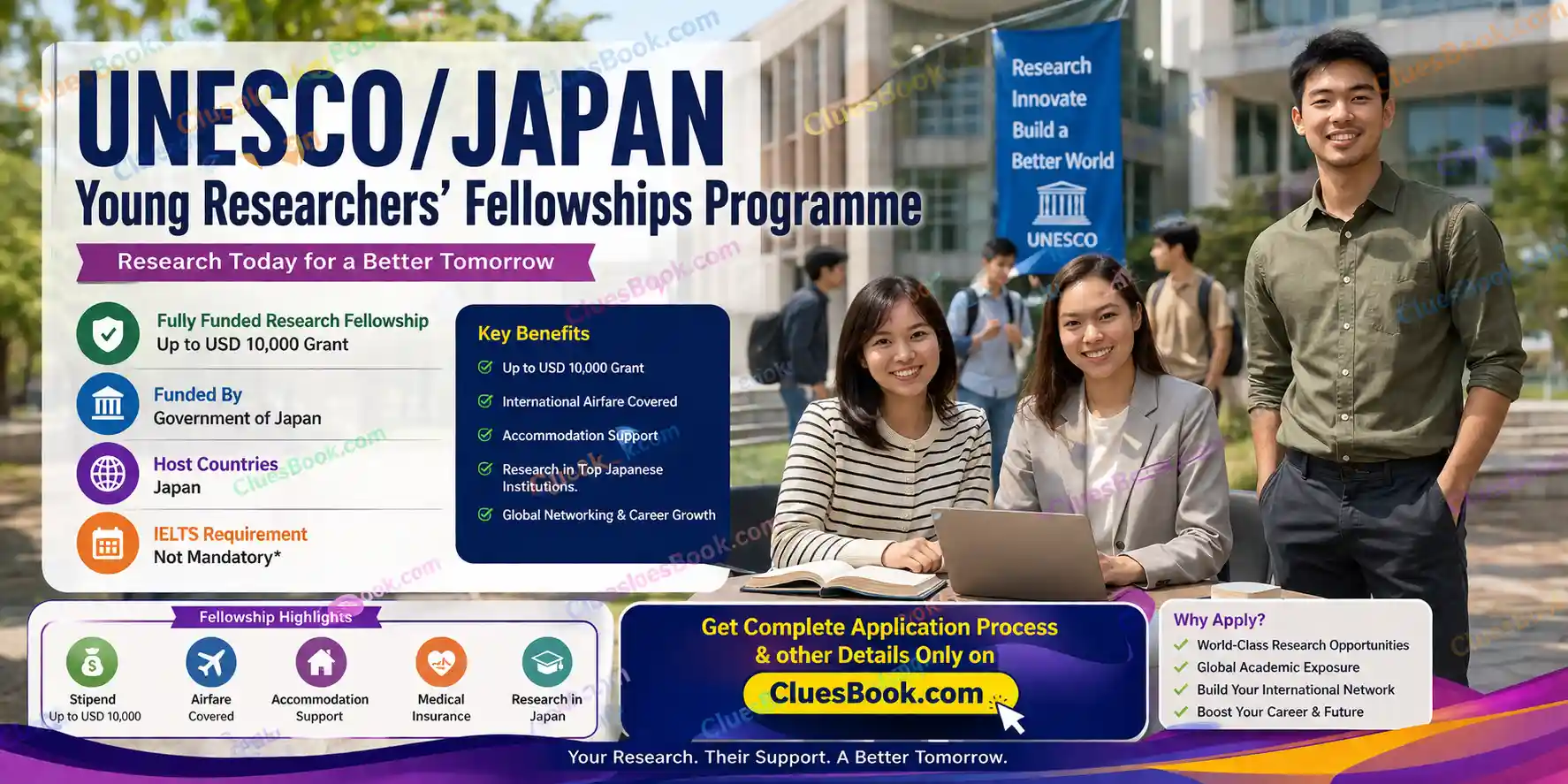
If you are looking for a fully funded research fellowship in Japan, this guide explains everything you need to know, including eligibility requirements, research areas, funding, application process, supervisor requirements, required documents, and the official deadline.
UNESCO/Keizo Obuchi Research Fellowships Overview
The UNESCO/Japan Young Researchers’ Fellowships Programme, officially known as the UNESCO/Keizo Obuchi Research Fellowships Programme, was established in 2001 through the Japanese Funds-in-Trust for the Capacity-Building of Human Resources. The fellowship is funded by the Government of Japan and administered by UNESCO to strengthen international research collaboration and support young researchers working on global development challenges.
Since its launch, the programme has supported:
- More than 291 researchers
- Researchers from 101 countries
- International collaboration with Japanese universities and research institutions
- High-impact postgraduate research aligned with UNESCO priorities
For the 2026 Cycle, UNESCO and the Government of Japan will award 10 competitive fellowships to exceptional researchers from eligible countries.
The fellowship supports innovative research in areas including:
- Heritage Conservation
- Artificial Intelligence
- Sustainable Development
- Climate Action
- AI Ethics
- Education
- Smart Cities
- Natural Resource Management
Successful fellows will conduct research at recognized Japanese universities and research institutions between February 2027 and December 2027.
UNESCO/Japan Young Researchers’ Fellowships Programme Details
- Host Organization: UNESCO
- Funded By: Government of Japan (Japanese Funds-in-Trust)
- Host Country: Japan
- Application Portal Link: Official application link
- Degree Level: Postgraduate Research Fellowship
- Scholarship Type: Fully Funded Research Fellowship
- Number of Fellowships: 10
- Maximum Funding: Up to US$10,000
- Study Level: Master’s Degree Holders, Researchers, Early-Career Researchers
- Program Duration: Minimum 3 months – Maximum 9 months
- Research Period in Japan: February 2027 to December 2027
- Application Deadline: 30 September 2026 (Midnight Paris Time)
- Submission Method: Through National Commission for UNESCO
- Supervisor Requirement: Mandatory
- Official Programme Name: UNESCO/Keizo Obuchi Research Fellowships Programme
Eligibility Criteria for UNESCO/Japan Young Researchers’ Fellowships Programme
- Applicants must satisfy all of the following requirements.
Nationality Requirements
Applicants must be citizens of one of the invited UNESCO Member States or Associate Members.
Eligible regions include:
- Africa (47 Member States)
- Bahrain
- Selected Small Island Developing States (Pacific Region)
- Caribbean Countries
- Türkiye
- Ukraine
Examples include:
- Nigeria
- Kenya
- South Africa
- Ghana
- Uganda
- Ethiopia
- Rwanda
- Tanzania
- Zambia
- Zimbabwe
- Singapore
- Maldives
- Fiji
- Samoa
- Papua New Guinea
- Jamaica
- Bahamas
- Barbados
- Trinidad and Tobago
- Türkiye
- Ukraine
Applicants should verify that their country appears in UNESCO’s official invited Member States list before applying.
Age Requirement
Applicants must:
- Be 40 years old or younger at the time of application.
Academic Qualification
Applicants must:
- Hold at least a Master’s degree or an equivalent postgraduate qualification.
- Have an academic background related to the proposed research topic.
- Demonstrate excellent academic performance.
- Show strong research potential.
Research Requirement
Applicants must submit an original research proposal that falls under one of UNESCO’s approved research themes for the 2026 cycle.
Language Requirement
Applicants must demonstrate sufficient reading and writing ability in the language used by the Japanese host institution or supervisor.
Supervisor Requirement
Applicants must already obtain official acceptance from a supervisor at a Japanese university or research institution before applying. Without a supervisor’s acceptance letter, the application is not eligible.
Research Commitment
Applicants should:
- Conduct independent postgraduate research
- Complete the project within the fellowship period
- Return to their home country after completing the fellowship
- Contribute to research capacity and sustainable development
Must Apply For: NSERC Scholarships in Canada
Eligible Research Fields and Approved UNESCO Research Areas in Japan
Applicants can only submit research proposals under one of the officially approved UNESCO research themes.
Heritage Conservation and Management
Available research areas include:
- Cultural Heritage Conservation
- World Heritage Management
- Archaeological Heritage
- Museum Studies
- Heritage Policy
- Heritage Documentation
- Community-Based Heritage Management
- Digital Heritage Preservation
Artificial Intelligence for Sustainable Management of Natural Resources and Climate Action
Available research topics include:
- AI for Climate Change
- Environmental Monitoring
- Biodiversity Conservation
- Water Resource Management
- Disaster Risk Reduction
- Forest Management
- Agricultural AI
- Renewable Energy Optimization
- Sustainable Ecosystem Monitoring
Ethical, Inclusive and Human-Centred Artificial Intelligence for Sustainable Development
Applicants may conduct research in:
- AI Ethics
- Responsible Artificial Intelligence
- Inclusive AI Systems
- AI Governance
- Human Rights and AI
- Fair AI Algorithms
- AI Policy Development
- AI Transparency
- AI Accountability
Artificial Intelligence for Sustainable Cities, Infrastructure and Societal Resilience
Research topics include:
- Smart Cities
- Urban Planning
- AI Transportation Systems
- Digital Infrastructure
- Public Safety Systems
- Disaster Prediction
- Smart Utilities
- Urban Sustainability
- Infrastructure Resilience
Artificial Intelligence and Education
Eligible research topics include:
- AI in Higher Education
- Personalized Learning
- Educational Technology
- Learning Analytics
- Digital Education
- AI Curriculum Design
- Educational Assessment
- Teacher Training Technologies
- Lifelong Learning Systems
- Online Learning Innovation
Application Requirements for UNESCO/Japan Young Researchers Fellowships Programme
To submit a competitive application, applicants must fulfill all official UNESCO application requirements.
Applicants should:
- Be nominated through the National Commission for UNESCO in their home country.
- Meet all nationality and age requirements.
- Hold a Master’s degree or equivalent qualification.
- Secure acceptance from a Japanese academic supervisor.
- Prepare a high-quality research proposal.
- Demonstrate language proficiency required by the host institution.
- Submit all required documents before the deadline.
- Follow UNESCO’s official application procedures.
- Ensure all information is accurate and complete.
- Submit applications well before the national submission deadline.
Required Documents for UNESCO Young Researchers Fellowships
Applicants generally need to prepare the following documents:
- Completed UNESCO Application Form (Annex 3)
- Research Proposal (Annex 4 Template)
- Copy of Passport or National Identification
- Master’s Degree Certificate
- Academic Transcripts
- Curriculum Vitae (CV)
- Letter of Recommendation
- Acceptance Letter from Japanese Academic Supervisor
- UNESCO Certificate of Language Knowledge
- Proof of Language Proficiency (if required by host institution)
- Research Publications (if available)
- Other supporting academic documents requested by the National Commission for UNESCO
Language Requirements for the UNESCO Fellowships Programme
Applicants must possess sufficient language proficiency to successfully complete research at the selected Japanese university or research institution. The required language depends on the institution and the supervising professor.
Most host institutions require proficiency in:
- English
- Japanese (where applicable)
- Another approved research language accepted by the host institution
Applicants should communicate directly with their prospective supervisor regarding language expectations before applying.
IELTS Requirements for Japan Young Researchers Fellowships
There is no universal IELTS requirement announced by UNESCO for this fellowship.
Instead:
- The host university or supervisor determines language requirements.
- Applicants may submit UNESCO’s Language Knowledge Certificate where applicable.
- Alternative proof of English proficiency may be accepted by some Japanese institutions.
- Some supervisors may accept previous education completed in English.
Many international scholarships today also allow applicants to study without IELTS if alternative proof of English proficiency is accepted. Countries such as Japan, Germany, China, Italy, Hungary, Türkiye, Malaysia, South Korea, Poland, and some universities in Australia and the United Kingdom may offer opportunities where IELTS is waived under specific conditions. However, applicants should always verify the language policy of their chosen institution before applying.
Is a Japanese Supervisor Required Before Applying?
- Yes.
Obtaining an official acceptance letter from a supervisor at a Japanese university or research institution is a mandatory eligibility requirement for the UNESCO/Japan Young Researchers’ Fellowships Programme.
How to Secure a Supervisor Successfully
- Identify universities conducting research in your field.
- Review faculty profiles and recent publications.
- Contact professors whose research aligns with your proposal.
- Prepare a professional research proposal.
- Attach your academic CV.
- Explain why your research matches the professor’s expertise.
- Request formal supervision.
- Obtain a signed acceptance letter before submitting your fellowship application.
Finding the right supervisor early significantly increases your chances of submitting a complete and competitive application.
Benefits of UNESCO/Japan Young Researchers’ Fellowships Programme
The UNESCO/Japan Young Researchers’ Fellowships Programme is one of the most competitive international research fellowships funded by the Government of Japan. Besides financial assistance, the programme offers exceptional opportunities for academic collaboration, international networking, and research development at leading Japanese universities and research institutions.
Financial Benefits of the UNESCO/Keizo Obuchi Research Fellowships Programme
Selected fellows may receive a lump-sum fellowship grant of up to US$10,000 to support their approved research stay in Japan.
The fellowship grant may cover:
- International round-trip airfare to and from Japan
- Domestic transportation related to the approved research itinerary
- Accommodation expenses during the fellowship period
- Daily living expenses
- Meals and personal subsistence
- Local transportation within Japan
- Mandatory medical insurance (arranged by UNESCO and deducted from the fellowship grant before disbursement)
- Research-related expenses directly connected with the approved research project
- Incidental costs necessary for completing the research
Expenses Not Covered
Applicants should note that the fellowship does not cover:
- Tuition fees
- University admission fees
- Purchase of computers or electronic equipment
- Research equipment
- Publication charges
- Conference registration fees (unless participation is fully justified as an essential part of the approved research)
- Personal travel unrelated to the fellowship
- Family expenses
- Visa costs not included by the fellow
Can I work part-time during the fellowship?
The fellowship is intended for full-time research activities. UNESCO expects fellows to dedicate themselves to their approved research project. Any part-time employment would depend on Japanese visa regulations and the policies of the host institution, so applicants should consult both before making plans.
Also Apply For: University of Oxford Weidenfeld Hoffmann Scholarship
Additional Benefits Beyond Financial Support
Apart from funding, selected fellows gain several long-term academic and professional advantages.
Benefits include:
- Conduct research at internationally recognized Japanese universities
- Work under experienced Japanese academic supervisors
- Access advanced laboratories and research facilities
- Collaborate with international researchers
- Expand global academic and professional networks
- Gain international research experience
- Improve research methodology and publication quality
- Enhance career prospects in academia, government, NGOs, and international organizations
- Build long-term collaborations between home institutions and Japanese universities
- Strengthen leadership and research capacity
- Contribute to UNESCO’s Sustainable Development Goals (SDGs)
- Receive international recognition as a UNESCO Fellow
- Experience Japanese culture, innovation, and academic excellence
Will UNESCO help with accommodation in Japan?
UNESCO does not directly provide accommodation. Fellows are generally responsible for arranging their own housing in consultation with their Japanese supervisor or host institution. Many universities offer assistance in locating university housing, guesthouses, or nearby apartments for international researchers.
Japan Young Researchers Fellowship Duration, Timeline & Selection Process
The fellowship is designed for short-term postgraduate research in Japan while allowing researchers to return to their home institutions with enhanced skills and international experience.
Fellowship Duration
- Minimum research period: 3 months
- Maximum research period: 9 months
Fellowship Period in Japan
- Research may begin from February 2027 onwards
- All fellowship activities must be completed no later than December 2027
Applicants should coordinate the exact research schedule with their Japanese academic supervisor after selection.
What type of visa do selected fellows need for Japan?
Most selected fellows will need an appropriate Japanese visa based on the nature and duration of their research stay. After selection, the host institution and relevant Japanese authorities provide guidance on visa procedures and the documents required.
Must Apply For: Konrad Adenauer Stiftung Scholarship
Selection Process for the UNESCO Fellowship Programme
The selection process is highly competitive and follows several evaluation stages.
Stage 1: National Screening
- Applicants submit their applications to the National Commission for UNESCO in their home country.
- The National Commission reviews applications.
- Only nominated candidates proceed to UNESCO.
Stage 2: UNESCO Verification
UNESCO checks whether:
- Eligibility requirements are met.
- Documents are complete.
- Research proposal follows programme guidelines.
- Supervisor acceptance letter is valid.
Incomplete applications are not considered.
Stage 3: Expert Evaluation
Applications are reviewed by a Selection Committee consisting of experts from:
- UNESCO
- Government of Japan
- Relevant academic fields
The committee evaluates:
- Academic excellence
- Originality of the research proposal
- Scientific quality
- Relevance to UNESCO priorities
- Feasibility of the project
- Expected global impact
Stage 4: Final Approval
The Government of Japan makes the final selection based on the committee’s recommendations while considering:
- Gender equality
- Geographic diversity
- Research quality
- Programme priorities
Step-by-Step Application Process for Japan Young Researchers Fellowship Programme
Applicants should carefully follow every official step.
- Read the official UNESCO Application Guide thoroughly.
- Confirm that your country is included in the invited Member States list.
- Identify a Japanese university or research institution that matches your research interests.
- Contact potential supervisors and obtain an official acceptance letter.
- Prepare your research proposal using UNESCO’s official template (Annex 4).
- Complete the UNESCO Application Form (Annex 3).
- Collect all required supporting documents.
- Obtain the UNESCO Certificate of Language Knowledge or other accepted language evidence if required.
- Submit your complete application to your country’s National Commission for UNESCO well before its internal deadline (UNESCO recommends submitting at least two weeks before the international deadline).
- Wait for nomination by your National Commission.
- If nominated, email the online application form and supporting documents to keizoobuchi.fellowships@unesco.org.
- Ensure your National Commission submits the official nomination package to UNESCO no later than 30 September 2026 (Midnight Paris Time).
- Monitor your email for any communication from UNESCO during the evaluation process.
Can current PhD students apply for this fellowship?
Yes. Current PhD candidates may apply if they satisfy all eligibility requirements, including nationality, age limit, academic qualifications, supervisor acceptance, and research alignment with UNESCO’s approved research areas.
Also Apply For: CSU HDR Scholarships
UNESCO/Japan Young Researchers’ Fellowships Programme Deadline & Important Dates
Applicants should carefully monitor all important dates to avoid missing any stage of the application process.
| Event | Date |
|---|---|
| Applications Open | 7 July 2026 |
| Programme Announcement | July 2026 |
| National Application Period | July–September 2026 (varies by country) |
| Recommended Submission to National Commission | At least 2 weeks before national deadline |
| UNESCO Nomination Deadline | 30 September 2026 (Midnight Paris Time) |
| Expert Evaluation | October–December 2026 (expected) |
| Final Selection | Late 2026 (expected) |
| Fellowship Begins | From February 2027 |
| Latest Completion Date | December 2027 |
Applicants should contact their National Commission for UNESCO early because internal deadlines may be earlier than UNESCO’s final submission deadline.
Participating Universities and Host Research Institutions in Japan
Unlike university-specific scholarships, the UNESCO/Japan Young Researchers’ Fellowships Programme allows applicants to conduct research at eligible Japanese universities and research institutions, provided they secure acceptance from a qualified academic supervisor.
Examples of leading host institutions include:
- The University of Tokyo
- Kyoto University
- Osaka University
- Tohoku University
- Kyushu University
- Hokkaido University
- Nagoya University
- Tokyo Institute of Science (formerly Tokyo Institute of Technology)
- Hiroshima University
- University of Tsukuba
- Waseda University
- Keio University
- Kobe University
- RIKEN Research Institute
- National Institute of Informatics (NII)
- Japan Agency for Marine-Earth Science and Technology (JAMSTEC)
- National Institute for Environmental Studies (NIES)
- Other accredited Japanese universities and government-approved research institutions
The final host institution depends on the applicant’s research topic and the acceptance of a qualified academic supervisor.
How competitive is the UNESCO/Japan Young Researchers’ Fellowships Programme?
The programme is highly competitive. Only 10 fellowships are awarded worldwide in the 2026 cycle, making the selection process extremely selective. Applicants with a strong academic background, an innovative research proposal, and a confirmed Japanese supervisor have the best chance of success.
Why Apply for the UNESCO/Japan Young Researchers’ Fellowships Programme?
There are many reasons why this fellowship is regarded as one of the best international research opportunities in Japan.
- Receive funding of up to US$10,000
- Conduct research in one of the world’s leading research environments
- Collaborate with internationally recognized Japanese experts
- Build a strong global academic profile
- Improve opportunities for future PhD studies or postdoctoral fellowships
- Contribute to UNESCO’s global development priorities
- Gain international research experience
- Expand professional and academic networks
- Develop advanced research and analytical skills
- Enhance employment opportunities with universities, governments, NGOs, and international organizations
- Experience Japanese culture, technology, and innovation
- Increase competitiveness for future international grants and fellowships
Must Apply For: Ford Foundation Fellowships
Common Mistakes to Avoid When Applying
Many strong applicants are rejected because of avoidable mistakes.
Avoid the following:
- Waiting until the last week to contact potential supervisors
- Submitting an incomplete application package
- Missing your National Commission’s internal deadline
- Using a weak or generic research proposal
- Choosing a research topic outside UNESCO’s approved research areas
- Failing to obtain an official supervisor acceptance letter
- Ignoring language requirements of the host institution
- Providing inconsistent academic information
- Uploading low-quality or unclear supporting documents
- Not following UNESCO’s application instructions
- Sending documents after the official deadline
- Copying research proposals from previous applications or online sources
UNESCO/Japan Young Researchers’ Fellowships Programme Salary
This programme is not a salaried employment position. Instead, successful applicants receive a research fellowship grant of up to US$10,000 as financial support for their approved research stay in Japan. The funding is intended to cover eligible research and living expenses rather than provide a monthly salary.
Although the exact monthly value depends on the fellowship duration, an indicative estimate is:
| Fellowship Duration | Approximate Average Monthly Support* |
|---|---|
| 3 Months | Up to approximately US$3,300/month |
| 6 Months | Up to approximately US$1,650/month |
| 9 Months | Up to approximately US$1,110/month |
*These figures are estimates based on the maximum grant of US$10,000. Actual spending depends on each fellow’s approved budget and research plan.
UNESCO Fellowship Programme Acceptance Rate
UNESCO does not officially publish the acceptance rate for the UNESCO/Keizo Obuchi Research Fellowships Programme.
However, based on publicly available programme information:
- Only 10 fellowships are awarded worldwide in the 2026 cycle.
- Applicants come from dozens of eligible countries across Africa, Asia-Pacific, the Caribbean, Europe, and the Arab States.
- The programme is considered highly competitive.
Estimated competitiveness:
- Estimated acceptance rate: Very low (likely well below 10%)
- Competition Level: Extremely High
- Selection Standard: Research excellence, originality, supervisor support, and alignment with UNESCO priorities
Because of the limited number of awards, applicants should focus on submitting an outstanding research proposal, securing a strong supervisor, and providing complete documentation.
Also Apply For: ESO Science Communication Internship
Apply Now to Secure Your Future in Japan
The UNESCO/Japan Young Researchers’ Fellowships Programme offers far more than financial assistance, it provides an opportunity to become part of a global network of researchers committed to solving some of the world’s most pressing challenges. With funding of up to US$10,000, access to world-class Japanese universities and research institutions, mentorship from experienced academic supervisors, and the chance to conduct internationally recognized research, this fellowship can significantly strengthen your academic and professional future.
If you meet the eligibility requirements, start preparing your research proposal, secure a supervisor in Japan, and coordinate with your National Commission for UNESCO as early as possible. Because only 10 fellowships are available worldwide, early preparation, a compelling research proposal, and complete documentation will greatly improve your chances of selection. Do not wait until the final deadline, begin your application today and take the next step toward becoming an internationally recognized researcher in Japan.